Introduction
Volos lies on the western side of the Pagasetic Gulf, a relatively sheltered body of water in central Greece. Its coastal setting connects the city with marine environments influenced by river inputs, currents, seasonal temperature changes, and human activity.
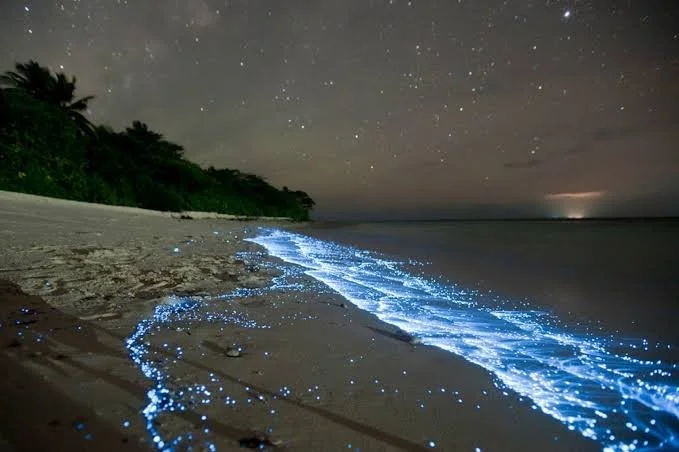
When microscopic marine organisms produce light, the surface of the sea can briefly glow in response to movement. This phenomenon, called bioluminescence, is sometimes described in dramatic terms as a glowing gulf or a hidden sea of light.
Bioluminescent plankton are real, but the phrase “Hidden Gulf of Volos” should not be interpreted as the name of a scientifically established glowing location. To determine whether the Pagasetic Gulf experiences a recurring bioluminescent event, observations must identify the organisms and environmental conditions responsible.
The Organisms Behind the Light
Plankton includes a wide variety of organisms that drift in water rather than swimming strongly against currents. Some are microscopic algae, while others are animals or the early life stages of larger organisms.
Certain dinoflagellates can produce brief flashes of light when mechanically disturbed. A wave breaking against a shore, a moving boat, or a disturbance in the water may trigger the reaction. When large numbers of these organisms are present, their flashes can create a visible glow.
The light-producing reaction involves specialized biochemical systems. Although the exact mechanisms differ among organisms, the process converts chemical energy into light. Because the emitted light is often blue or blue-green, it can be visible even in small flashes against dark water.
Bioluminescence should not be confused with fluorescence. Fluorescence occurs when a substance absorbs light and re-emits it at a different wavelength. Bioluminescence produces light through a chemical reaction and does not require external illumination.
What Causes a Bloom?
A plankton bloom occurs when a population increases significantly under favorable conditions. Temperature, sunlight, nutrients, water circulation, and grazing by other organisms can all influence population growth.
The term “bloom” does not automatically imply a harmful event. Many blooms are part of ordinary seasonal ecological cycles. However, some plankton species can produce toxins, and dense blooms may contribute to environmental problems under certain conditions.
A luminous bloom requires more than a large quantity of plankton. The organisms must belong to species capable of producing visible light, and the physical environment must allow the light to be observed.
Water movement can concentrate plankton in some locations and disperse it in others. As a result, visible bioluminescence may occur in one part of a gulf while nearby waters show little or none.
The Pagasetic Gulf as a Research Setting
A semi-enclosed gulf can be an interesting setting for studying plankton because local circulation, freshwater inputs, and seasonal stratification may influence the distribution of organisms. However, these characteristics do not guarantee bioluminescence.
The Pagasetic Gulf is also a coastal environment affected by human activity. Urban development, shipping, wastewater management, aquaculture, and runoff can influence water quality and ecosystem dynamics. Assessing the ecological status of the gulf requires measurements rather than assumptions based on appearance.
A study of bioluminescence would ideally combine night observations with water sampling. Researchers could identify plankton under a microscope, measure temperature and salinity, record nutrient levels, and document the timing and intensity of visible flashes. Repeated surveys would help establish whether the event is seasonal, occasional, or highly localized.
Such research would also distinguish ordinary luminous activity from a dense bloom that might require additional ecological assessment.
Viewing Bioluminescence Without Harming the Environment
Bioluminescence is best observed in darkness, but safety should come first. Coastal rocks, piers, and beaches may be slippery or poorly lit. Entering unfamiliar water at night can be dangerous, and visitors should follow local safety guidance.
People should not assume that luminous water is safe for swimming. Light alone cannot identify the organism involved or determine whether toxins are present. Local water-quality notices and public health advice are more reliable than visual impressions.
Photographs of glowing water can also be misleading because long exposure times and image processing may make faint flashes appear much brighter than they were to the naked eye. Such images can be valuable records, but they should be interpreted alongside the photographer's description and the observation conditions.
Conclusion
The possibility of bioluminescent plankton in the Pagasetic Gulf connects a familiar Greek coastal landscape with the remarkable chemistry of marine life. Microscopic organisms can produce visible flashes that transform moving water into a brief natural light display.
Nevertheless, a recurring bioluminescent bloom in a particular “hidden” part of the Gulf of Volos needs direct documentation. Scientific observation can establish which organisms are responsible, when the phenomenon occurs, and whether it has ecological significance. This approach preserves the wonder of the event while distinguishing confirmed marine biology from an appealing but unverified destination story.