Introduction
Mount Taygetus rises above the southern Peloponnese, forming a dramatic mountain chain between the regions surrounding Sparta and the Mani Peninsula. Its slopes include forests, rocky ridges, ravines, and high-altitude terrain. As moist air moves across the mountain, changing temperature and humidity can produce clouds and fog that drift through wooded areas.
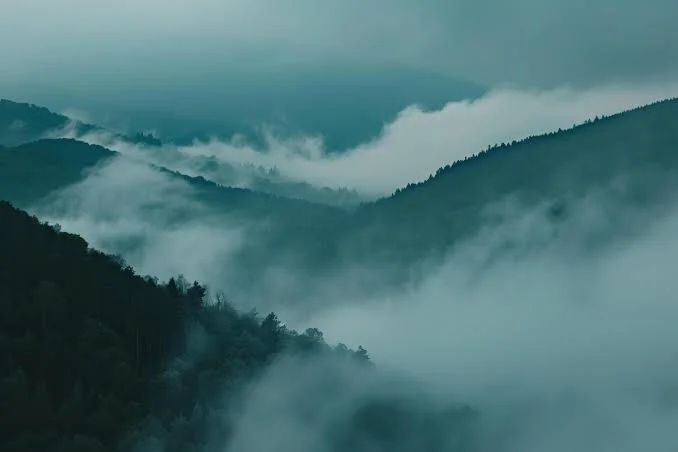
A forest enveloped in fog can appear otherworldly. Trees emerge gradually from the mist, distant slopes disappear, and moisture collects on leaves and branches. Although the expression “ethereal fog forest” is poetic rather than a formal ecological classification, it describes an atmospheric phenomenon that can be explained through meteorology and forest ecology.
Understanding fog on Taygetus also reveals how mountain weather influences vegetation, soil moisture, and the experience of the landscape.
How Mountain Fog Forms
Fog consists of tiny water droplets suspended close to the ground. It forms when moist air cools sufficiently for water vapor to condense into liquid droplets. This can occur through several processes.
One common mechanism in mountainous terrain is orographic lifting. When air encounters a mountain slope, it is forced upward. As the air rises, atmospheric pressure decreases and the air expands and cools. If it contains enough moisture, clouds may form along the slope or near the summit.
Fog can also develop when warm, moist air moves over a cooler surface or when the ground loses heat and cools the air immediately above it. In valleys, cold air may collect overnight, creating localized conditions favorable for fog.
These processes can occur together. A mountain may experience clear weather on one side while clouds or fog obscure another, depending on wind direction, moisture, and local topography.
Forests and the Capture of Moisture
Forests interact with fog in ways that can affect their local environment. Leaves, needles, twigs, and branches intercept droplets carried by the wind. Some of this water evaporates, while some drips to the ground or runs down tree trunks.
This process is often called fog interception or cloud-water interception. Its importance varies among ecosystems. In some regions, it provides a meaningful additional source of moisture; in others, rainfall remains the dominant source of water.
Forest structure influences how much fog is intercepted. Trees with large surface areas, dense canopies, or particular leaf and needle shapes may collect droplets differently. Wind speed, fog density, and the duration of fog events also matter.
However, not every foggy forest is classified as a cloud forest. That term is generally associated with particular ecological conditions in which frequent cloud immersion has a significant influence on the ecosystem. A foggy morning on a mountain is not enough to establish that classification.
Taygetus and Mediterranean Mountain Ecology
Taygetus contains a range of habitats shaped by elevation, exposure, temperature, soil, and water availability. Lower slopes experience Mediterranean conditions, while higher elevations can be cooler and more exposed to wind, frost, and seasonal changes.
Vegetation changes with these conditions. Forests and scrub communities occupy different zones, while rocky highlands support plants adapted to shallow soils and harsher conditions. The mountain's topography creates many small environmental variations, sometimes allowing distinct habitats to exist close together.
Fog can temporarily alter these environments by reducing sunlight, increasing humidity, and depositing moisture. For plants, such conditions may reduce water loss, although persistent dampness can also affect fungal activity and other ecological processes.
The ecological effects depend on frequency and duration. A forest that experiences occasional fog is different from one that remains immersed in cloud for long periods.
Fog, Climate, and Changing Conditions
Mountain fog depends on air temperature, moisture, wind patterns, and the relationship between cloud height and the terrain. Changes in these factors can alter when and where fog forms.
Climate change may affect mountain moisture regimes through shifts in temperature, precipitation, evaporation, and atmospheric circulation. The direction and magnitude of changes will depend on local conditions, so it is not appropriate to assume that fog must either increase or decrease everywhere.
Long-term observations are needed to identify meaningful trends. Weather stations, satellite imagery, humidity measurements, and ecological monitoring can help researchers determine whether fog frequency is changing and how vegetation responds.
Such monitoring can be valuable in mountainous areas where plant communities may be sensitive to changes in water availability.
Experiencing Fog Responsibly
Fog can reduce visibility quickly, especially on ridges and exposed trails. Hikers should be prepared for changes in weather, carry suitable navigation equipment, and avoid routes that exceed their experience or equipment.
Wet rock and soil can become slippery, while strong winds may accompany mountain cloud and mist. Visitors should follow local trail guidance and respect protected habitats.
Photography can capture the visual atmosphere of fog, but images may exaggerate its permanence. A dramatic fog scene represents conditions at a particular time, not necessarily the typical appearance of the mountain throughout the year.
Conclusion
Fog on Mount Taygetus emerges from the interaction of moist air, mountain topography, and changing atmospheric conditions. When fog moves through a forest, it can influence moisture levels and create striking visual effects.
The phrase “fog forests” is best understood as a descriptive expression unless a particular area has been scientifically classified as a cloud forest. Even so, the combination of mountain weather, forest ecology, and Mediterranean landscapes makes Taygetus an excellent setting for exploring how atmospheric processes shape the natural world.