Introduction
The Saronic Gulf, near Athens and the northeastern Peloponnese, contains islands, rocky coastlines, sheltered bays, and underwater habitats. Its marine environment reflects the interaction of geology, sea-level history, coastal erosion, and biological processes.
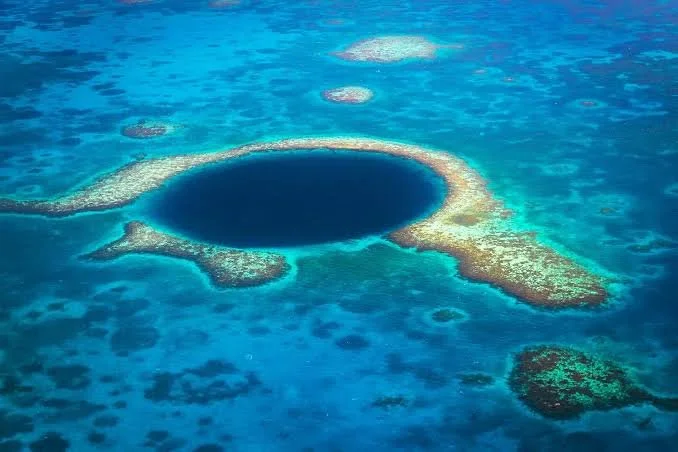
The term cenote is most strongly associated with the water-filled sinkholes of the Yucatán Peninsula in Mexico. These features typically develop where groundwater dissolves limestone, creating cavities that may later collapse or become flooded. Although similar karst processes occur in other parts of the world, the presence of islands and underwater cavities in the Saronic Gulf does not establish the existence of cenotes there.
The phrase “submerged cenotes in the Saronic Island Reefs” therefore requires geological clarification. Underwater caves, sinkholes, and flooded karst systems are real features, but a specific Saronic site should not be called a cenote without evidence of its geological origin.
How Cenotes Form
Cenotes commonly develop in soluble carbonate rocks, especially limestone. Rainwater absorbs carbon dioxide as it passes through the atmosphere and soil, forming a weakly acidic solution that can dissolve carbonate rock.
Over long periods, this process enlarges fractures and creates underground drainage networks. Cavities may connect to one another, allowing groundwater to flow through passages that can extend considerable distances.
If a cave roof becomes too thin to support the overlying rock, part of it may collapse and expose the water below. A resulting sinkhole can fill with groundwater or, in coastal areas, become connected to the sea.
Sea-level change can influence these systems. During periods when sea level was lower, some coastal cave passages may have developed above the waterline. Rising sea levels can later flood them. However, the history of each cave depends on local geology, elevation, and hydrological conditions.
Underwater Caves and Karst Landscapes in the Mediterranean
Karst landscapes occur in many parts of the Mediterranean, including areas of Greece where limestone is widespread. Dissolution creates caves, sinkholes, springs, and underground drainage systems. Some coastal caves extend below sea level, while others contain freshwater, brackish water, or seawater.
These features can provide valuable information about past sea levels and changes in coastal environments. Cave sediments, mineral deposits, and fossil remains may preserve evidence of earlier conditions, although interpreting them requires careful geological analysis.
An underwater cavity is not necessarily a cenote. It may be a sea cave formed by wave action, a flooded limestone passage, a tectonic fracture, or another type of geological feature. Correct classification depends on how the cavity formed.
This distinction matters because different processes create different shapes, sediments, and ecological conditions.
What Could Exist Around the Saronic Islands?
The Saronic islands and nearby coastlines contain a variety of geological and marine environments. Limestone outcrops and coastal erosion can produce caves and cavities, while reefs and rocky seabeds provide habitat for marine organisms.
To establish the presence of a submerged karst sinkhole, researchers would need to map the seabed and identify the structure of the cavity. Underwater imaging, sonar, geological sampling, and direct observation by trained divers or remotely operated vehicles may help determine its shape and origin.
Researchers would also investigate whether the feature connects to a groundwater system. Measurements of salinity, temperature, and water chemistry could reveal whether freshwater enters the cavity or whether it is fully marine.
Without this evidence, a submerged opening should not automatically be described as a cenote.
Ecological Significance of Underwater Cavities
Underwater caves can support distinctive communities of organisms. Light levels change rapidly with distance from the entrance, and water circulation may differ from that of the surrounding sea. Some organisms specialize in low-light environments, while others use caves as shelter.
These habitats can be vulnerable to disturbance. Sediment stirred up by divers, physical contact with cave walls, discarded materials, and excessive visitor traffic may damage fragile communities.
Cave diving also presents serious risks. Narrow passages, limited visibility, overhead rock, and complex navigation make some underwater environments unsuitable for inexperienced divers. Exploration should be undertaken only by qualified specialists using appropriate procedures and equipment.
Conclusion
Submerged karst systems provide valuable evidence about the interaction of groundwater, limestone, sea-level change, and coastal evolution. The Mediterranean contains many geological settings in which underwater caves and flooded cavities can form.
However, the specific claim of submerged cenotes among the Saronic islands needs verification. The term cenote should not be used simply as a dramatic synonym for any underwater hole or cave. Careful mapping and geological analysis are necessary to establish whether a particular feature is a sinkhole, a flooded karst passage, or a sea cave. This distinction allows the Saronic Gulf's underwater landscapes to be explored accurately and responsibly.