Introduction
The plains surrounding Philippi in northeastern Greece occupy a region with a long history of human settlement and environmental change. Located near the modern city of Kavala, Philippi is known especially for its ancient and Roman history. The wider landscape also includes sedimentary deposits that can preserve evidence of earlier environments.
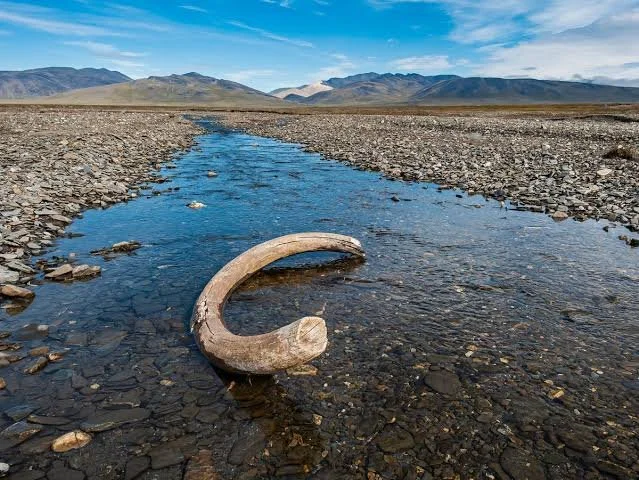
The title “Petrified Mammoth Tusk Sites Near Philippi Plains” suggests a specific concentration of fossilized mammoth remains. Mammoths once inhabited large parts of Eurasia, and their remains have been discovered in various regions. However, the existence of a documented mammoth-tusk site near Philippi requires evidence from paleontological records or verified fossil discoveries.
It is also important to distinguish petrification from fossilization. A mammoth tusk can be preserved as a fossil without becoming fully replaced by stone. The processes involved depend on the surrounding sediments, groundwater chemistry, and burial history.
Mammoths and Their Environments
Mammoths were members of the elephant family and evolved into several species adapted to different environments. The woolly mammoth is especially associated with cold, open landscapes of the Pleistocene, although mammoth species occupied a range of habitats across different periods.
The Pleistocene began approximately 2.58 million years ago and ended about 11,700 years ago. It was characterized by repeated changes in global climate, including glacial and interglacial periods. These changes influenced vegetation, water availability, animal migration, and the distribution of large mammals.
Mammoth remains can provide information about these environments. Their teeth, tusks, bones, and associated sediments may help researchers investigate diet, age, growth, movement, and ecological conditions.
Not all mammoths lived in the same climate or at the same time. A fossil identification must therefore establish the species, geological age, and context rather than relying on the general appearance of a large tusk.
How Mammoth Tusks Become Fossils
Mammoth tusks consist primarily of dentine, a mineralized tissue similar in composition to the material forming much of a tooth. They grew throughout much of the animal's life and preserve patterns that can sometimes be studied to investigate growth and environmental conditions.
After an animal died, its remains could be scavenged, weathered, transported, or buried. Burial in sediment may protect a tusk from some forms of physical damage, while groundwater can alter its mineral composition over time.
During fossilization, organic components may degrade and minerals may enter the remaining structure. In some settings, mineral replacement can preserve the external shape while changing the material's composition. In others, substantial portions of the original tissue remain.
A fossil tusk is not necessarily completely petrified. The term “petrified” is often used informally for ancient mineralized remains, but paleontologists distinguish between different preservation processes because they affect what information can be recovered.
What a Tusks' Geological Context Can Reveal
The position of a tusk within a sedimentary deposit is crucial. A specimen found in river gravel may have been transported from another location. A tusk preserved in fine sediment may have remained closer to where it was originally buried, although this must still be demonstrated.
Associated animal fossils, plant remains, pollen, and sediment characteristics can help researchers reconstruct the environment. For example, the presence of particular plant fossils or other herbivores may provide evidence about the vegetation available to mammoths.
Dating methods can help establish the age of the deposit. Depending on the specimen and its preservation, researchers may use radiocarbon dating for sufficiently recent material, other dating techniques for older deposits, or stratigraphic comparison with well-dated geological layers.
The results can contribute to understanding the movement of animals across southeastern Europe during the Pleistocene.
Verifying a Mammoth Site Near Philippi
To establish that a mammoth-tusk site exists near Philippi, researchers would need a documented locality, an identifiable specimen, and a reliable record of its geological context. Museum catalogues, paleontological publications, excavation reports, and official geological records are useful sources for checking such claims.
A large fossil fragment should not be identified as mammoth solely because it resembles a tusk. Other large mammals have teeth, bones, and mineralized remains that can be mistaken for one another when fragments are incomplete.
If a genuine tusk is discovered, its location should be recorded before the specimen is removed. The surrounding sediments may contain evidence needed to establish the fossil's age and the environment in which it was preserved.
Unrecorded collecting can destroy this contextual information. Fossils may also be subject to legal protections, and any excavation should comply with applicable heritage and land-management requirements.
Preserving the Fossil Record
Fossils are nonrenewable records of past life. Once removed from their geological context, they may lose much of their scientific value. Proper documentation includes photographs, precise locality information, sediment descriptions, and a record of how the specimen was collected.
Museum conservation can stabilize fragile material and make it available for research. Modern analytical techniques may help identify the specimen, study its internal structure, or investigate chemical information preserved within the tusk.
The wider landscape matters as well. Sedimentary deposits, river terraces, and exposed geological layers can reveal how the region changed long before the development of the ancient city of Philippi.
Conclusion
Mammoth fossils offer an opportunity to investigate the Pleistocene environments of southeastern Europe and the changing distribution of large mammals. Tusks may preserve anatomical, ecological, and chronological information, but their scientific value depends heavily on reliable identification and geological context.
The existence of a particular petrified mammoth-tusk site near Philippi should not be treated as established without supporting records. A careful investigation would consult paleontological collections and geological publications before describing the location as a confirmed fossil site. This approach respects the evidence while preserving the possibility of future discoveries and a deeper understanding of the region's ancient natural history.