Introduction
Ios, one of the southern Cycladic islands, occupies a position within an Aegean region that experienced significant cultural and economic change during the early first millennium BCE. Its settlements participated in maritime networks linking the Cyclades with Crete, mainland Greece, and the eastern Mediterranean.
The Geometric period, conventionally dated from approximately 900 to 700 BCE, is recognized for distinctive ceramic decoration, evolving settlement patterns, and the development of new artistic traditions.
Investigating Geometric pottery in inland kilns on Ios offers an opportunity to explore how local communities produced and distributed ceramic vessels. However, the existence of particular inland kiln sites must be established through archaeological excavation rather than assumed from pottery discoveries alone.
Ios During the Geometric Period
The Cyclades experienced considerable cultural activity during the Geometric period. Communities maintained maritime connections while developing local artistic and manufacturing traditions.
Ios' location between other southern Aegean islands made it well positioned to participate in the movement of goods and people.
The island's hills, valleys, and coastal settlements offered different opportunities for agriculture, habitation, and craft production. Inland areas could provide access to suitable clay sources, fuel, and working space.
Archaeological evidence from securely dated sites is essential for reconstructing the extent of occupation during this period.
Characteristics of Geometric Pottery
Geometric pottery takes its name from the repeated geometric patterns used in its decoration. These include horizontal bands, zigzags, triangles, circles, meanders, and carefully arranged combinations of lines and shapes.
As the period developed, some vessels incorporated more complex compositions, including stylized human and animal figures.
Different vessel types served different purposes. Amphorae could be used for storage and transport, while cups, bowls, jugs, and kraters played roles in domestic and ceremonial activities.
The shapes and decorative patterns of pottery help archaeologists establish chronological sequences and compare regional artistic traditions.
Understanding Ancient Kilns
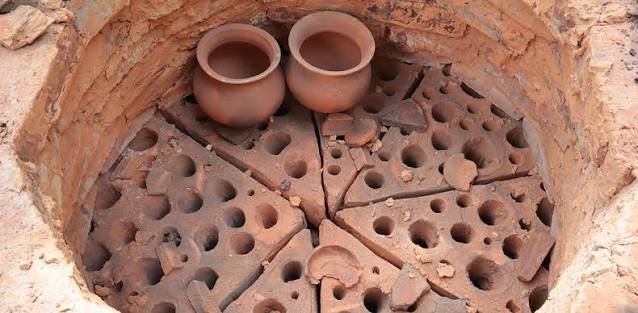
A pottery kiln was a specialized installation designed to heat ceramic vessels at controlled temperatures. Its structure generally included a combustion area and a chamber where vessels were fired.
Kiln designs varied according to local technologies and production requirements. Some installations were relatively simple, while others incorporated carefully constructed floors, walls, and ventilation systems.
The archaeological identification of a kiln requires more than finding burnt soil or fragments of pottery. Researchers look for structural evidence, firing surfaces, ash deposits, wasters, and other traces of ceramic production.
A concentration of broken vessels may represent a refuse deposit rather than a workshop.
Why Inland Locations Were Useful
Pottery production required reliable supplies of clay, water, and fuel. Inland locations could offer convenient access to these resources.
They could also reduce the risk of fire near densely occupied residential areas. A workshop situated outside a settlement might have had sufficient space for clay preparation, vessel drying, storage, and firing.
However, the decision to locate a kiln depended on local conditions. Coastal workshops could also benefit from easy access to transport routes and commercial customers.
For Ios, the relationship between inland production sites and coastal settlements would be particularly interesting to investigate.
Reconstructing the Production Process
Ceramic production involved several stages. Potters first collected and prepared clay, removing unwanted materials and adjusting its consistency.
The clay was then shaped by hand or with a wheel, depending on the period and manufacturing tradition. Vessels were dried before being decorated and fired.
The firing process required control over temperature and atmospheric conditions. These factors influenced the final color, hardness, and surface appearance of the pottery.
Kiln failures could produce warped or cracked vessels, which often remained at production sites. Such rejected objects are especially useful because they provide direct evidence of local manufacturing.
Identifying Local Production
Not all Geometric pottery found on Ios would necessarily have been manufactured there. Vessels could have arrived through maritime trade or exchange.
Petrographic analysis can identify mineral inclusions in ceramic fabrics, while chemical analysis may help compare pottery with local clay sources.
Researchers can also examine forming techniques, firing characteristics, and decorative methods.
If pottery fragments from a suspected kiln match the composition of local clay deposits, this may support a local-production interpretation. The strongest evidence comes from combining material analysis with clear workshop remains.
Pottery and Social Life
Geometric pottery reflects more than technological development. Vessels were used in households, feasting, storage, religious practices, and funerary ceremonies.
Changes in decoration and vessel shape can indicate shifting preferences and connections between communities.
The appearance of particular styles on Ios may reveal participation in broader Cycladic traditions, while distinctive local features could point toward regional workshop identities.
Pottery distributions can also help researchers understand how objects moved between inland production areas and coastal settlements.
Archaeological Challenges
Kiln remains are often fragile and difficult to recognize after centuries of erosion and later land use.
Agricultural activity, construction, and the movement of soil can disturb archaeological deposits. Inland sites may also be affected by vegetation and changes in drainage.
Excavation should record the kiln structure, associated waste, and surrounding deposits in detail. Scientific analysis can then help determine the installation's date and production characteristics.
Conclusion
Geometric pottery production on Ios offers a valuable subject for understanding the island's economy and artistic development during the early first millennium BCE. Inland kilns, if securely identified, could reveal how local craftspeople organized production and supplied vessels to nearby communities.
The specific claim of established Geometric kiln sites in Ios' interior requires archaeological verification. Nevertheless, the study of ceramic technology, local resources, and regional exchange provides a strong framework for investigating the island's place in the Geometric Aegean.