Introduction
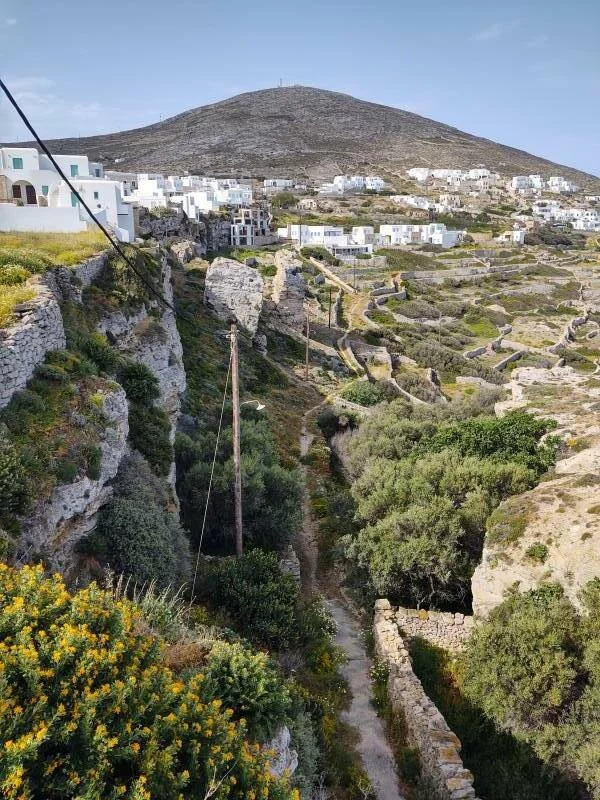
Folegandros is a rugged island in the southern Cyclades, characterized by steep cliffs, rocky hillsides, and small areas of cultivable land. Its landscape differs from the broad plains of mainland Greece, making it an interesting setting for investigating how prehistoric communities adapted their homes to challenging terrain.
The Mycenaean civilization flourished during the Late Bronze Age, particularly between approximately 1600 and 1100 BCE. Although its most prominent centers were located on the Greek mainland, Mycenaean material culture and influence reached many Aegean islands.
The proposed existence of Mycenaean dwellings on Folegandros' slopes raises important questions about settlement distribution, island resources, and maritime connections. Specific buildings, however, must be supported by archaeological evidence before they can be treated as confirmed Mycenaean settlements.
Folegandros and Its Island Environment
Folegandros lies between Milos and Sikinos in the southern Cyclades. Its terrain is dominated by elevated rocky areas, narrow valleys, and a coastline marked by steep slopes.
These geographical conditions influenced settlement choices. Communities needed access to water, agricultural land, safe routes, and locations suitable for constructing durable buildings.
In prehistoric times, small terraces and sheltered valleys may have supported cultivation and animal husbandry. Coastal areas could also provide access to fishing and maritime transport.
The island's position made it part of a wider network connecting the southern Cyclades with Crete and the mainland.
Mycenaean Expansion Across the Aegean
Mycenaean culture developed around powerful centers such as Mycenae, Tiryns, Pylos, and Thebes. These settlements were associated with palatial administration, specialized craft production, and extensive regional exchange.
During the Late Bronze Age, Mycenaean pottery, objects, and cultural practices appeared at sites throughout the Aegean.
The spread of Mycenaean material culture was not necessarily the result of direct political occupation. It could reflect trade, migration, diplomatic relationships, and the movement of craftspeople.
In the Cyclades, local communities interacted with mainland traditions while maintaining their own regional characteristics.
Building Dwellings on Sloping Ground
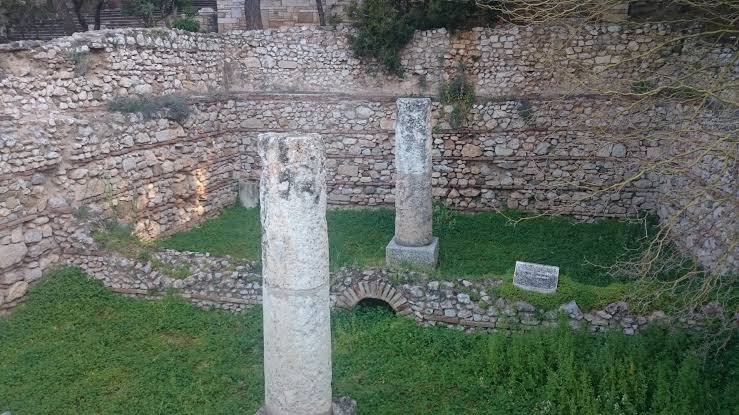
Constructing houses on steep terrain required careful planning. Builders could use natural rock surfaces as foundations, create terraces, or construct retaining walls to provide stable building platforms.
Stone was often readily available on rocky islands, making it a practical material for foundations and wall construction.
A dwelling might consist of one or more rooms arranged around a courtyard or working area. The exact design depended on local resources, household needs, and the shape of the terrain.
However, a stone structure on a hillside cannot automatically be dated to the Mycenaean period. Its construction technique must be evaluated alongside associated archaeological material.
Domestic Life in the Late Bronze Age
Mycenaean households engaged in a variety of activities, including food preparation, storage, textile production, and the maintenance of agricultural resources.
Pottery was essential to everyday life. Cooking pots, bowls, cups, storage jars, and transport containers served different domestic and economic purposes.
Grinding stones, loom weights, animal bones, and botanical remains can provide additional evidence of household activities.
If a Mycenaean dwelling were identified on Folegandros, its associated artifacts could help establish whether the household was primarily agricultural, involved in maritime exchange, or connected to specialized production.
Water and Food Resources
Water availability was a major consideration for island settlements. Communities could rely on springs, wells, cisterns, and the collection of rainwater.
On sloping terrain, runoff could be directed into storage installations. Properly designed terraces and channels also helped manage water and reduce soil erosion.
Agricultural production on small islands often involved a combination of cereals, legumes, olives, vines, and animal husbandry, depending on local environmental conditions.
Marine resources provided another important source of food. Fishing and coastal collection could supplement agricultural products and strengthen links with neighboring communities.
Mycenaean Pottery and Dating
Pottery is among the most useful tools for identifying Late Bronze Age occupation.
Mycenaean ceramic styles developed through recognizable chronological phases, with changes in vessel shapes, painted motifs, and manufacturing techniques.
Archaeologists compare pottery from a proposed settlement with material from securely dated sites. Petrographic and chemical analysis may also help determine where the clay originated.
A small number of imported sherds might indicate contact with Mycenaean communities without proving that a settlement itself was established by Mycenaean settlers.
The strongest case for a dwelling would involve pottery recovered from sealed occupation layers directly associated with the building.
Surveying Folegandros' Slopes
Archaeological survey is particularly useful on islands with difficult terrain. Researchers can examine exposed rock formations, terraces, surface pottery, and visible architectural remains.
Digital elevation models and geographic information systems can help identify possible settlement zones and reconstruct ancient routes between valleys, uplands, and the coast.
Surface survey alone cannot always determine the date of a structure. Excavation or more detailed analysis may be required to establish its chronology.
Environmental sampling can also reveal changes in vegetation and land use, helping researchers understand how prehistoric communities modified the island's landscape.
Conclusion
Mycenaean dwellings on Folegandros' slopes would provide valuable evidence for understanding how Late Bronze Age communities adapted to the geography of the southern Cyclades. Their study could illuminate domestic architecture, agricultural practices, water management, and connections with the wider Mycenaean world.
Nevertheless, the specific claim of confirmed Mycenaean dwellings on Folegandros requires archaeological verification. Securely dated pottery, architectural remains, and associated occupation deposits would be essential to establish their existence and historical significance.