Introduction and Historical Background
The study of optical objects in prehistoric societies raises important questions about technological knowledge, craftsmanship, and the development of visual culture. Objects described as lenses may have been used for magnification, light concentration, decoration, or other purposes. Their identification requires careful examination because naturally polished stones and decorative objects can resemble optical instruments.
Thymaina is a small island in the eastern Aegean, near Fournoi and the coast of Samos. Its island environment provides a relevant setting for investigating prehistoric movement and the use of caves as places of shelter, storage, or ritual activity.
The proposed study of Bronze Age lenses in Thymaina Cave offers an opportunity to explore possible early optical technologies in the Aegean. However, no object should be classified as a lens solely because it is transparent, polished, or curved. Its optical properties, manufacturing traces, archaeological context, and date must be independently established.
Caves and Bronze Age Activity
Caves were used by prehistoric communities for a variety of purposes. Depending on their location and physical characteristics, they could provide shelter, storage space, burial locations, or settings for ritual activity.
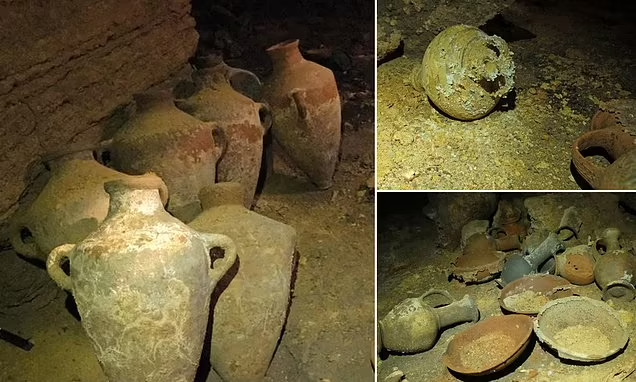
Archaeological remains in caves may include pottery, tools, animal bones, charcoal, metal objects, and other materials. Their presence can indicate repeated human activity, although the exact function of a cave may have changed over time.
The study of Thymaina Cave should begin with the documentation of its archaeological layers and the relationship between any proposed lens objects and associated materials.
Optical Knowledge in the Ancient World
The use of transparent and reflective materials was known in ancient societies. Polished crystals, glass, and other materials could produce visual effects, although their intended functions were not always optical.
Objects commonly described as ancient lenses have been interpreted in different ways. Some may have functioned as magnifying devices, while others may have been used as decorative inlays, ornaments, or fire-starting materials.
The distinction between an optical instrument and a decorative object requires experimental and scientific investigation.
Materials and Manufacturing Techniques
A proposed Bronze Age lens could have been made from rock crystal, glass, or another transparent material. Each material requires a different approach to identification and analysis.
Rock crystal is a naturally occurring form of quartz that can be polished to produce transparent surfaces. Glass is manufactured through the heating and transformation of silica-based materials, often with additional components that influence its color and properties.
Microscopic examination may reveal grinding marks, polishing traces, scratches, or evidence of shaping. These details can help reconstruct the manufacturing process.
Optical Examination
The most important test for an alleged lens is whether it produces a measurable optical effect. Researchers can examine its curvature, focal properties, transparency, and ability to magnify an image.
Experimental archaeology may help determine whether an object could have been used to enlarge small details or concentrate sunlight. However, demonstrating an optical effect does not automatically prove that ancient people used the object for that purpose.
The archaeological context must support the proposed interpretation.
Chronology and Cultural Connections
Bronze Age communities across the Aegean exchanged raw materials, finished objects, and technical knowledge. Transparent stones and glass objects could have circulated through maritime networks.
If an object from Thymaina can be securely dated to the Bronze Age, comparisons with similar materials from Crete, mainland Greece, Cyprus, and the eastern Mediterranean may help establish its cultural relationships.
Such comparisons must consider differences in material composition, manufacturing techniques, and archaeological context.
Conclusion
The proposed study of Bronze Age lenses in Thymaina Cave provides a framework for investigating early material technologies and the possible use of optical objects in the prehistoric Aegean.
The most important research priorities are material identification, optical testing, microscopic examination, and secure archaeological dating. These steps are necessary before the objects can be interpreted as genuine prehistoric lenses rather than decorative or naturally shaped materials.