Introduction and Historical Background
Crosses are among the most important symbols in Byzantine Christian art and religious practice. They appeared in churches, monasteries, personal objects, manuscripts, tombs, and other settings. Their forms varied according to the period, function, and artistic tradition.
Agios Efstratios is a small island in the northern Aegean Sea. Its location between larger islands and mainland routes makes it relevant to the study of maritime movement and religious activity in the Aegean.
The proposed study of Byzantine reef crosses near Agios Efstratios raises questions about coastal religious practices, maritime devotion, and the relationship between Christian communities and the sea. However, the term reef crosses needs archaeological clarification. It could refer to crosses recovered from submerged reefs, stone crosses placed near coastal hazards, or cross-shaped objects associated with maritime activity. These possibilities should not be treated as equivalent.
The Cross in Byzantine Religious Culture
The cross held central importance in Byzantine Christianity. It represented the crucifixion of Christ, salvation, protection, and the triumph of Christianity.
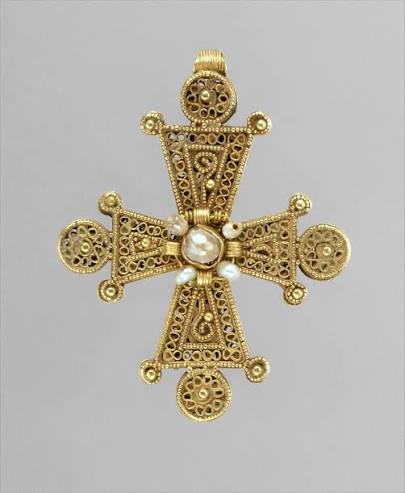
Crosses appeared in many forms, including simple wooden crosses, metal pendants, stone carvings, monumental architectural decorations, and liturgical objects.
The material and design of a cross could reflect its function. Small personal crosses might be worn as pendants, while larger crosses could be placed in churches or used during religious ceremonies.
Maritime Christianity in the Aegean
The sea played an important role in the lives of Byzantine island communities. Fishing, transportation, trade, and communication depended on maritime routes.
Christian communities living near the coast could develop religious practices connected with travel and the dangers of the sea. Sailors and fishermen might seek divine protection before journeys or express gratitude after surviving difficult conditions.
Churches, chapels, and religious monuments were sometimes established in coastal settings. Their locations could be associated with settlements, harbors, routes, or places of local religious significance.
Possible Functions of Coastal Crosses
A cross located near a reef could have served different purposes. It may have marked a dangerous maritime area, commemorated a shipwreck, represented a religious offering, or formed part of a coastal religious structure.
These interpretations require different types of evidence. A navigational marker, for example, would need to be examined in relation to historical routes and maritime hazards. A votive object would require evidence of deliberate deposition or an associated religious context.
The term reef cross should therefore remain descriptive until its function is established.
Submerged Archaeological Contexts
Objects found underwater may have reached their location through deliberate deposition, accidental loss, shipwrecks, or later movement.
Marine currents, storms, sediment accumulation, and human activity can alter the original position of archaeological materials. This makes underwater context particularly important.
Researchers should document the depth, orientation, seabed conditions, nearby structures, and relationship between the cross and other archaeological remains.
Dating and Material Examination
The dating of Byzantine crosses can be difficult because some forms continued to be used for long periods. Their chronological interpretation should consider shape, decoration, inscriptions, manufacturing techniques, and archaeological context.
Metal crosses may be examined through elemental analysis and microscopic investigation. Stone crosses can be studied through geological identification and analysis of carving techniques.
Inscriptions, when present, can provide important evidence. Their language, letter forms, and religious formulas may help establish chronology and cultural context.
Conservation of Submerged Religious Objects
Objects recovered from marine environments may be affected by salt, corrosion, biological growth, and changes in temperature or humidity after recovery.
Metal objects require appropriate stabilization, while stone objects may need desalination and controlled conservation. Recovery should be undertaken by qualified specialists to prevent unnecessary damage.
Where possible, in-situ documentation should precede removal. This preserves information about the object's original position and relationship to the surrounding environment.
Conclusion
The proposed study of Byzantine reef crosses near Agios Efstratios offers a framework for investigating maritime religion, coastal symbolism, and Christian material culture in the northern Aegean.
The interpretation of these objects depends on determining what is meant by reef crosses and establishing their date, original position, and function. Reliable evidence could help illuminate how Byzantine island communities expressed religious beliefs within maritime environments.