Introduction and Historical Background
Stone tools were essential to the development of Neolithic communities. During this period, people increasingly practiced agriculture, animal husbandry, food storage, and settled forms of living. These changes encouraged the production of specialized tools for clearing land, constructing houses, processing food, and manufacturing other objects.
The region of Drama, in eastern Macedonia, contains a landscape shaped by rivers, plains, mountains, and agricultural resources. Its natural environment supported prehistoric settlement and provided access to different raw materials.
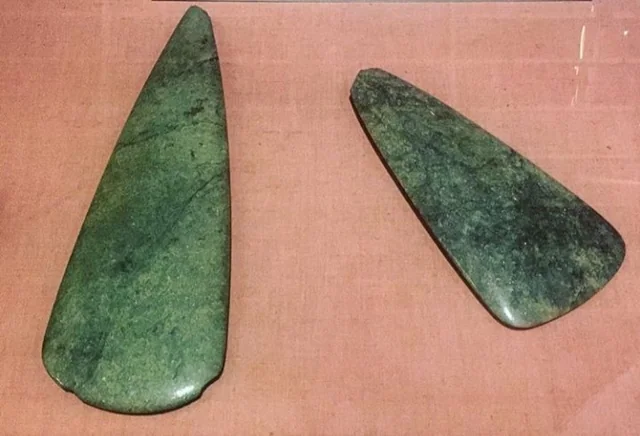
The proposed study of Neolithic jade axes in Drama riverbeds raises questions about stone procurement, tool production, exchange networks, and the relationship between prehistoric communities and their environment. However, the identification of particular objects as jade axes requires mineralogical confirmation. The term jade should not be applied to polished green stone tools solely because of their color.
Neolithic Communities and the Development of Polished Stone Tools
The Neolithic period was characterized by major changes in human settlement and economic activity. Communities increasingly depended on cultivated plants and domesticated animals, although hunting, fishing, and gathering continued to contribute to subsistence.
The development of permanent or semi-permanent settlements created new practical needs. People required tools for woodworking, building, land clearance, and agricultural activities.
Polished stone axes were particularly useful for working wood. They could be used to cut trees, prepare timber, and construct houses or other structures. Their production involved selecting suitable stone, shaping the blank, grinding the surface, and polishing the finished tool.
Jade and Other Greenstone Materials
Jade is a general term used for two different minerals: jadeite and nephrite. Both can be used to produce durable polished objects, but they have different mineralogical compositions.
Other green-colored stones may resemble jade but belong to different mineral groups. Archaeological identification therefore requires scientific examination rather than visual description alone.
The use of jadeite or nephrite in prehistoric tools can be significant because suitable geological sources are not equally distributed across all regions. The movement of jade objects may indicate the circulation of raw materials, finished tools, or technical knowledge.
However, the presence of a green polished axe does not automatically demonstrate long-distance exchange. Researchers must first establish the object's mineral identity and compare it with possible geological sources.
Stone Axe Production
The manufacture of polished axes involved several stages. A suitable stone blank was first selected according to its size, shape, and physical properties. The blank could then be shaped through controlled percussion or other techniques.
Grinding removed irregularities and produced a more regular surface. Polishing created a smoother finish and could improve the appearance and handling of the tool.
Some axes were designed to be mounted in wooden handles, while others may have been held directly or used with different hafting arrangements. The form of the cutting edge, body, and butt can provide clues about the tool's intended function.
Archaeologists examine manufacturing traces, surface wear, edge damage, and microscopic polish to investigate how stone tools were used.
Riverbeds and the Movement of Archaeological Objects
Riverbeds can contain archaeological materials transported from their original locations. Water movement, erosion, flooding, and changes in river channels may carry stone tools and other objects away from prehistoric settlements.
A polished axe discovered in a riverbed may therefore have been deposited through natural processes rather than intentionally placed there. Its original context may be difficult to reconstruct.
This creates important challenges for archaeological interpretation. An object recovered from a riverbed may provide information about prehistoric technology, but it may not provide a reliable date or direct association with a particular settlement unless additional evidence is available.
The study of riverbed finds should consider geological processes, sediment layers, and the possibility of secondary deposition.
Exchange Networks and the Movement of Stone
The circulation of distinctive stone materials can provide evidence of contact between prehistoric communities. Raw materials could be transported over considerable distances, exchanged between neighboring settlements, or carried by individuals moving through different regions.
If a jadeite or nephrite axe from Drama can be scientifically linked to a distant geological source, it may provide evidence of long-distance movement. Such a result would contribute to understanding the connections between Neolithic communities in the Balkans and neighboring regions.
The interpretation of exchange should consider several possibilities. The stone may have moved as a raw block, a partially worked blank, a finished axe, or an heirloom passed between generations.
Scientific Methods of Identification
Mineralogical analysis is essential for determining whether an object is jadeite, nephrite, or another stone. Techniques such as X-ray diffraction, Raman spectroscopy, and petrographic examination can help identify the mineral composition.
Geochemical analysis may contribute to provenance studies by comparing the object's composition with known geological sources. However, the identification of an exact source may remain difficult when different deposits share similar characteristics.
Use-wear analysis can help determine whether the tool was used for cutting, woodworking, or other activities. Microscopic examination may reveal polish, scratches, edge damage, and traces of hafting.
Social and Cultural Significance
Polished stone axes had both practical and possible symbolic significance. Their production required time and skill, and some examples may have been valued beyond their immediate usefulness.
A finely polished axe made from an unusual stone could have served as a prestige object, ceremonial item, or marker of social relationships. Nevertheless, such interpretations must be supported by archaeological context.
The study of stone tools from Drama can contribute to understanding how prehistoric communities adapted to their environment, organized production, and participated in wider networks of interaction.
Conclusion
The proposed study of Neolithic jade axes in Drama riverbeds offers an opportunity to investigate prehistoric technology, raw material procurement, and the movement of objects across the Balkans.
The most important research priorities are the scientific identification of the stone, the documentation of the recovery context, and the investigation of possible geological sources. These steps are necessary before claims about jade use or long-distance exchange can be established.