Ancient Greece was one of the most influential centers of innovation in the ancient world. Although Greek civilization is often remembered for philosophy and democracy, its contributions to science, engineering, and technology were equally important and far-reaching.
One of the most remarkable Greek inventions is the Antikythera mechanism, discovered in a shipwreck near the island of Antikythera. This complex bronze device contained a system of gears that could predict astronomical events such as eclipses, lunar phases, and even Olympic cycles. Modern researchers often describe it as the world’s first analog computer because of its extraordinary mechanical sophistication.
Another important invention was the clepsydra, or water clock. This device measured time by controlling the flow of water from one container to another. It was widely used in legal courts to time speeches so that each speaker had an equal opportunity to present their case. This innovation reflects how Greeks valued fairness and structure in public life.
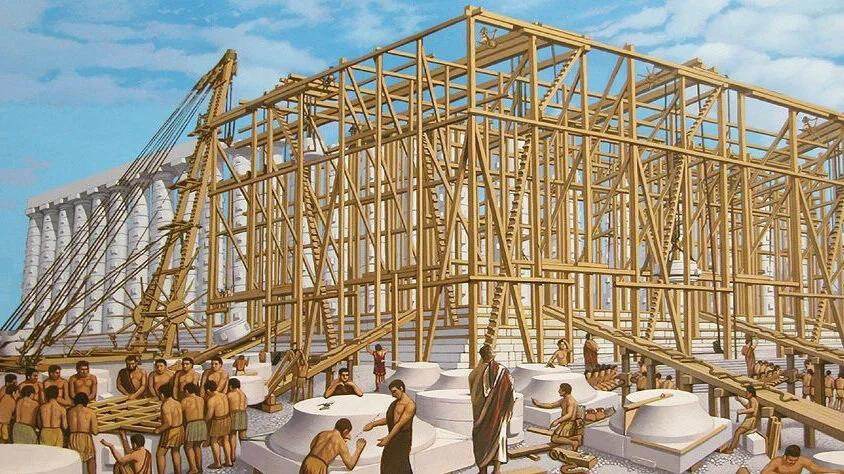
In construction and engineering, the Greeks developed improved crane systems that allowed builders to lift heavy stone blocks used in temples such as the Parthenon. These cranes used ropes, pulleys, and rotating beams, dramatically increasing efficiency in large-scale architecture.
Maritime innovation was also crucial. The Greeks perfected the trireme, a highly advanced warship powered by three rows of oars on each side. These ships were fast, agile, and designed for naval warfare. Their bronze rams allowed them to strike enemy vessels with precision, making them dominant in battles like the Battle of Salamis.
Greek innovation extended beyond physical inventions. Their advancements in mathematics, astronomy, medicine, and engineering principles laid the groundwork for later scientific developments in both the Roman world and modern science.