Ancient Greek shipbuilding was one of the most sophisticated maritime technologies of the ancient world. It supported not only warfare but also trade, colonization, fishing, and cultural exchange across the entire Mediterranean basin. The Greeks lived in a geography that encouraged seafaring, and as a result, shipbuilding became a highly specialized and respected craft.
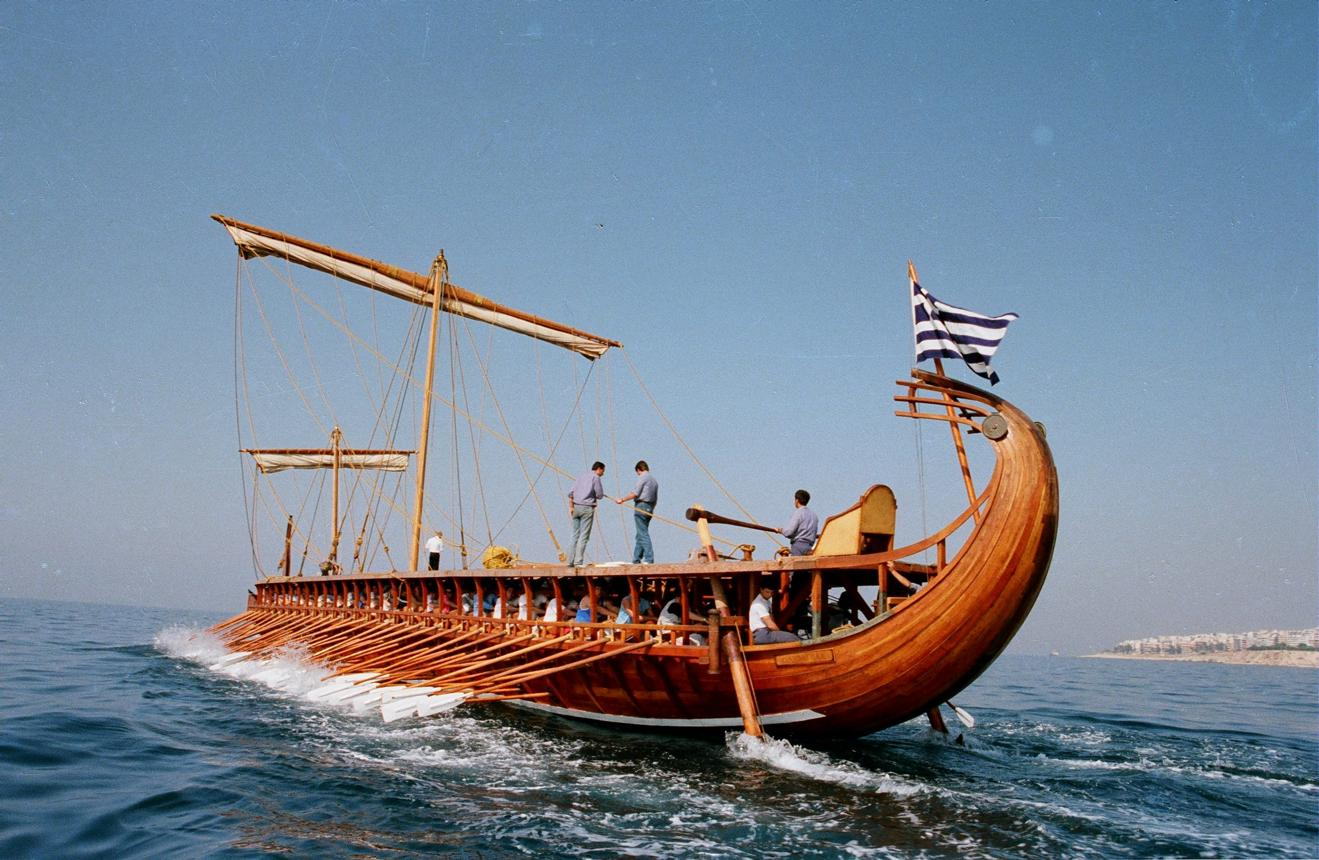
The most famous type of Greek warship was the trireme, a long, narrow, and extremely fast vessel designed primarily for naval combat. Its name comes from the three rows of oars on each side, which allowed for powerful and coordinated movement across the water. Triremes were not large ships in terms of cargo capacity, but they were highly efficient in speed and maneuverability, which made them dominant in naval battles.
Greek shipbuilders carefully selected materials, primarily using lightweight but durable woods such as pine, fir, and cedar. The choice of wood was essential because ships needed to be strong enough to withstand waves and combat damage, yet light enough to remain fast and agile. Timber was often seasoned and treated to improve durability and resistance to water.
One of the most important innovations in Greek shipbuilding was the shell-first construction method. Unlike later shipbuilding traditions that began with a wooden frame, Greek builders first constructed the outer hull. They joined wooden planks together using mortise-and-tenon joints—precisely carved interlocking systems that allowed for strong, watertight connections without modern nails. Once the hull was completed, internal frames, supports, and decking were installed to reinforce the structure. This method required exceptional craftsmanship and coordination among skilled laborers.
The trireme was powered by approximately 170 rowers, arranged in three vertical tiers along each side of the ship. These rowers had to operate in perfect synchronization, following strict rhythm commands. Even a slight delay or mismatch in rowing could reduce speed or cause instability. Training rowers was therefore as important as building the ship itself, and crews often practiced extensively before battle.
In addition to oars, triremes were equipped with a single square sail, used primarily for long-distance travel or when wind conditions were favorable. However, in battle, sails were usually lowered to maximize control and maneuverability.
At the front of the ship was one of its most dangerous features: the bronze ram, known as the embolon. This reinforced projection was designed to strike enemy ships at high speed, either breaking their hulls or disabling their oars. Naval battles such as the famous Battle of Salamis in 480 BCE demonstrated the effectiveness of triremes, where speed and coordination allowed smaller Greek forces to defeat a much larger Persian fleet.
Beyond warfare, Greek ships played a crucial role in trade and colonization. They enabled the transport of goods such as olive oil, wine, pottery, and grain across vast distances. Greek colonies were established throughout the Mediterranean and Black Sea regions, spreading Hellenic culture, language, and political ideas.
In this way, Greek shipbuilding was not just a technological achievement—it was a foundation of Greek civilization itself, shaping economic systems, military power, and cultural expansion.