Music was an essential and deeply integrated part of Ancient Greek society. Unlike in modern culture, where music is often treated as entertainment alone, the Greeks saw music as a powerful force that shaped morality, education, emotional balance, and even political stability. It was closely tied to religion, philosophy, and daily life.
Music appeared in almost every social setting. It was performed during religious ceremonies, funerals, weddings, athletic competitions, and public festivals. Major religious events often included processions accompanied by musical performance, reinforcing the connection between sound and divine worship. In theaters, music played a vital role in both tragedies and comedies, enhancing emotional impact and helping audiences connect with the story.
Greek musical performance was also closely linked to poetry and dance. The Greeks did not separate these art forms the way modern societies often do. Instead, poetry was often sung or chanted with musical accompaniment, while dance movements followed rhythmic patterns. This combination created unified performances that expressed cultural identity and shared values.
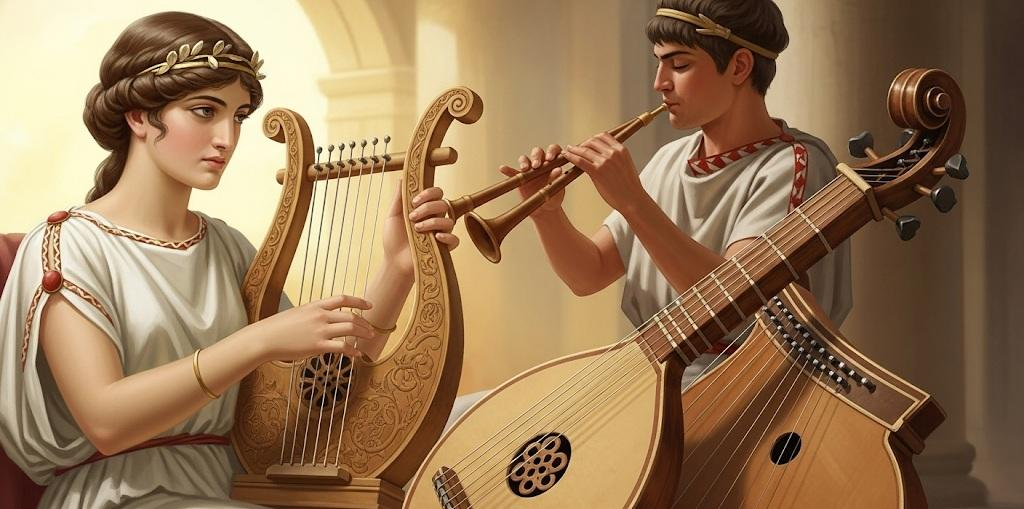
The most common musical instruments in Ancient Greece were the lyre, kithara, and aulos. The lyre, a small stringed instrument often associated with the god Apollo, was widely used in education and informal performances. It symbolized harmony, order, and intellectual refinement. The kithara was a larger and more complex version of the lyre, typically played by professional musicians during public performances and competitions.
The aulos, a double-reeded wind instrument, produced a much louder and more intense sound. It was often associated with emotional or ecstatic music and was frequently used in religious rituals, theatrical performances, and military settings. Its sound was considered powerful and sometimes even dangerous in its emotional intensity.
Greek philosophers such as Plato and Aristotle studied music in depth and believed it had a direct influence on human character. They argued that different musical modes (scales) could shape emotional states and behavior. For example, certain modes were thought to encourage courage and discipline, while others might lead to sadness or disorder. Because of this belief, music education was carefully structured in some city-states, especially Athens, where it was seen as part of moral training.
Music was also used as a tool of unity and identity. Shared songs and performances helped reinforce communal bonds, especially during festivals such as the Panathenaia. Musical competitions were also held, where performers competed in skill and artistry.
In this way, music in Ancient Greece was not just an art form—it was a fundamental part of how people learned, worshipped, communicated, and understood the world around them.