Diogenes the Cynic: The Most Eccentric Philosopher
Diogenes arrived in Athens as an exile after he (or his father) was accused of defacing the currency in his hometown of Sinope. This act of "defacing" became the metaphor for his entire life: he sought to "deface" the artificial customs, laws, and social graces of humanity to reveal the raw, natural truth beneath.
1. The Philosophy of the Barrel
Diogenes believed that virtue was better revealed in action than in theory. To him, happiness was achieved through Autarkeia (self-sufficiency) and Askēsis (self-discipline). He famously:
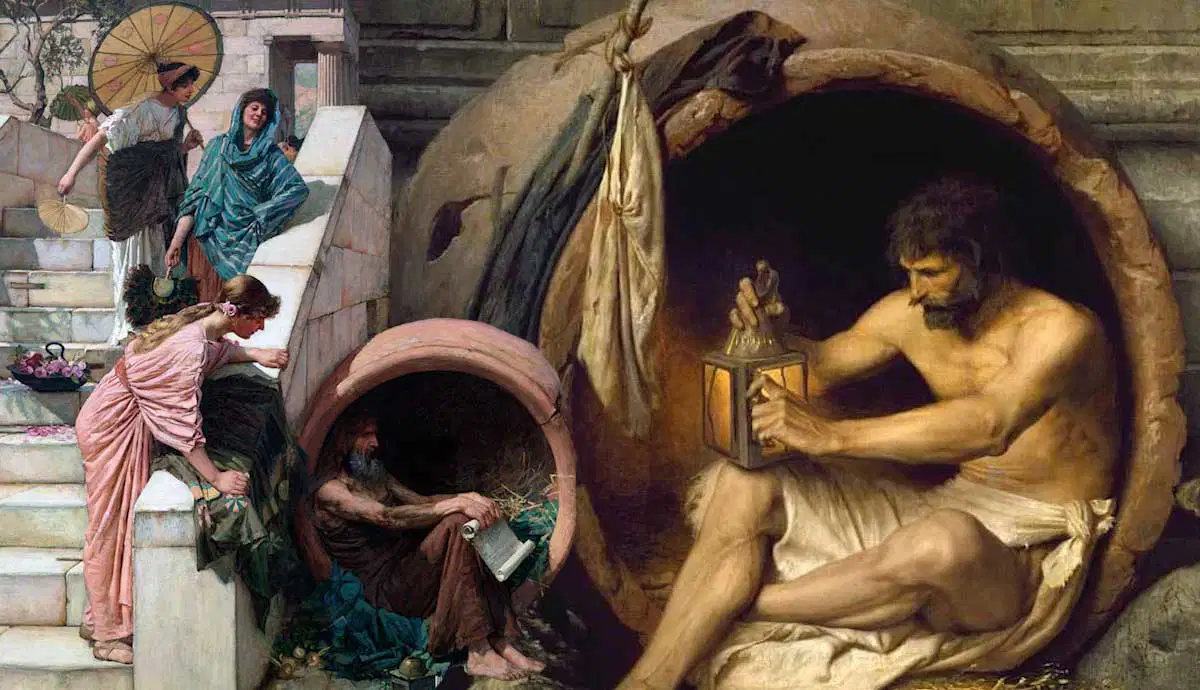
Abandoned all property: He lived in a large ceramic storage jar (pithos) in the Athenian marketplace to prove he didn't need a house.
The Wooden Bowl: He once owned a single wooden bowl, but after seeing a child drink water from his cupped hands, Diogenes threw the bowl away, crying, "A child has beaten me in plainness of living!"
Living like a Dog: The term "Cynic" comes from the Greek word kynikos (dog-like). Diogenes embraced this, eating, sleeping, and even performing his private bodily functions in the street, arguing that if an act is natural, it is not shameful.
2. "I am Looking for an Honest Man"
One of the most iconic images of Diogenes is him walking through the sun-drenched streets of Athens at high noon carrying a lit lamp. When confused citizens asked what he was doing, he would bark, "I am looking for an honest man!" This was a biting critique of his fellow citizens, whom he believed were so bogged down in hypocrisy and social performance that they had lost their true humanity.
3. The Scourge of Intellectuals
Diogenes had no patience for the abstract theories of the Academy. He viewed Plato’s metaphysics as useless "ivory tower" nonsense.
The Plucked Chicken: When Plato famously defined a human being as a "featherless biped," Diogenes plucked a chicken, brought it into the Academy, and announced, "Behold! I have brought you a man." (This forced Plato to add "with broad flat nails" to his definition).
Walking the Walk: When a philosopher argued that motion was impossible, Diogenes simply stood up and walked around the room, proving that observation beats abstract logic every time.
4. The Encounter with Alexander the Great
The most famous anecdote in the history of philosophy is the meeting between the man who owned the world and the man who owned nothing. Alexander the Great, intrigued by Diogenes’ reputation, found him sunning himself in Corinth. The King asked, "Ask of me any boon you desire." Diogenes, without even sitting up, replied: "Stand out of my sunlight."
Alexander was so struck by this absolute disdain for power and status that he told his officers, "If I were not Alexander, I should wish to be Diogenes." This encounter highlighted the core of Cynic thought: a person who desires nothing is more powerful than a king who desires everything.
5. Death and Legacy
Legend has it that Diogenes died on the same day as Alexander the Great in 323 BCE. While Alexander died in a palace surrounded by an empire, Diogenes died in the dirt, allegedly by holding his breath or from a stray dog bite. He requested that his body be thrown over the city walls to feed the animals, remaining a "citizen of the world" (kosmopolitēs) until the end.