While Socrates, Plato, and Aristotle sought absolute truths, a different group of intellectuals was busy teaching the citizens of Athens how to win at life. The Sophists (from the Greek sophistēs, meaning "wise man" or "expert") were the world’s first professional educators. Emerging in the 5th century BCE, they transformed philosophy from a study of the cosmos into a practical toolkit for social and political success.
The Sophists: Ancient Greece’s Controversial Teachers
The rise of the Sophists was inextricably linked to the birth of Athenian democracy. In a system where any citizen could be called to argue a case in court or propose a law in the Assembly, the ability to speak persuasively was the ultimate currency. The Sophists recognized this need and stepped in to fill it—for a substantial fee.
1. The Masters of Rhetoric
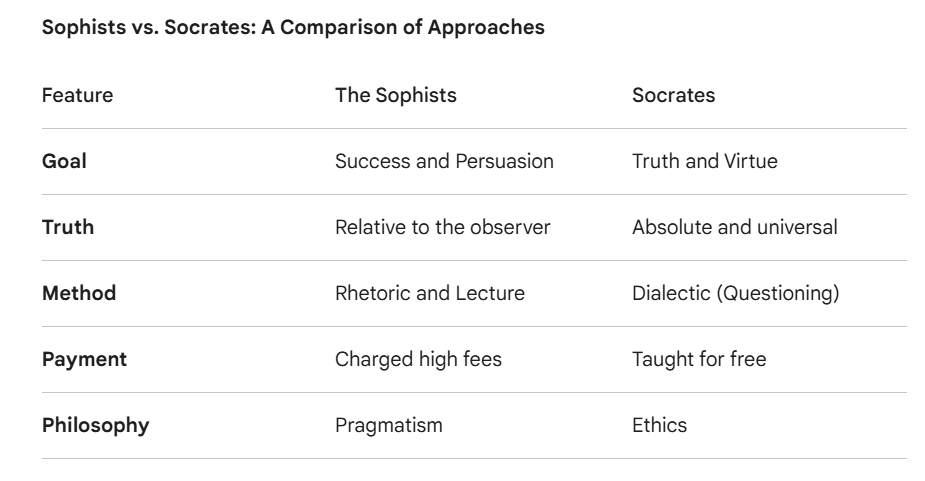
The Sophists were, above all, teachers of Rhetoric—the art of persuasion. They argued that "truth" was often less important than the ability to convince an audience. They pioneered techniques of public speaking, grammar, and linguistics that are still taught in law schools today.
Protagoras: The most famous of the group, he claimed he could make the "weaker argument appear the stronger."
Gorgias: A master of style, he believed that speech was a powerful lord that could stop fear, banish grief, and create joy. He treated language almost like magic, capable of molding the minds of listeners to the speaker's will.
2. Radical Relativism: "Man is the Measure"
The Sophists introduced a revolutionary—and to many, dangerous—idea: Relativism. Protagoras famously declared, "Man is the measure of all things: of the things that are, that they are, and of the things that are not, that they are not."
This meant that there was no objective, universal truth. If a wind feels cold to one person and warm to another, the wind is both cold and warm. They applied this to morality as well, suggesting that laws and justice were not divine or natural, but merely social contracts (nomos) that varied from city to city.
3. The Distinction Between Nature (Physis) and Law (Nomos)
The Sophists were among the first to distinguish between what is natural and what is merely a human convention.
Physis (Nature): Unchanging laws like gravity or the need for food.
Nomos (Law/Custom): Human-made rules like the prohibition of certain foods or the structure of government.
By arguing that many "sacred" traditions were actually just nomos, they paved the way for social reform and the questioning of absolute monarchies and religious dogmas.
4. Why Were They So Controversial?
Despite their brilliance, the Sophists are often remembered as villains in the history of philosophy, primarily because their main critics were Plato and Aristotle. The "Anti-Sophist" arguments centered on three points:
Charging Fees: Plato viewed the sale of wisdom as "intellectual prostitution." He believed truth should be pursued for its own sake, not for profit.
Moral Skepticism: By teaching that truth is relative, critics argued the Sophists were undermining the moral fabric of society, encouraging people to be "clever" rather than "good."
Eristic Debate: They were accused of teaching "Eristic"—argumentation aimed solely at winning, regardless of the truth.
5. The Modern Legacy
Though the word "sophistry" now carries a negative connotation (referring to a clever but false argument), the Sophists were the fathers of Humanism. They shifted the focus of inquiry from the stars to human society. They were the first to treat education as a professional field and were essential in developing the legal and political frameworks that allow democratic debate to function.