1. Socrates: The Gadfly of Athens
Socrates (c. 470–399 BCE) is arguably the most influential figure in the history of Western thought, despite never writing a single word. He was born to Sophroniscus, a stonemason, and Phaenarete, a midwife—a heritage he often referenced when describing himself as a "midwife of ideas." Unlike the pre-Socratic philosophers who focused on the origin of the cosmos (the archê), Socrates shifted the philosophical gaze toward human ethics and the nature of virtue (arete).
The Socratic Method and Intellectual Midwifery
At the heart of Socratic philosophy is the Socratic Method (elenchus). This was not a lecture-based approach but a dialectical one. Socrates would engage citizens in the Athenian agora, often those claiming expertise in a subject, and lead them through a series of probing questions. These questions were designed to expose the logical inconsistencies in their beliefs, eventually leading them to a state of aporia—a productive intellectual confusion.
Socrates famously claimed that the Oracle at Delphi had pronounced him the wisest man in Athens because he alone recognized his own ignorance. His core mantra, "The unexamined life is not worth living," suggested that moral excellence is inextricably linked to knowledge. He believed that no one does evil knowingly; rather, evil is a result of ignorance. By refining one's understanding of concepts like justice, piety, and courage, one could inherently live a more virtuous life.
The Trial: A Clash of Ideologies
In 399 BCE, at the age of 70, Socrates was indicted by Meletus, Anytus, and Lycon. The charges were twofold: Impiety (refusing to recognize the state’s gods and introducing "new divinities") and Corrupting the Youth. The historical context is vital here; Athens had recently suffered a devastating loss in the Peloponnesian War and a brief, bloody reign by the "Thirty Tyrants." Because some of these tyrants had been students of Socrates, the restored democracy viewed him with deep suspicion.
During the trial, as recorded in Plato’s Apology, Socrates refused to grovel. Instead, he maintained his role as a "gadfly," sent by the gods to sting the "sluggish horse" of the Athenian state into self-awareness. When found guilty by a jury of 501 citizens and asked to propose his own punishment, he audaciously suggested he should be given free meals for life at the Prytaneum (a public hall for heroes).
Death and the Final Lesson
The jury, incensed by his lack of contrition, sentenced him to death. During his final month in prison, Socrates’ friends, led by Crito, attempted to bribe the guards and facilitate his escape. Socrates refused, arguing in the Crito that since he had benefited from the laws of Athens his entire life, it would be unjust to break them now simply because they were turned against him.
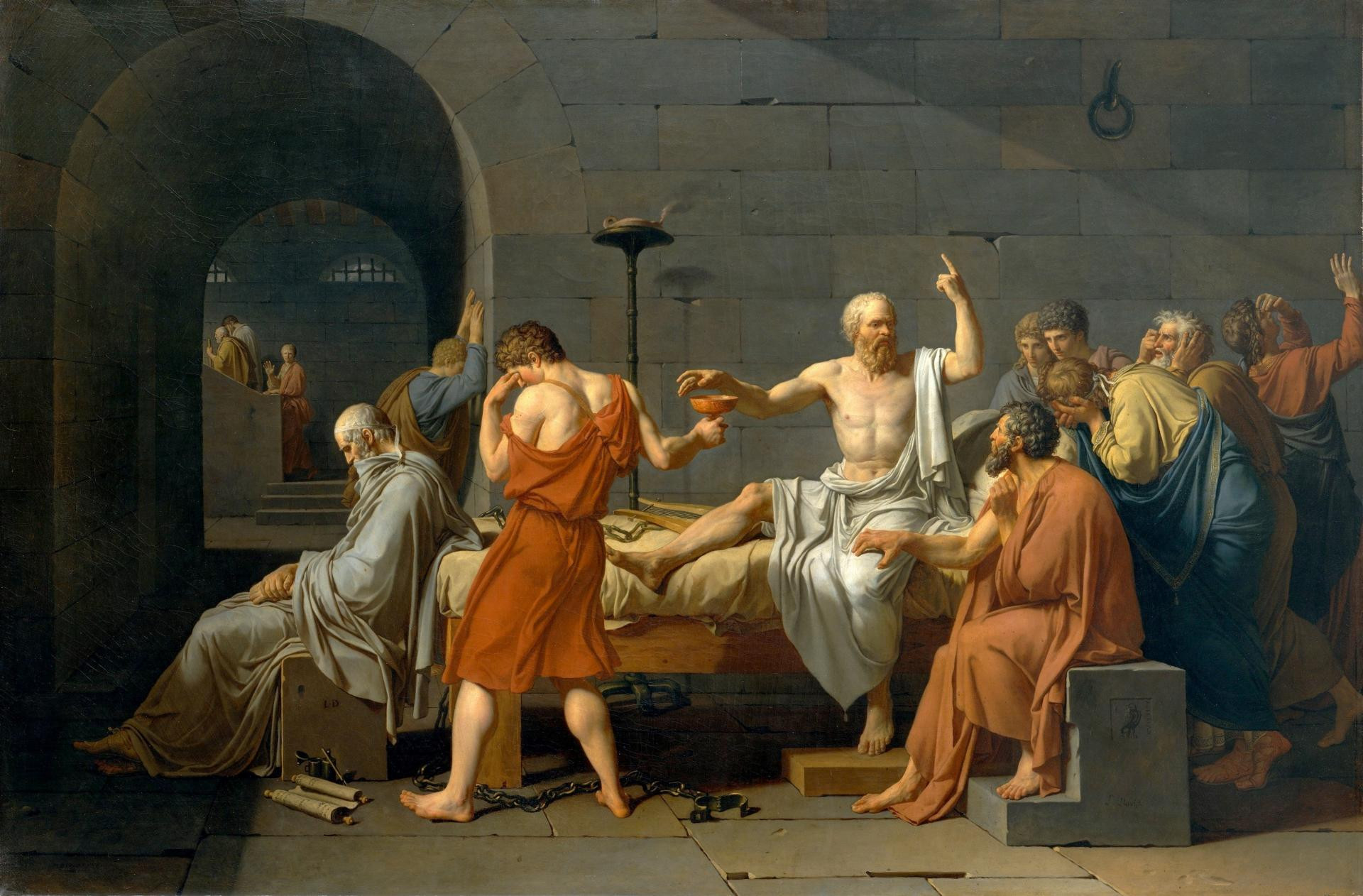
On the day of his execution, as described in the Phaedo, Socrates discussed the immortality of the soul with his disciples until the sun began to set. He then calmly drank a cup of toxic hemlock. His final words were, "Crito, we owe a cock to Asclepius; pay it and do not neglect it." This reference to the god of healing suggested that Socrates viewed death as a "cure" for the burdens of the physical body, a final act of philosophical liberation that turned him into a permanent martyr for truth and intellectual integrity.
2. Plato’s Republic: Key Ideas Explained
Plato (c. 427–347 BCE) was the most prominent student of Socrates and founded the Academy, the first institution of higher learning in the Western world. His most famous work, The Republic, is a 10-book dialogue that attempts to define justice and design a "perfect" city-state (Kallipolis).
The Theory of Forms
Plato’s metaphysics is defined by Idealism. He believed that the world we perceive with our senses is a mere shadow of a higher, eternal realm of Forms (or Ideas). For example, while every chair in the physical world is flawed and will eventually break, the "Form of Chairness" is perfect and unchanging. This is famously illustrated by the Allegory of the Cave, where prisoners mistaking shadows on a wall for reality must be led into the sunlight to see the true objects of the world.
The Tripartite Soul and Society
Plato argues that the human soul and the state are reflections of one another. Both are composed of three parts:
Reason (Logistikon): The part that seeks truth. In the state, these are the Philosopher Kings.
Spirit (Thymoeides): The part associated with courage and anger. In the state, these are the Auxiliaries (warriors).
Appetite (Epithymetikon): The part that desires physical pleasures. In the state, these are the Producers (merchants and farmers).
Justice, for Plato, is "minding one's own business"—it occurs when each part of the soul (and each class in society) performs its specific function without interfering with the others.
The Philosopher King and the Noble Lie
Plato was skeptical of democracy, which he blamed for Socrates' death. He proposed that only those who have glimpsed the "Form of the Good"—the philosophers—are fit to rule. To maintain social order in his utopia, he suggested the "Noble Lie" (or Myth of the Metals): the citizens would be told that their souls were mixed with gold, silver, or bronze, determining their social rank from birth. While often criticized as totalitarian, Plato’s work remains the foundation of political philosophy, questioning the balance between individual freedom and state stability.
3. Aristotle’s Contributions to Science and Philosophy
Aristotle (384–322 BCE) entered Plato’s Academy at 17 and stayed for 20 years. However, he eventually diverged from his teacher’s abstract idealism, preferring a grounded, Empiricist approach. After leaving the Academy, he tutored the future Alexander the Great and founded his own school, the Lyceum.
The Father of Logic and the Four Causes
Aristotle was the first to formalize a system of logic, known as Syllogism. This allowed for deductive reasoning, such as: $All \ men \ are \ mortal \ + \ Socrates \ is \ a \ man \ = \ Socrates \ is \ mortal$. This framework governed Western science for nearly two millennia.
To understand why things are the way they are, Aristotle developed the Four Causes:
Material Cause: What a thing is made of (e.g., the marble of a statue).
Formal Cause: The design or pattern (e.g., the shape of the statue).
Efficient Cause: The agent that brings it into being (e.g., the sculptor).
Final Cause (Telos): The ultimate purpose (e.g., to honor a god).
Biology and the Chain of Being
Aristotle was a pioneer in biology. He classified over 500 species of animals based on their physiology and habitat. He conceived the Scala Naturae (Great Chain of Being), a hierarchical structure of all living things, with plants at the bottom and humans at the top. His insistence on observation and categorization laid the groundwork for the scientific method.
The Golden Mean
In his Nicomachean Ethics, Aristotle explored how humans can achieve Eudaimonia (flourishing). He argued that virtue is a habit, not an act. It is found in the Golden Mean—the desirable middle between two extremes. For instance, Courage is the mean between the deficiency of Cowardice and the excess of Rashness. Aristotle believed that by practicing these means, we achieve moral excellence and a balanced, happy life.
4. The Sophists: Ancient Greece’s Controversial Teachers
The Sophists were a group of itinerant teachers in the 5th century BCE who specialized in Rhetoric and the "art of the word." As Athens became a direct democracy, the ability to persuade a crowd became the most valuable skill a young man could possess.
Protagoras and Relativism
The most famous Sophist, Protagoras, declared: "Man is the measure of all things." This was a radical departure from the search for absolute truth. It suggested that truth is relative to the observer. If a room feels cold to one person and warm to another, there is no "objective" temperature; both perceptions are true for the individuals involved. This relativism extended to morality and law, suggesting that justice is whatever a community agrees it is at a given time.
Rhetoric as a Tool for Success
Sophists like Gorgias claimed they could make the "weaker argument appear the stronger." They taught their students how to win debates regardless of the truth. This made them essential for legal and political success but earned them the enmity of Socrates and Plato. Plato viewed them as "merchants of knowledge" who cared only for profit and power rather than the soul.
The Legacy of Sophistry
Despite their negative reputation, the Sophists were the first to move philosophy toward the study of human affairs (Humanism). They contributed significantly to linguistics, grammar, and the development of educational systems. They forced philosophers to define what "truth" actually meant in a world of conflicting opinions, effectively creating the landscape of modern debate and legal theory.
5. Diogenes the Cynic: The Most Eccentric Philosopher
Diogenes of Sinope (c. 412–323 BCE) was the "enfant terrible" of Greek philosophy and the most famous representative of Cynicism. He believed that the more humans adhered to the artificial rules of society, the further they moved away from true happiness.
Back to Nature (Physis)
Diogenes advocated for a life of extreme simplicity. He lived in a large ceramic storage jar (pithos) in the center of Athens, owned nothing but a cloak and a staff, and begged for his food. He famously walked through the streets with a lit lantern during the day, claiming to be "looking for an honest man." By living like a "dog" (the Greek word kyon is the root of "Cynic"), he aimed to show that human needs are actually very minimal.
Shamelessness and Social Critique
Diogenes practiced anaideia (shamelessness). He would perform his private bodily functions in public, arguing that if something is natural, it shouldn't be hidden. He used his eccentricity to mock the pretension of other philosophers. When Plato defined man as a "featherless biped," Diogenes famously plucked a chicken and brought it into the Academy, shouting, "Behold, I have brought you a man!"
The Encounter with Alexander
The most famous story involving Diogenes is his meeting with Alexander the Great. Alexander, intrigued by the philosopher’s reputation, approached him and asked, "Ask of me any boon you desire." Diogenes, who was sunning himself, replied simply, "Stand out of my light." Alexander was so impressed by this disdain for power that he remarked, "If I were not Alexander, I should wish to be Diogenes." Diogenes’ legacy is one of radical self-sufficiency, reminding us that true freedom is the ability to say "no" to the world's demands.