The Conquered Conqueror: How Greek Ideas Built the Roman Soul
The Roman poet Horace famously wrote, "Graecia capta ferum victorem cepit," meaning "Captive Greece took captive her savage conqueror." This paradox defines the history of the Mediterranean. While Rome militarily crushed the Greek city-states by 146 BCE, the Romans were so intellectually overwhelmed by Greek culture that they effectively adopted, adapted, and archived it.
Rome provided the muscle and the law, but Greece provided the "operating system" for Roman civilization.
1. Literature: From Translation to Transformation
Roman literature did not evolve organically; it began as a deliberate imitation of Greek models. The first major work of Latin literature was actually a translation of the Odyssey by Livius Andronicus, a Greek slave.
The Epic Tradition: Virgil’s Aeneid was commissioned to give Rome a founding myth as grand as those of Greece. Virgil structured the work specifically to mirror Homer: the first six books (wandering) reflect the Odyssey, while the final six (warfare) reflect the Iliad.
The Birth of the Sitcom: Roman playwrights like Plautus and Terence adapted Greek "New Comedy." They took the stock characters of Greek theater—the clever slave, the boastful soldier, the young lovers—and refined them into a style that directly influenced modern situational comedy.
2. Philosophy: The Rise of the Roman Stoic
For the Roman elite, education was synonymous with Greek philosophy. While Rome was traditionally suspicious of "abstract" thinking, they embraced Greek schools that offered practical guides for living.
Stoicism: This Greek school became the unofficial "religion" of the Roman state. It emphasized duty (officium), endurance, and the suppression of destructive emotions—values that aligned perfectly with the Roman military character.
The Legacy of Cicero: Marcus Tullius Cicero translated Greek philosophical concepts into Latin. He essentially invented the Latin vocabulary for "quality," "individual," and "moral," providing the linguistic tools that European thinkers would use for the next two thousand years.
3. Architecture and Art: The Classical Blueprint
Roman architecture is often remembered for its engineering (concrete, arches, and domes), but its aesthetic was almost entirely Greek.
The Orders: Romans adopted the Greek Doric, Ionic, and Corinthian columns. However, they favored the ornate Corinthian style, viewing it as a symbol of imperial grandeur.
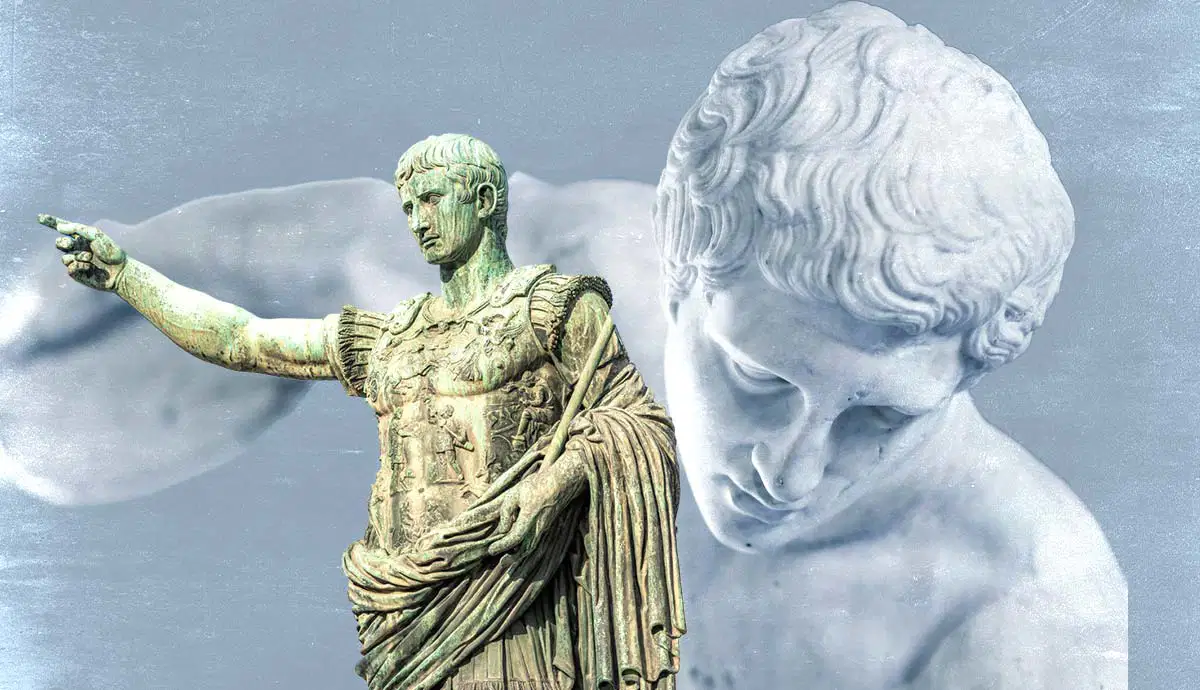
Sculpture: Romans were obsessed with Greek statues. They imported thousands of original Greek works and commissioned countless copies. While Greek sculpture focused on "idealized" beauty, Romans eventually evolved this into "verism"—a hyper-realistic style that captured every wrinkle and flaw of a leader’s face.
4. Education: The Bilingual Elite
To be an educated Roman was to be bilingual. Roman boys of the upper class were often taught by Greek slaves (paedagogi) and finished their education by traveling to Athens or Rhodes to study rhetoric.
Rhetoric: The Greek art of persuasion became the most vital skill for a Roman politician. The Roman legal system and Senate were built on the foundations of Greek rhetorical structures, specifically the "Three Modes of Persuasion" (Ethos, Pathos, and Logos).
Science and Medicine: Roman doctors were almost exclusively Greek (or trained in Greek methods). The work of Galen, a Greek physician in Rome, remained the definitive medical authority in Europe until the Renaissance.
5. Religion: The Olympian Merger
The Romans already had their own native spirits and gods (numina), but they lacked the rich mythology of the Greeks. Over time, they performed a "theological merger" known as Interpretatio Romana.
They identified their local deities with Greek counterparts:
Jupiter became identified with Zeus
Juno with Hera
Venus with Aphrodite
Mars with Ares
This allowed Rome to adopt the vast body of Greek myths and literature as their own, providing a shared cultural language for the entire empire.
Summary of Influence
Without the Greek foundation, Rome would have likely remained a regional power with a strictly legalistic and military culture. By absorbing Greek ideas, Rome became a "vessel" that preserved the best of ancient thought. When the Roman Empire eventually spread across Europe, it wasn't just spreading Roman law—it was spreading the Greek spirit of inquiry, art, and philosophy to the Western world.