The Hellenistic Ripple: How Greek Culture Conquered the Conquerors
The death of Alexander the Great in 323 BCE did not signal the end of his empire’s influence; instead, it marked the beginning of the Hellenistic Age. For the next three centuries, Greek culture, language, and thought acted as a "global" adhesive, stretching from the Mediterranean to the Indus Valley. This era transformed the ancient world into a massive, interconnected network where East and West fused into something entirely new.
1. The Mechanics of Expansion: Cities as Cultural Hubs
Alexander’s most enduring legacy was the foundation of dozens of cities, often named Alexandria, across his conquered territories. These weren't just military outposts; they were designed as miniature versions of Athens.
Architectural DNA: Every new Hellenistic city featured the staples of Greek life: the Agora (marketplace), the Gymnasium, and the Theater.
The Power of Koine: A simplified version of the Greek language, known as Koine ("common"), became the universal tongue of trade, diplomacy, and literature. This allowed a merchant in Egypt to communicate perfectly with a scholar in Bactria (modern-day Afghanistan).
2. Alexandria in Egypt: The Intellectual Capital
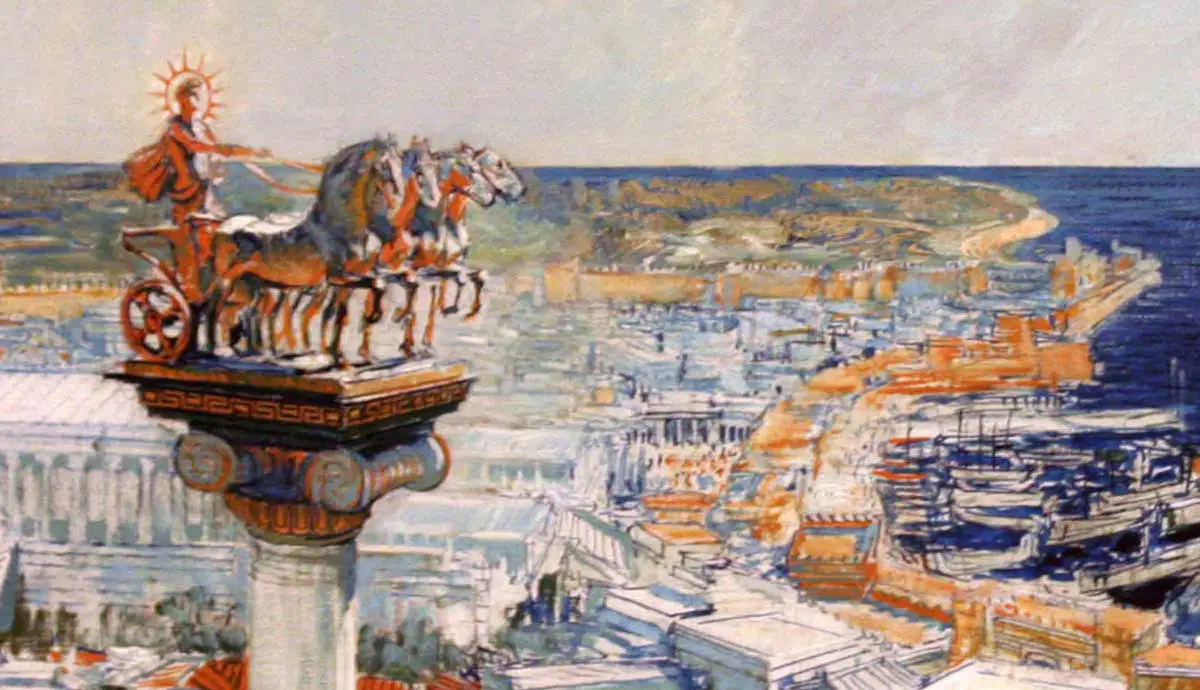
Under the Ptolemaic dynasty, Alexandria became the greatest city in the world. It was home to the Musaeon (Temple of the Muses) and the legendary Library of Alexandria.
The Library: At its peak, the library held an estimated 400,000 to 700,000 papyrus scrolls. It was the first time in history that a civilization attempted to collect the entirety of human knowledge in one place.
Scientific Renaissance: While the philosophers of the Classical Age focused on ethics, Hellenistic scholars in Alexandria pioneered hard sciences. Eratosthenes calculated the circumference of the Earth with remarkable accuracy, and Aristarchus proposed the first heliocentric (sun-centered) model of the solar system.
3. The Eastern Frontier: Greco-Buddhism
One of the most startling results of the Hellenistic spread occurred in the Greco-Bactrian and Indo-Greek kingdoms. Here, Greek settlers lived alongside Buddhist populations, leading to a unique cultural hybrid known as Greco-Buddhism.
The Human Buddha: Before Greek influence, the Buddha was represented only by symbols (like a footprint or an empty throne). Greek artistic traditions of anthropomorphism led to the first statues of the Buddha in human form, often styled with the robes and wavy hair of the Greek god Apollo.
The Milinda Panha: This famous Buddhist text records the philosophical debates between the Greek King Menander I and the monk Nagasena, showing that Greek dialectics were being used to explore Eastern spirituality.
4. The Conquered Conqueror: Greece and Rome
As the Roman Republic expanded into the eastern Mediterranean, it militarily defeated the Hellenistic kingdoms. However, the Romans were so enamored by Greek culture that they effectively adopted it.
Education and Literature: Wealthy Romans hired Greek tutors, and Roman poets like Virgil modeled their work directly on Homeric epics.
The Birth of "Graeco-Roman" Culture: The Romans took Greek philosophy (especially Stoicism), art, and mythology and spread them to the furthest reaches of Western Europe, from Britain to the Danube. Without the Hellenistic "bridge," the Classical tradition might never have reached the Western world.
5. The Hellenistic Legacy in Science and Math
The Hellenistic period was arguably the most productive era for mathematics and engineering until the Renaissance.
Euclid: His work Elements became the standard textbook for geometry for over 2,000 years.
Archimedes: Living in Syracuse, he pioneered the principles of buoyancy, the lever, and the screw, as well as calculating the value of pi.
The Antikythera Mechanism: This incredible archaeological find—an ancient analog computer used to predict astronomical positions—shows that Hellenistic engineering was far more advanced than previously believed.
The Summary of Influence
The Hellenistic Age proved that culture is more powerful than armies. Though the political empires of Alexander’s generals eventually crumbled, the "Hellenization" of the world ensured that Greek ideas about reason, beauty, and inquiry became the foundation of modern Western and Middle Eastern thought. Whether in a Buddhist monastery in India or a law court in Rome, the Greek spirit remained the defining force of the ancient world.