Greek Fire was one of the most formidable weapons of the Middle Ages, serving as a decisive technological advantage for the Byzantine Empire from the 7th through the 14th centuries. Often compared to modern-day napalm, it was a highly incendiary, liquid substance that could burn on water, making it devastatingly effective in naval combat against wooden fleets.
I. The Secret Composition
The exact "recipe" for Greek Fire was a jealously guarded state secret, known only to a select few and passed down through the Byzantine imperial line. Because it was never formally written down, the precise chemistry remains a mystery to modern historians. However, most scholars agree on a probable composition:
Base: Petroleum naphtha, likely sourced from natural seeps in regions like Syria or the Black Sea.
Additives: Substances such as sulfur, quicklime, resins, and pitch were likely mixed in to thicken the substance, increase its adhesive properties (allowing it to stick to enemy ships and soldiers), and ensure it remained ignited.
Unique Properties: Its ability to burn on water made it nearly impossible for enemy sailors to extinguish. Historical accounts suggest it could only be put out with specific substances like sand, strong vinegar, or old urine.
II. Delivery Systems
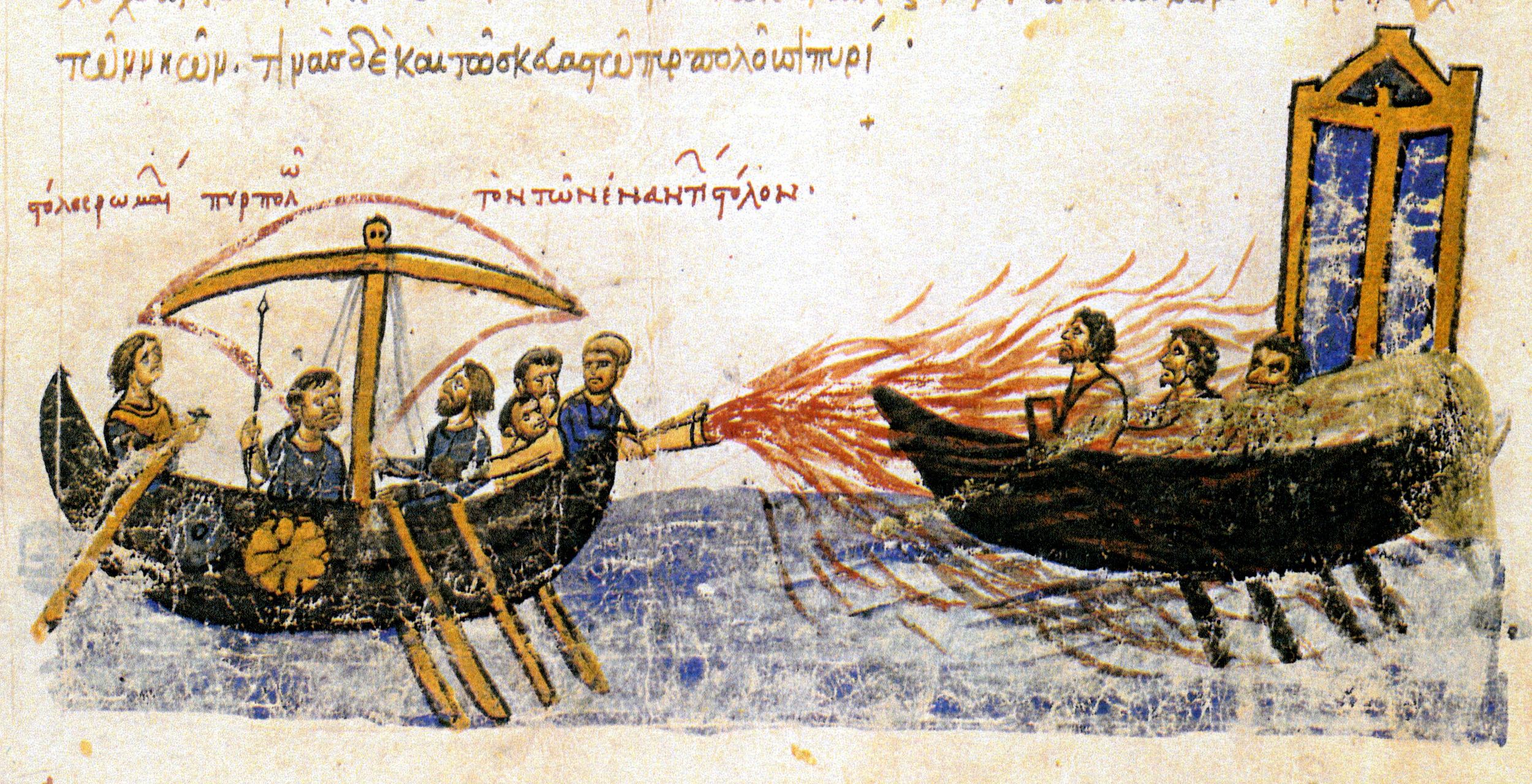
The true innovation of the Byzantine weapon system was how it was projected. Rather than simply throwing incendiary pots, the Byzantines developed a sophisticated mechanical system:
The Siphon: A bronze tube mounted on the bow of warships (dromons).
Pressure Pump: Using a force pump, the liquid was pressurized and likely heated before being sprayed through the tube. This turned the weapon into an ancient, ship-mounted flamethrower.
Visual and Psychological Impact: The discharge was accompanied by a loud, thunderous roar and thick smoke, which—combined with the sight of "burning water"—often caused enemy crews to panic and break formation before combat truly began.
III. Strategic Importance
Greek Fire was primarily credited with saving Constantinople during two major Arab sieges (674–678 and 717–718). By denying enemy fleets access to the city’s harbors, the Byzantines were able to prevent blockades that could have led to the empire's collapse. It acted as a "force multiplier" that allowed a smaller Byzantine navy to rout much larger invading forces.
IV. The Decline of the Secret
The weapon's effectiveness relied as much on the secrecy of its production as its chemical properties. The Byzantines treated the manufacturing process like a central plant operation, controlling the supply chain from raw materials to the distribution of the finished liquid to fleet commanders. Once the Byzantine Empire began to decline and its central control faltered, the specialized knowledge required to manufacture and deploy the weapon was eventually lost to history, leaving only the terror it once inspired in the accounts of contemporary chroniclers.