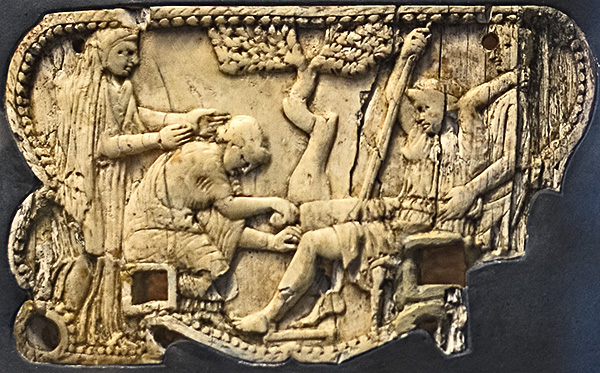
Midwives (maiai) were the backbone of women’s healthcare in ancient Greece. While the public sphere of medicine was often dominated by men, the private, critical world of childbirth was entrusted entirely to women.
I. Titles and Roles
A midwife’s role extended far beyond the delivery itself. She was often referred to as a maia (a term also associated with nurses or "motherly" figures) or by more specialized titles:
Maia: The common term for midwife, often implying a woman of experience and wisdom.
Omfalotomos: Literally "the person who cuts the umbilical cord."
Akestris: A "healer" or "repairer."
Iatrine: A term used for highly skilled midwives who functioned similarly to female physicians, possessing advanced medical knowledge of gynecology.
II. Skills and Training
The training of a midwife was typically an apprenticeship-based tradition, passed down from mother to daughter or from an experienced midwife to an apprentice.
By the time of the Roman-era physician Soranus of Ephesus (whose work Gynaecology remains our most detailed source), expectations for a midwife were rigorous. She was expected to be literate, well-versed in theory, and skilled in both surgery and pharmacology. Key qualifications included:
Physicality: She needed to be "sound of limb" and robust, as labor could be long and physically demanding.
Dexterity: Midwives were expected to have soft hands and "long, slim fingers" with neatly trimmed nails to avoid wounding the mother during examinations.
Composure: Beyond medical skill, she had to provide psychological support, be capable of keeping family secrets, and remain calm during high-stress complications.
Scientific Approach: Soranus explicitly insisted that a good midwife should be free of superstitions and religious "magic," favoring a medical understanding of the body and its functions.
III. Daily Responsibilities
The midwife’s duties spanned the entire reproductive journey:
Prenatal Care: Providing dietetic advice to ensure the health of the mother and fetus.
Labor and Delivery: Directing the mother during labor and managing the actual birth, including handling abnormal presentations or difficult deliveries.
Postnatal Care: Assessing the health of the newborn, clearing the uterine cavity of clots, and instructing the mother on infant aftercare and nursing.
Decision-making: In some instances, the midwife assessed whether a newborn was healthy enough to survive, playing a role in the difficult decisions regarding the child’s future.
IV. Social Status
The status of a midwife was complex and varied:
Freedwomen: Many known midwives were freed slaves who had used their skills to earn their liberty. Being a midwife was one of the few professional paths that could allow a woman to gain financial independence and social respect.
Professional Recognition: While some midwives were of lower social standing, those who achieved the status of iatrine (female physician) were highly respected and were often celebrated in inscriptions—an honor usually reserved for the elite or professionals.
A "Neutral" Role: Because they worked in the private domestic sphere, midwives occupied a unique space. They were often viewed as having a "masculine" level of authority and intellect because they mastered medical arts, yet they remained firmly within the female-coded world of the household.
The ancient Greek midwife was a bridge between the biological reality of birth and the emerging science of medicine. They operated in the shadows of the male-dominated medical world, yet their expertise was indispensable. Without them, the high-stakes reality of childbirth in the ancient world would have been even more perilous.