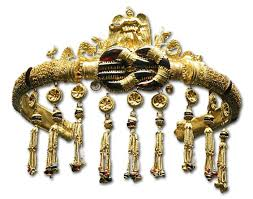
Ancient Greek jewelry was a fusion of unparalleled craftsmanship and deep symbolic meaning. It functioned as both an aesthetic adornment and a manifestation of the wearer's status, piety, and protection. Greek goldsmiths were masters of their craft, utilizing techniques that remain difficult to replicate even today, such as filigree (the use of delicate metal threads) and granulation (the application of tiny metal spheres).
Here are the most common and popular forms of jewelry in ancient Greece:
I. Diadems and Circlets
The diadem was perhaps the most prestigious form of head ornament, signaling status and divine favor.
Design: Often crafted from thin sheets of gold, these headpieces frequently featured intricate botanical motifs like laurel or myrtle leaves, which were sacred to gods such as Apollo and Aphrodite.
Symbolism: Wearing a diadem was often associated with royalty, victory in contests, or participation in religious rites. It framed the face and elevated the wearer's stature, literally and figuratively.
II. Earrings
Earrings were an essential part of a woman's ensemble, often designed to be eye-catching and intricate.
Styles: A very popular form was the "pendant earring," which featured dangling elements such as small gold figurines of Erotes (winged figures associated with love), sirens, or geometric shapes.
Technique: Goldsmiths used fine wires to create delicate, airy designs that moved with the wearer. The use of gemstones and glass inlay became more common in the Hellenistic period, adding color to the traditional gold.
III. Necklaces and Pendants
Necklaces ranged from simple gold chains to elaborate, multi-layered masterpieces.
Chain-and-Pendant: A classic design consisted of a fine gold chain from which hung a series of decorative pendants—often shaped like acorns, amphorae, or animal heads.
Beaded Necklaces: Many necklaces incorporated semiprecious stones like garnet, carnelian, or rock crystal, often interspersed with gold beads or spacers. These were prized not just for beauty, but often for their perceived protective or curative properties.
IV. Bracelets and Armlets
Greeks wore bracelets on their wrists and often higher up on the upper arm, known as armlets.
Spiral Designs: One of the most iconic forms was the "snake bracelet"—a spiraling design that coiled around the arm multiple times, often with the head and tail of the snake rendered in stunning detail.
Significance: Serpents held complex meanings in Greek culture, ranging from fertility and rejuvenation to protection, making these bracelets highly significant personal items.
V. Pins and Fibulae
While these were technically functional—used to fasten garments like the chiton or peplos—they were also essential decorative pieces.
The Fibula: This was the ancient equivalent of a safety pin. It consisted of a pin, a catch, and a decorative bow or plate.
Artistry: These plates were often intricately engraved or embossed with mythological scenes, floral patterns, or animal motifs. A well-crafted fibula was a mark of refinement, as it was a prominent, visible part of daily dress.
VI. Finger Rings
Rings were worn by both men and women and served various roles.
Signet Rings: Often made of gold or engraved stone, these were used to press wax seals onto documents, serving as a personal signature or mark of identity.
Decorative Rings: These featured elaborate settings with stones or detailed metalwork. They were often given as tokens of affection or worn to showcase family wealth.
The jewelry of ancient Greece was never just "bling." It was deeply integrated into the culture’s obsession with beauty and its need to communicate identity. The techniques developed during this time—such as granulation and filigree—are still considered the gold standard for goldsmiths today.