The art of pottery in ancient Greece was a sophisticated marriage of chemistry, engineering, and storytelling. It was far more than just a craft; it was the primary "canvas" for Greek culture, serving as an essential part of daily life while also recording the myths, rituals, and social habits of the time.
I. The Making: From Clay to Kiln
The creation of Greek pottery was a multi-stage industrial process often carried out in specialized family-run workshops.
Preparation: Raw clay was purified through "levigation"—mixing it with water in large basins so that impurities (like rocks or twigs) could be removed as they sank or floated. The remaining fine clay was then "wedged" to remove air bubbles and improve its consistency.
Shaping:
Throwing: Most fine pottery was "thrown" on a potter’s wheel. Larger vessels, which were too heavy to form at once, were often thrown in sections and joined together once they reached a "leather-hard" state.
Hand-Building: Coarser items, like large storage jars or simple kitchenware, were often built by hand using coils or pinching techniques.
Firing: This was the most technical aspect. Greek potters used a complex three-stage firing cycle in wood-fired kilns:
Oxidizing: Air was allowed into the kiln, turning the iron-rich clay a warm, reddish-orange.
Reducing: The vents were closed and moisture (like green wood) was added to create carbon monoxide, which turned the entire vessel black.
Re-oxidizing: Air was let back in. The parts painted with "slip" (a fine-particle clay "paint") had already been vitrified (fused) during the reducing stage, so they stayed black, while the rest of the pot turned back to its characteristic reddish-orange.
II. Decorative Techniques
The Greeks evolved their painting styles over centuries, moving from simple geometric patterns to incredibly detailed human narratives.
Black-Figure (c. 620–480 BCE): Figures were painted as black silhouettes on the red clay background. Artists then used sharp tools to "incise" (scratch) fine details like eyes, muscles, and clothing into the black paint, revealing the lighter clay underneath.
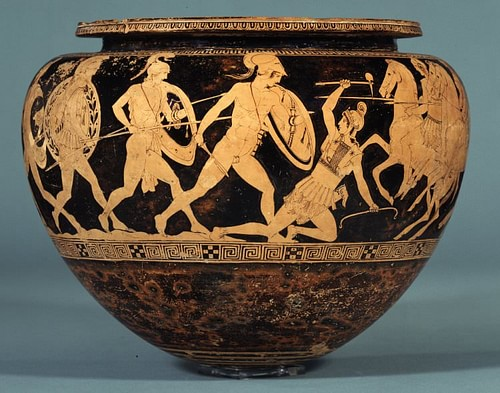
Red-Figure (c. 530 BCE onwards): This was the "reverse" of black-figure. The background was painted black, leaving the figures the natural color of the clay. This allowed artists to use a brush to paint details—like facial expressions and folds in fabric—rather than scratching them in, resulting in much greater realism and anatomical accuracy.
White-Ground: Used primarily for funeral vases (lekythoi), this involved painting on a white chalky slip. It allowed for a wide range of colors but was very delicate, as the colors were applied after firing and didn't last as long as the vitrified black-and-red slips.
III. Daily Utility and "Social" Use
Because these vessels were not behind glass, they were the "crockery" of the ancient world. They were designed for interaction and movement.
Storage and Transport: The amphora was the "all-purpose jar," used to store and transport the staples of Greek life: olive oil, wine, and grain.
Social Rituals: Vessels were specifically designed for the symposion (the formal drinking party). The krater was a large bowl used to mix wine with water (drinking it straight was considered "barbaric"), while the kylix—a wide, shallow drinking cup—featured internal designs that were slowly revealed to the user as they finished their wine, a playful "secret" for the drinker.
The "Canvas" of Life: Because so little ancient Greek wall painting survived, these pots are our primary window into their world. They depict everything from the mundane (market scenes, cooking, laundry) to the monumental (Homeric battles, religious processions, and the unruly parties of Dionysus).
Ultimately, Greek pottery was designed to be handled. When a person tilted a kylix to take a sip, the painted figures on the side moved and disappeared, turning the vessel into a piece of "living" art. It bridged the gap between a simple household tool and a prestige object, proving that even the most common items could be a medium for high culture and personal expression.