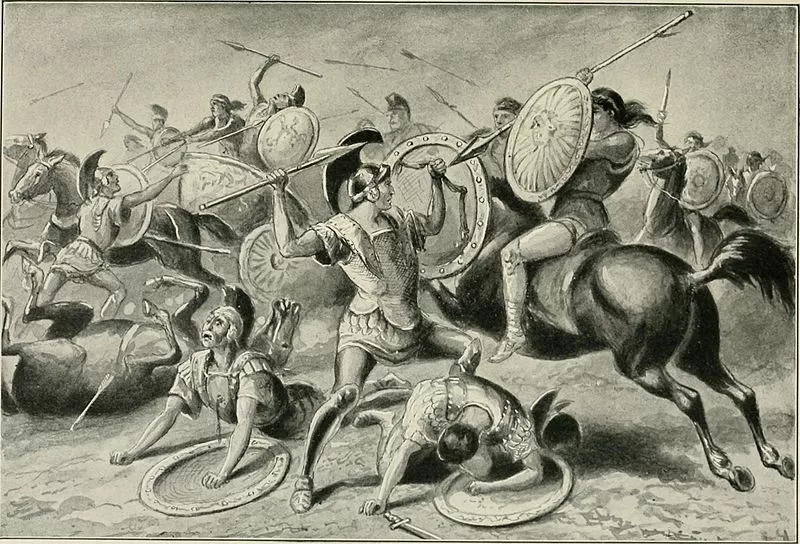
The Battle of Leuctra (371 BCE) is one of the most significant tactical milestones in the history of warfare. It marked the definitive end of the "Spartan Mirage"—the myth of Spartan invincibility on land—and established Thebes as the new superpower of Greece.
More importantly, it proved that creative thinking and tactical innovation could overcome centuries of rigid military tradition.
1. The Context: The Breaking Point
Following the King's Peace, Sparta had become increasingly aggressive in enforcing its will. In 371 BCE, a Spartan army led by King Cleombrotus I marched into Boeotia to force Thebes to dismantle its regional alliance.
The two armies met on the small plain of Leuctra. On paper, the Spartans were the clear favorites; they had never lost a major pitched battle when their full phalanx was present.
2. Epaminondas and the "Oblique Order"
The Theban general Epaminondas knew that a traditional head-to-head clash would result in a Spartan victory. He introduced three revolutionary tactical changes that would later influence commanders like Alexander the Great and Napoleon.
A. Massing the Left Wing
In a traditional Greek battle, both sides placed their strongest troops on the right wing (the "position of honor"). Epaminondas did the opposite. He placed his elite Sacred Band and his best troops on the left, directly opposite King Cleombrotus and the Spartan elite.
B. Depth over Breadth
A standard phalanx was usually 8 to 12 ranks deep. Epaminondas massed his left wing 50 ranks deep. This created a literal "human hammer" designed to crush the Spartan line through sheer weight and momentum before the rest of the army could react.
C. The Echelon (Oblique) Advance
Epaminondas refused his center and right wings, holding them back in a staggered formation. This meant that the Spartan allies on the other side of the field were effectively "out of the fight" while the decisive blow was being struck against the Spartan core.
3. The Sacred Band: The Heart of the Hammer
Leading the charge was the Sacred Band of Thebes, an elite unit of 300 hoplites composed of 150 pairs of male lovers. Their commander, Pelopidas, launched a lightning-fast strike against the Spartan king just as the main phalanxes were about to lock shields.
The logic behind the Sacred Band was that men would fight more fiercely to protect and impress their partners. At Leuctra, their cohesion and ferocity were the "tip of the spear" that pierced the Spartan line.
4. The Moment of Collapse
The Spartan line, though disciplined, could not withstand the 50-rank-deep Theban column.
The Death of the King: Cleombrotus was mortally wounded early in the fighting. In Spartan culture, losing a king in battle was a catastrophic blow to morale.
The Break: Once the Spartan elite on the right wing collapsed, the rest of their allies—who were already lukewarm about fighting for Sparta—simply fled the field without engaging.
The Toll: Over 400 of the 700 full Spartan citizens (Spartiates) present were killed. For a city already suffering from a shrinking population, this was a demographic death blow from which they never recovered.
5. The Aftermath: The Liberation of Messenia
Epaminondas didn't just win a battle; he dismantled the Spartan system. Following the victory, he marched into the Peloponnese and liberated Messenia, the region where the Spartans kept their Helot slaves.
Loss of the Workforce: By freeing the Helots and building the city of Messene, Epaminondas stripped Sparta of the slave labor that allowed them to be full-time soldiers.
The Theban Hegemony: For the next decade, Thebes was the dominant power in Greece, a period known as the Theban Hegemony.
6. The Legacy of Leuctra
The Battle of Leuctra is a masterclass in concentration of force. It taught the world that you don't need a larger army to win; you only need to be stronger at the decisive point of the battle.
A young hostage living in Thebes at this time watched these tactics closely. His name was Philip of Macedon. He would later take Epaminondas' ide