The story of Icarus and Daedalus is perhaps the most enduring allegory for the dangers of hubris—the overbearing pride or presumption that leads a person to ignore the limits of human capability and the warnings of the wise.
While often viewed as a simple "don't fly too high" moral, the myth is a complex study of the intersection between human genius, fatherhood, and the tragic consequences of losing one's grounding.
1. The Architect and the Labyrinth
Before the flight, the story begins with Daedalus, the greatest inventor of the ancient world. He was imprisoned on the island of Crete by King Minos to ensure the secrets of the Labyrinth—which Daedalus himself had designed to house the Minotaur—would never be revealed.
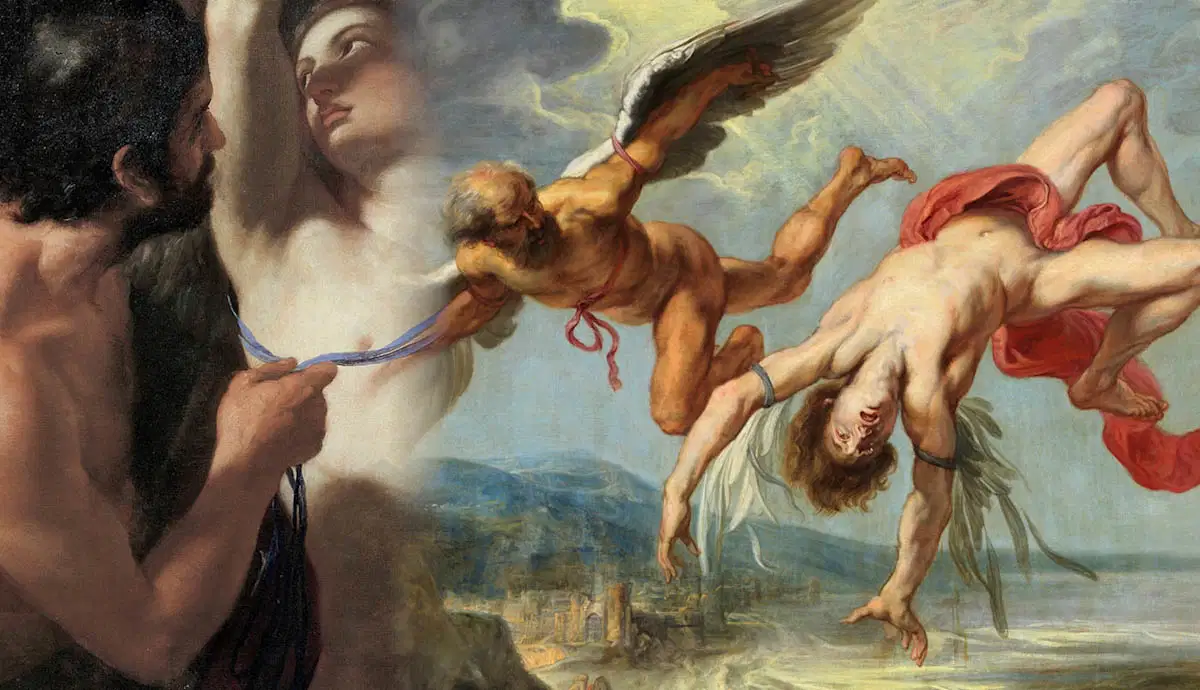
The Ingenious Escape: Realizing that the land and sea were guarded, Daedalus turned his mind to the only open path: the sky. He fashioned two pairs of wings using bird feathers, meticulously arranged and secured with thread and beeswax.
The Golden Mean: Before taking flight, Daedalus gave his son Icarus a crucial warning. He told him to fly the middle course.
Too Low: The dampness of the sea would soak the feathers and make them too heavy to flap.
Too High: The heat of the sun would melt the wax holding the wings together.
2. The Flight and the "Icarus Complex"
As they took to the air, the sensation of flight—something previously reserved only for the gods—overwhelmed the young Icarus.
The Thrill of Transcendence: Initially, Icarus followed his father. But as the exhilaration of soaring took hold, he began to feel a sense of divine power. He ignored his father's "middle course" and began to climb higher and higher, driven by a desire to reach the heavens.
The Physical Collapse: Just as Daedalus warned, the sun's heat softened the wax. The feathers began to detach one by one. Icarus flailed his arms, but with no plumage to catch the air, he plummeted into the sea—now known as the Icarian Sea—and drowned.
3. Hubris vs. Sophrosyne
In Greek culture, the myth was a lesson in Sophrosyne—the concept of temperance, moderation, and self-knowledge.
Defying the Gods: By flying too high, Icarus was seen as challenging the natural order. In the Greek worldview, for a mortal to act like a god (metaphorically or literally) invited Nemesis (divine retribution).
The Failure of Mentorship: The tragedy also reflects on Daedalus. As a master of techne (technical skill), he provided the means for flight but could not provide the wisdom (phronesis) to use it safely. His "superior" invention became the instrument of his greatest grief.
4. Artistic and Philosophical Interpretations
The myth has been a staple of Western art, most notably in Pieter Bruegel the Elder’s painting, Landscape with the Fall of Icarus.
The Indifference of the World: In Bruegel’s interpretation, Icarus is a tiny pair of legs disappearing into the water in the corner of the frame. The plowman, the shepherd, and the merchant continue their work, oblivious to the "epic" tragedy. This highlights a cynical truth: hubris often ends in a lonely, unnoticed failure.
The Romantic Counter-View: While the Greeks saw it as a warning, some Romantic-era poets viewed Icarus as a hero. They argued it was better to die having reached for the sun than to live a safe, "middle-course" life of mediocrity.
5. The Modern Context: Technological Hubris
Today, the "Icarus" label is frequently applied to pioneers who push technology too far without considering the safety or ethical guardrails. Whether in AI development, genetic engineering, or space exploration, the myth serves as a reminder that the brilliance of the "wings" doesn't exempt the "flyer" from the laws of nature.
The myth of Icarus suggests that human potential is limitless, but human nature is fragile. The wax that holds us together is often softer than we care to admit when we are blinded by the light of our own success.