For the Ancient Greeks, the transition from the world of the living to the realm of Hades was a journey that required meticulous ritual. Failure to provide a proper burial was considered a profound religious crime, as an unburied soul was condemned to wander the banks of the River Styx, forever denied peace.
Greek burial customs, known as the Kedeia, followed a strict three-part "Old Style" process that remained remarkably consistent for centuries.
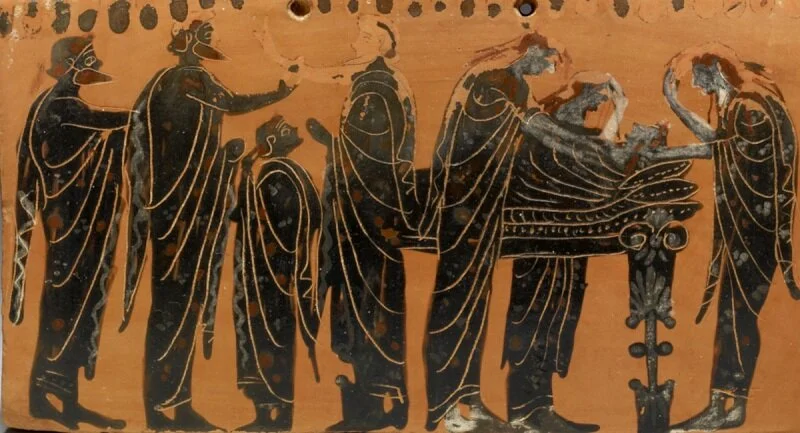
1. The Prothesis: Laying Out the Body
The first stage took place within the home and was primarily the responsibility of the women in the family.
Preparation: The eyes and mouth were closed. The body was washed, anointed with fragrant oils (such as myrrh), and dressed in a white shroud.
The "Obol": A small coin, the obol, was often placed in the mouth of the deceased. This was the "fare" for Charon, the ferryman of the underworld.
The Wake: The body was laid out on a high bed (kline). Female relatives stood around the deceased, performing ritual lamentations—singing dirges, tearing their hair, and scratching their cheeks as a visible sign of grief.
2. The Ekphora: The Funeral Procession
Before dawn on the third day, the body was moved from the house to the cemetery.
The Path: The deceased was carried on a wagon or by pallbearers. This public procession, the ekphora, allowed the community to witness the transition.
The Participants: Men walked in front of the bier, while women walked behind. Flute players often accompanied the group, providing a somber soundtrack to the march.
3. Interment: Cremation vs. Inhumation
The Greeks practiced both burial (inhumation) and cremation, often depending on the era and local tradition.
Cremation: The body was placed on a pyre. Once consumed by fire, the bones were quenched with wine, collected, and placed in a bronze or ceramic urn.
Inhumation: The body was placed in a stone sarcophagus or a simple wooden coffin.
Grave Goods: The deceased was buried with items they might need or cherished—pottery, jewelry, weapons, or toys for children. These "Old Style" offerings were intended to provide comfort in the afterlife.
4. The Kerameikos and Roadside Tombs
Cemeteries were strictly located outside the city walls for reasons of hygiene and religious purity.
Monuments: Wealthy families erected elaborate markers. Early styles included large vases (Lekythoi), while later periods featured Stele—upright stone slabs carved with high-relief scenes of the deceased, often depicted in a final, quiet moment of "parting" (dexiosis) with their family.
Location: Tombs were often placed along the main roads leading into the city, ensuring that the living would pass by and remember the names of the dead.
5. Ritual Purification and the Perideipnon
After the burial, the "pollution" of death had to be cleansed from the household.
The Feast: The family returned to the house for the Perideipnon, a funeral banquet. This was the first time the family ate together after the death, serving as a symbolic return to the world of the living.
Ongoing Remembrance: The ritual didn't end at the grave. Families returned to the tomb on the third, ninth, and thirtieth days after the burial, and annually thereafter, to leave offerings of cakes, honey, and libations of wine or milk.
6. The White Ground Lekythos
The most poignant archaeological evidence of these rituals comes from the White Ground Lekythos. These were specialized oil jars painted specifically for funerals. Unlike sturdy everyday pottery, their delicate white paint was fragile—designed for the quiet stillness of a tomb rather than the chaos of a kitchen. They often depict Hermes leading a soul toward Charon’s boat, bridging the gap between archaeology and ancient belief.