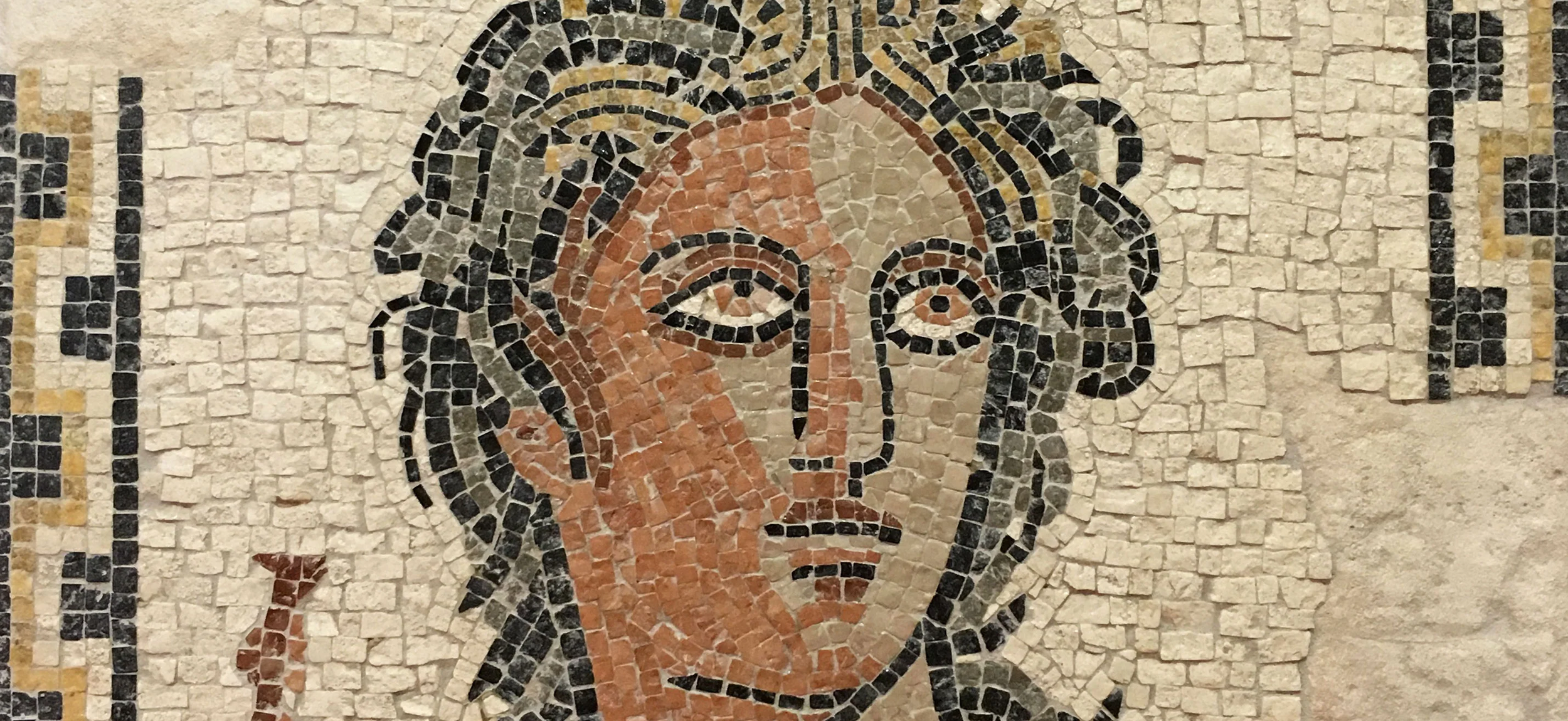
The Greek art of mosaic making was a journey from "Old Style" simplicity to breathtaking technical complexity. While we often associate mosaics with the Romans, it was the Greeks who pioneered the techniques—moving from the use of raw, natural pebbles to the invention of precision-cut tiles (tesserae) that allowed for a "painterly" style in stone.
1. Pebble Mosaics: The Natural Beginning
The earliest Greek mosaics (8th–4th century BC) did not use cut stones. Instead, artists collected smooth, water-worn pebbles from beaches and riverbanks.
The Palette: These were limited to natural colors—mostly black, white, and occasionally red or yellow.
Technique: Pebbles were set into a thick bed of lime mortar. To create fine lines, artists would sometimes use thin strips of lead or terracotta to outline figures.
Notable Sites: The city of Pella, the capital of the Macedonian Empire, contains the most famous examples, such as the Lion Hunt mosaic, which uses shades of grey and white to create a sense of 3D musculature.
2. The Revolution: Opus Tessellatum
In the 3rd century BC, a technological shift occurred. Artists began hand-cutting stones into small, uniform cubes called tesserae.
The Benefit: Unlike rounded pebbles, square tesserae could be fitted tightly together with almost no visible mortar. This allowed for much more detailed and flat surfaces.
Material Variety: In addition to marble and limestone, Greeks began using colored glass paste and even semi-precious stones to expand their color palette.
3. Opus Vermiculatum: "Worm-Like" Detail
The pinnacle of Greek mosaic art was Opus Vermiculatum. This technique used incredibly tiny tesserae (some only 1–2 millimeters in size) to create curved lines and delicate shading.
The Emblema: Artists would often create a highly detailed central masterpiece, called an emblema, in a workshop on a portable tray. This would then be transported to a home and "plugged" into a larger, simpler geometric floor pattern.
Visual Effect: This style allowed for "shadowing" (skiagraphia), making the mosaics look like high-end paintings. The famous Alexander Mosaic (though found in Pompeii) is believed to be a copy of a 4th-century BC Greek painting executed in this hyper-detailed style.
4. The Laying Process: A Multilayered Foundation
A Greek mosaic was only as good as the floor beneath it. To prevent cracking over time, the "Old Style" of preparation involved several layers:
Statumen: A base layer of large, fist-sized stones.
Rudus: A thick layer of rubble and lime rammed down hard.
Nucleus: A finer layer of crushed pottery and lime.
Setting Bed: A very thin layer of fine plaster where the artist would sometimes "sketch" the design before pressing the stones in.
5. Themes and Symbolism
Greek mosaics were rarely just decorative; they reflected the owner's status and the function of the room.
The Andron: The men's dining room usually featured the finest mosaics. Themes often included Dionysus (the god of wine), griffins, or theatrical masks to set the mood for a symposium.
Threshold Protection: Mosaics at the entrance of a house often featured "Apotropaic" symbols—like the "Evil Eye" or a fierce dog—intended to ward off bad luck.
6. The Delos Masterpieces
By the 2nd century BC, the island of Delos became the world center for mosaic production. The houses there, such as the House of the Dolphins and the House of Dionysus, show the transition into the Roman era. Here, we see the use of "trompe l’oeil" (trick of the eye) techniques, where 2D floors were made to look like 3D cubes or deep basins, showcasing the Greek mastery of geometry and perspective.