Introduction: The Ultimate Destiny of Asia
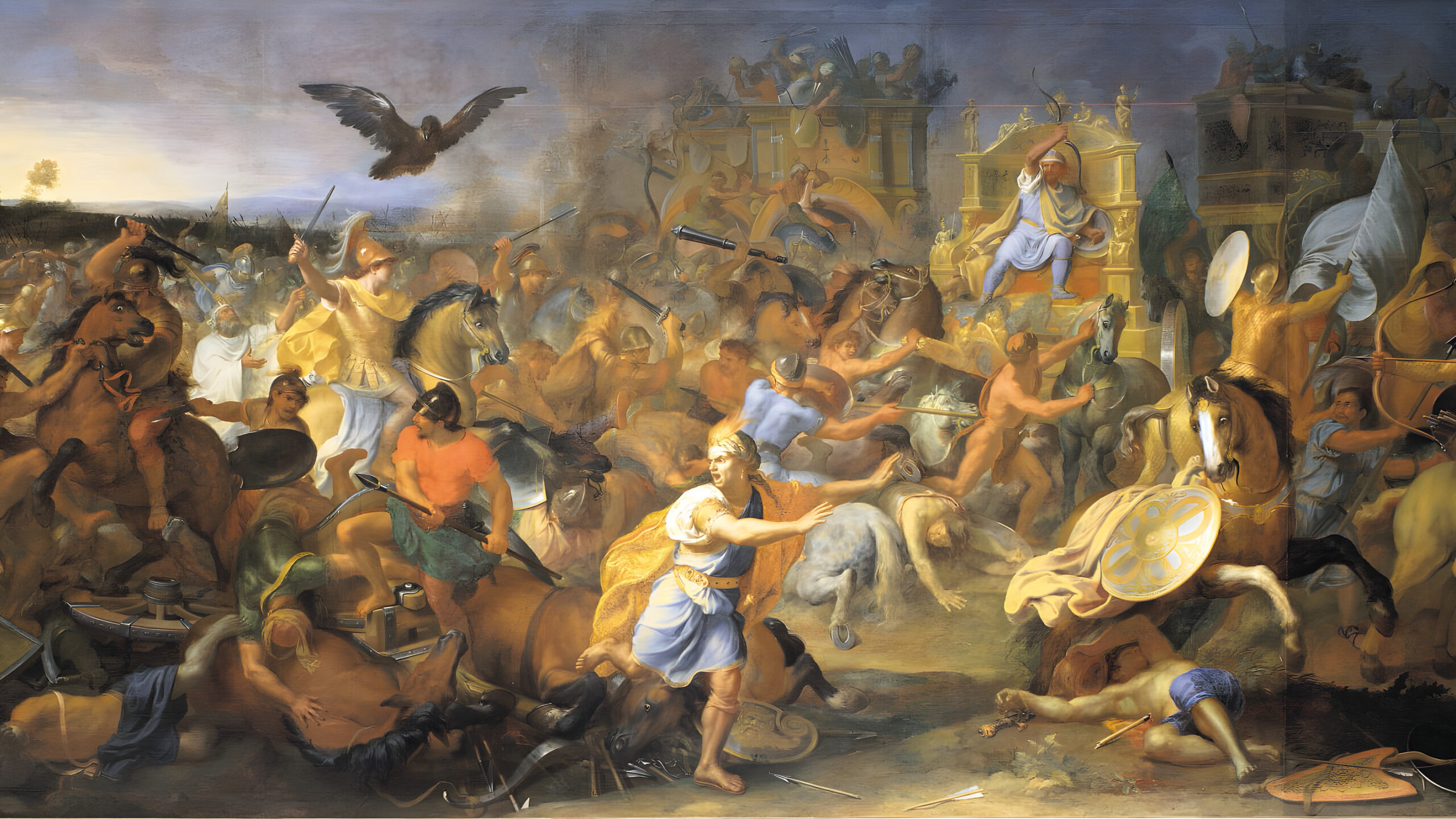
In October of 331 BC, the fate of the ancient world was decided on a dusty, wide-open plain in modern-day northern Iraq. This was the Battle of Gaugamela (often called the Battle of Arbela), the definitive, terminal clash between Alexander the Great of Macedon and Darius III, the Great King of Persia.
Two years prior, Alexander had humiliated Darius at Issus. But at Issus, the narrow terrain had choked the Persian numbers. For this final showdown, Darius took no chances. He selected Gaugamela precisely because its vast, flat horizon allowed him to deploy his entire multi-national imperial host—an army that outnumbered Alexander’s forces at least five to one. Darius even went so far as to systematically level the terrain, removing trees, rocks, and ditches to create a smooth, unobstructed canvas for his deadliest secret weapons: scythed chariots and war elephants.
Alexander was facing a strategic nightmare: a massive, sprawling line that would easily overlap and encircle his smaller army. Yet, through a masterpiece of innovative battlefield geometry, deceptive maneuvering, and a calculated tactical gamble, Alexander baited the Persian line into breaking its own center, opening a path for a devastating strike straight at the Great King.
1. The Tactical Chessboard: Opposing Formations
Darius’s Imperial Host
Darius deployed his massive army in a sprawling, multi-tiered line designed to completely wrap around the Macedonian forces.
The Front Line: Stationed at the very front were the 200 scythed chariots—heavy wooden carts featuring three-foot steel blades projecting horizontally from the wheel hubs, engineered to literally slice through human flesh and bone. Alongside them stood a small contingent of Indian war elephants.
The Left Flank: Comanded by the brilliant satrap Bessus, this wing was packed with thousands of heavily armored Bactrian and Scythian horsemen, tasked with executing a massive sweeping envelopment around Alexander's right side.
The Center: Darius sat in a towering royal chariot, surrounded by his elite Royal Guard (the Immortals) and hardened Greek mercenaries.
Alexander’s Innovative Box
To counter the certainty of being surrounded, Alexander rejected traditional linear deployment and engineered a revolutionary staggered, defensive box formation.
          [ Persian Sprawling Front Line ]

  ◄ [Cavalry Flank]  [ Main Macedonian Phalanx ]  [Cavalry Flank] ►
  (Angled Backward)        (Heavy Sarissas)        (Angled Backward)

                    [ Second Reserve Phalanx ]
                    (Facing to the Rear/Flanks)
He placed his primary heavy infantry phalanx in the center, but flanked them with auxiliary infantry and cavalry angled sharply backward at 45-degree angles. Behind the main phalanx, he stationed a complete second reserve phalanx with orders to instantly face backward if the enemy managed to loop behind them. This transformed the Macedonian army into a flexible, hollow rectangular fortress capable of fighting effectively in all 360 degrees.
2. The Opening Move: The Diagonal March
The battle began with a highly unusual, deceptive maneuver that completely disrupted Darius’s pre-leveled battlefield strategy.
Instead of advancing straight ahead across the smooth ground Darius had prepared for his chariots, Alexander ordered his entire army to shift dynamically to the right, marching diagonally across the field.
This diagonal movement threw the Persian line into a panic. If Alexander kept moving right, he would slide entirely off the leveled ground, rendering the scythed chariots useless. Terrified of losing his tactical advantage, Darius ordered Bessus’s massed Bactrian and Scythian cavalry on his extreme left to sprint outward parallel to the Greeks, attempting to block Alexander's path and ride around his flank.
3. Neutralizing the Scythed Chariots
Seeing his left wing engaged in a running parallel race, Darius unleashed his primary terror weapon: the 200 scythed chariots. They charged across the dust, the blades spinning at high speeds, aimed directly at the heart of the Macedonian phalanx.
However, Alexander had anticipated this threat and had thoroughly briefed his light infantry skirmishers (the Agrianian javelin-throwers).
The Softening Volley: As the chariots roared forward, the Agrianians ran out in front of the line, unleashing a devastating storm of javelins and arrows that targeted the horses and drivers rather than the armored carts.
The "Mouse Trap" Maneuver: For the remaining chariots that made it through the missile volley, Alexander executed a brilliant, disciplined drill. On a trumpet signal, the heavy phalanx soldiers did not panic; instead, they stepped aside, opening up wide, pre-planned vertical lanes within their formation.
The Safe Funnel: The chariot horses, naturally choosing the path of least resistance, galloped harmlessly down these open corridors without striking a single shield. Once funneled inside the lanes, the chariots were easily surrounded, their drivers pulled to the ground, and the units systematically neutralized by Alexander’s rear attendants.
4. The Surgical Strike: The Wedge at the Center
The defining turning point of Gaugamela occurred because of the running cavalry race on the right flank. As Bessus’s Persian cavalry kept shifting further and further to their left to match Alexander's diagonal march, they began to outrun their own infantry support.
Because the Persian left wing was moving left while Darius’s center remained stationary, a localized, physical gap opened up in the Persian line just to the left of Darius’s royal chariot.
Alexander had been waiting for this exact structural fracture. He immediately halted his diagonal march, wheeled his elite Companion Cavalry (Hetairoi) around, and formed them into a tight, massive, aggressive cavalry wedge. Backed by four regiments of the heavy phalanx bristling with 18-foot sarissa pikes, Alexander drove the wedge directly into the open seam.
The momentum of this heavy horse-and-pike wedge was catastrophic. They broke through the inner security perimeter, trampling Darius's royal bodyguards. The long Macedonian pikes poked directly at the faces of the Persian drivers and horses. Blinded by choking clouds of white dust and realizing his defensive line had been completely pierced, Darius panicked. When his personal chariot driver was speared to death, Darius leaped onto a fresh mare and fled the field for the second time in his career, triggering an immediate morale collapse across the Persian center.
5. The Left Flank Crisis: Parmenio’s Stand
While Alexander was hunting Darius, the Macedonian army came perilously close to total destruction on the opposite side of the field.
The Left Flank Collapse: Because Alexander had taken the bulk of the cavalry to execute his center strike, his left flank—commanded by the steady, aging general Parmenio—was completely overwhelmed. The Persian right wing, led by Mazaeus, had successfully enveloped Parmenio’s lines, cutting them off and slaughtering his horses.
The Subterranean Penetration: Simultaneously, a massive gap had opened up in the Macedonian center during the rapid advance of the wedge. A large contingent of Persian and Indian cavalry surged straight through this hole, riding deep into the Macedonian rear to raid the baggage train and rescue Darius’s captured mother and children.
The Urgent Recall: Facing total annihilation, Parmenio managed to send a desperate courier galloping after Alexander, shouting that the left wing was collapsing and the battle would be lost if he did not return. Alexander was forced to abandon his personal pursuit of the fleeing Darius, wheel his Companion Cavalry around, and ride back into the center of his own lines to clear out the invading Persian cavalry in a brutal, close-quarters melee.