Introduction: The Industrialization of the Siege
For much of the Classical Era, Greek city-states were remarkably inept at capturing fortified cities. If a city possessed competent stone walls, like Athens or Byzantium, the standard military approach was simply to surround it and wait years for starvation or betrayal to do the work. Traditional hoplite warfare lacked the kinetic power to breach heavy masonry, and early attempts at siege craft relied on primitive battering rams or scaling ladders.
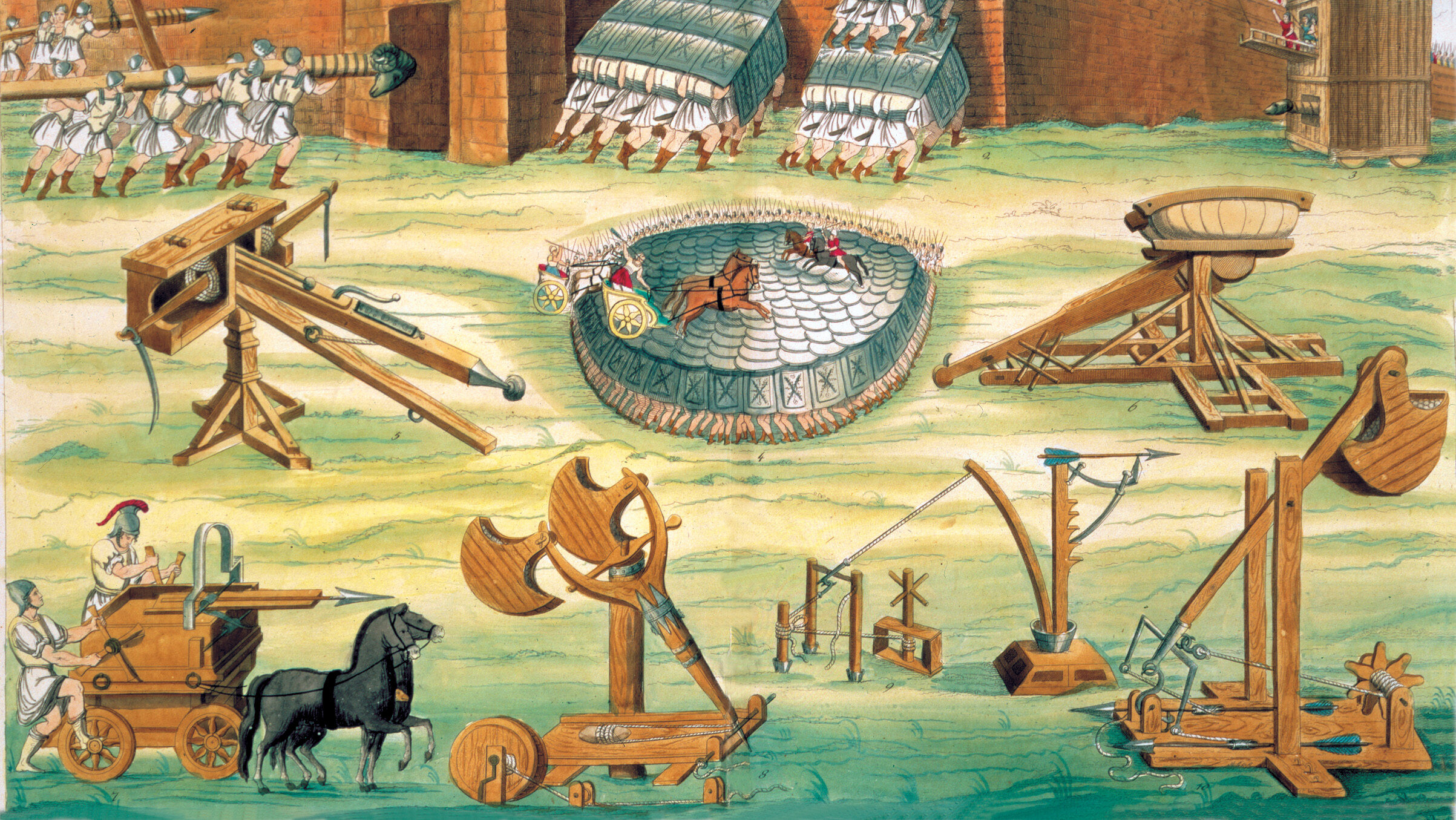
This strategic paralysis was shattered in the 4th century BC by the state-sponsored military laboratories of Philip II of Macedon and the tyrants of Syracuse. Through the systematic application of mathematics, physics, and engineering, the Greeks revolutionized warfare by inventing torsion artillery and monumental siege engines. This development shifted siege craft (poliorketika) from a crude trial of patience into an industrial science, transforming the stone walls of the Mediterranean from impenetrable barriers into temporary obstacles.
1. The Technological Evolution: From Bow to Torsion
The trajectory of Greek artillery moved from simple mechanical tension to the far more powerful physics of torsion.
The Gastraphetes (The Belly-Bow)
Invented around 400 BC in Syracuse under the tyrant Dionysius I, the gastraphetes was the ancestor of the crossbow. It utilized a composite bow made of wood, horn, and sinew. To cock it, a soldier rested his stomach against a curved pad at the rear of the stock and used his full body weight to push a slide forward, pulling back a heavy bowstring. While highly accurate and possessing greater range than a standard hand-bow, its power was strictly limited by the physical flexibility of the wooden bow arms.
The Torsion Revolution: The Katapeltes and Ballista
Around 350 BC, Macedonian engineers discovered that they could bypass the limits of traditional wood by utilizing torsion springs. Instead of bending a flexible bow, they built rigid wooden frames housing vertical tightly twisted bundles (skeins) of organic cordage—specifically made from animal sinew or human hair (which possessed ideal elasticity and tensile strength). Rigid wooden levers were inserted into these twisted skeins. When pulled back by a winch, the twisting tension stored immense potential energy.
[ Twisted Sinew Skein ] ◄── [ Rigid Wooden Lever Arm ] ◄── [ Winch Rope pulled back ]
This mechanical breakthrough birthed two standardized artillery variants:
The Oxybeles / Katapelta: Torsion engines engineered to shoot long, heavy wooden bolts or arrows at a flat trajectory with terrifying velocity, designed primarily to pierce enemy shields and armor on the ramparts.
The Lithobolos / Ballista: Massive, two-armed engines calibrated using complex mathematical cube-root formulas to launch heavy spherical stones weighing anywhere from 10 to 180 pounds ($~4\text{ to }80\text{ kg}$). These stones were hurled at a high arc to smash through roofs, shatter wooden palisades, and systematically crack stone defensive towers.
2. The Great Titans: Monumental Mobile Siege Engines
Alongside artillery, Greek engineers constructed massive, mobile wooden superstructures designed to directly assault enemy walls while protecting the soldiers operating them.
The Helepolis (The Taker of Cities)
The absolute pinnacle of Hellenistic engineering was realized by Epimachus of Athens for Demetrius Poliorcetes during the epic Siege of Rhodes (305 BC) with the construction of the Helepolis. This was a colossal, nine-story mobile siege tower that stood over 130 feet ($40\text{ meters}$) tall and 65 feet wide, weighing roughly 160 tons.
The machine was entirely clad in iron plates to protect it from incendiary arrows, featured internal water tanks to extinguish fires, and was mounted on eight massive wheels. Every story housed specialized combat crews: the lower levels contained heavy stone-throwing ballistas to smash the walls, the middle levels contained high-velocity arrow-projectors to clear the ramparts, and the top levels featured drop-down boarding bridges (epibathrai) allowing shock infantry to storm straight onto the enemy battlements. It required over 3,400 men working in shifts to manually push the structure forward.
The Tortoise (Chelone)
To allow engineers to approach the base of an enemy wall safely to undermine the foundations or fill in defensive ditches, the Greeks invented the chelone (tortoise). These were heavily fortified, sloping wooden sheds mounted on wheels or rollers. Covered in raw hides, wet clay, or seaweed to neutralize fire arrows, these mobile bunkers sheltered crews of sappers as they dug underneath stone walls, causing entire defensive circuits to collapse under their own weight.
3. Tactical Integration: The Combined-Arms Siege
In actual combat operations, catapults and siege engines were deployed within a highly coordinated, multi-phased system designed to overwhelm a city's defenses simultaneously.
[ Long-Range Ballista Stone Barrage ] ──► [ Continuous Bolt-Thrower Fire ] ──► [ Sappers Advance in Tortoises ] ──► [ Siege Towers Drop Boarding Bridges ]
Phase 1: The Suppression Barrage: Long-range stone-throwers (lithoboloi) opened fire from a distance, targeting the crenellations, roofs, and defensive towers of the city. Their objective was to crush the defenders' own artillery platforms and destabilize the upper masonry.
Phase 2: Clearing the Ramparts: As the mobile towers (helepoleis) and tortoises advanced, rapid-fire bolt-throwers took over. They rained a continuous storm of heavy darts across the top of the walls, making it suicidal for enemy archers or citizens to look over the parapets to throw down rocks or boiling oil.
Phase 3: The Breach and Storm: With the defenders suppressed, the tortoises moved in to breach the gates with battering rams or collapse a section of the wall via mining. Simultaneously, the siege towers crawled up to the fractured line, dropped their bridges, and poured elite mercenary troops directly onto the battlements to secure a foothold.
4. Counter-Measures: The Defense Against the Machine
As offensive siege technology advanced, Greek architects engineered brilliant, highly reactive counter-strategies to save their cities from mechanical annihilation.
The Inventions of Archimedes: During the Siege of Syracuse (213–212 BC), the legendary mathematician Archimedes transformed the city's coastal walls into a lethal automated defense network against the invading Romans. He engineered variable-range torsion catapults that could target ships both at a distance and immediately beneath the walls. He also deployed the Claw of Archimedes—a massive crane fitted with a heavy iron grappling hook that swung out over the wall, hooked the bow of an invading warship, lifted it completely out of the water, and dropped it back down, causing it to capsize and flood.
The Mud Deflection: When facing heavy stone-throwing catapults, defenders inside a city would rapidly build secondary, crescent-shaped mudbrick walls behind the primary stone wall currently being targeted. Mudbrick was soft and elastic compared to rigid stone; when a massive catapult stone struck a mudbrick wall, the impact energy was harmlessly absorbed by the earth rather than shattering the structure, leaving the inner defense intact.
The Demolition Trench: To halt the terrifying advance of the Helepolis at Rhodes, the defensive architect Diognetus ordered his citizens to secretly channel the city's sewage and wastewater directly into the field in front of the advancing tower overnight. When the 160-ton machine rolled forward the next morning, it crashed straight into the hidden swamp, sinking deep into the mud and becoming completely stuck, rendering the ultimate terror weapon of the age entirely useless.