Introduction: Signaling Through the Chaos of the Phalanx
In the idealized imagination of classical Greece, battles were orderly affairs directed by the clear, piercing notes of a bronze trumpet or the steady rhythm of marching flutes. But the physical reality of a hoplite battlefield was a chaotic nightmare of suffocating dust clouds, clashing bronze, and deafening screams. Once two massive infantry walls collided in the othismos (the mutual pushing match), visibility dropped to near zero inside the enclosed eye-slits of Corinthian helmets.
In this sensory-deprived environment, verbal commands from a general were completely useless. To prevent their formations from fracturing into a blind, disorganized mob, Greek armies relied on an advanced visual communication infrastructure: battle standards (semeia) and flags. Far from being mere decorative symbols or empty pomp, these physical markers functioned as tactical beacons, navigation points, and psychological anchors, serving as the literal nervous system of the ancient Greek war machine.
1. The Typology of Greek Standards: From Objects to Cloth
Unlike the highly standardized, eagle-topped silver poles (aquilae) of the later Roman legions, classical Greek battle standards evolved through various material phases, adapting to the shifting tactical needs of the city-states.
The Rigid Aniconic Standards: The earliest Greek standards were often physical, three-dimensional objects mounted on long wooden spears. These could include polished bronze disks that caught the sunlight, carved wooden figures of patron animals, or simple bronze spheres. Their primary purpose was sheer height, designed to project above the forest of raised 8-foot spears (sarissas or dory) so that distant soldiers could orient themselves toward their unit's center.
The Phoenix and the Cloth Flags: As naval warfare and expansive land campaigns grew during the Peloponnesian War, the Greeks increasingly adopted cloth flags, known as phoinikides due to their brilliant crimson or purple dye. These flags could be raised or lowered dynamically from a central command post or flagship to signal complex, pre-arranged tactical commands across vast distances.
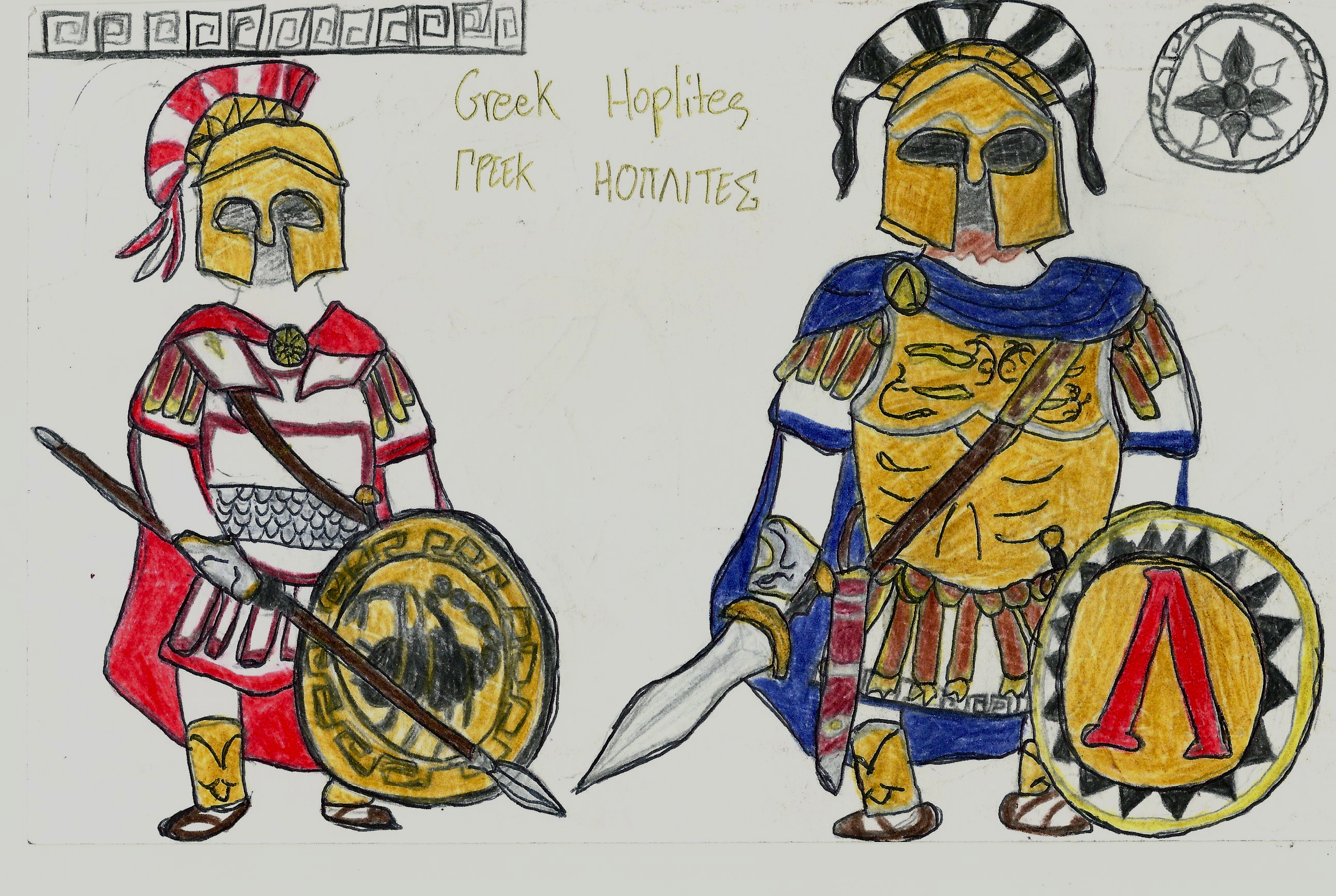
The Inscribed Shield Art: While not a standard on a pole, the episema—the distinct heraldic device painted on an individual hoplite’s shield—operated as a localized visual standard. In the 5th century BC, city-states standardized these designs. The Spartans painted the iconic inverted V-shape, the letter lambda ($\Lambda$), representing Lacedaemon. The Thebans used the club of Heracles, and the Athenians painted the owl of Athena. This allowed a soldier, in the blinding panic of a collapsing line, to instantly identify a friendly unit simply by glancing at the shields around him.
2. Tactical Functionality: The Visual Radio
In the hands of a dedicated officer, the battle standard operated as a visual radio, transmitting the strategic intent of the high command to thousands of moving men simultaneously.
The Command to Advance or Halt: When an army deployed into its final battle lines, the central standard of the commanding general remained lowered. The moment the standard was hoisted high into the air, it served as the universal, silent directive for the entire frontline phalanx to begin its forward march. Conversely, if the standard was dipped or waved frantically from side to side, it signaled an immediate halt or a shift into a defensive posture.
The Pivot Anchor: Executing a wheeling maneuver or a flank deployment with a rigid infantry block was incredibly dangerous; if the line separated, the formation was ruined. To execute these moves safely, the semeiophoros (the standard-bearer) acted as the physical pivot point. The entire unit would fix their eyes on his standard, adjusting their stride to match his speed, ensuring the geometric integrity of the shield wall remained unbroken during complex tactical evolutions.
The Rally Point in the Rout: If a phalanx was broken by a heavy cavalry charge or outflanked by skirmishers, the battle standard became the absolute threshold of survival. As long as the standard-bearer stood his ground and kept the flag flying, fleeing soldiers knew exactly where to converge to reform a desperate defensive circle. If the standard fell, it signaled to the surrounding troops that the command structure had been annihilated, frequently triggering a total, irreversible panic.
3. The Maritime Sphere: Flags on the Trireme
The importance of visual signaling was amplified exponentially in naval warfare, where fleets of 100 to 200 triremes were spread across miles of open, choppy water.
The Admiral’s Flagship: The supreme commander of an Athenian or Spartan fleet directed operations from a specialized flagship (strategis). This vessel was identifiable by an oversized, brilliant purple or scarlet cloth standard draped over the stern or mounted high on the main mast.
The Signal to Ram: During the approach phase of a naval engagement, the admiral monitored the enemy's shifting geometry. When he detected a fatal fracture or a gap in their line, he would order his crew to hoist a massive, gilded bronze shield or a specific flag to the top of the mast. This visual trigger was echoed down the line by subordinate captains, signaling the entire fleet to instantly drop their sails, maximize their rowing speed, and execute aggressive ramming maneuvers like the diekplous or periplus.
The Ambush at Cyzicus (410 BC): During the Peloponnesian War, the Athenian alcibiades utilized naval flags to execute a legendary trap against the Spartan fleet. He led a small vanguard of just 20 ships into open view, making them appear vulnerable. The Spartans immediately took the bait and pursued. The moment the Spartans were drawn far away from their coastal base, Alcibiades hoisted a pre-arranged signal flag on his mast. Hidden in the bays out of sight, two massive Athenian reserve squadrons saw the flag, surged out from their hiding spots, and completely encircled the Spartan fleet, scoring a catastrophic, bloodless victory.
4. Psychological and Religious Warfare
To the ancient Greeks, a battle standard was not merely a tool of military communication; it was a deeply sacred, religious object that carried the literal presence of the gods onto the field.
The Sacred Purification: Before an army marched out of the city gates, the battle standards underwent rigorous religious rituals and animal sacrifices (sphagia). They were anointed with sacred oils and blessed by state seers. To lose a standard to the enemy was not just a tactical disaster; it was an act of profound religious sacrilege that proved the gods had abandoned the city, inflicting a catastrophic moral wound on the population.
The Trophy Transformation (Tropaion): When a Greek army secured victory on the field, they did not immediately march home. Instead, they gathered at the exact geographic point where the enemy had broken rank and turned to flee—the trope (turning point). There, they constructed a tropaion (trophy). They took a wooden tree trunk, stripped its branches, and dressed it in the captured armor, shields, and battle standards of the defeated army. This monument stood as a permanent, physical testament to the psychological submission of the enemy, warning future travelers that the local soil was protected by the martial favor of the gods.