Introduction: The Martial Crucible of the Mediterranean
When the young Roman Republic began its expansion beyond the Italian peninsula in the 3rd century BC, it collided directly with the Hellenistic world—a sphere dominated by the military legacy of Philip II of Macedon and Alexander the Great. The Greeks had perfected a highly scientific, rigid form of warfare centered on the crushing weight of the sarissa-wielding phalanx. Rome, conversely, fielded the maniple system: a flexible, checkerboard infantry formation born out of gritty mountain warfare against the Samnites.
The encounter between these two contrasting military philosophies did not result in a simple replacement of one by the other. Instead, it triggered a centuries-long process of adaptation, assimilation, and tactical synthesis. Rome systematically hollowed out the core components of Greek military science—including siege mechanics, naval architecture, combined-arms doctrines, and strategic theory—and rebuilt them to serve the brutal efficiency of the Roman legions. By studying this cross-cultural military transmission, historians can trace how Rome used Greek intellectual blueprints to construct an unstoppable, global war machine.
1. The Tactical Clash: Legion vs. Phalanx
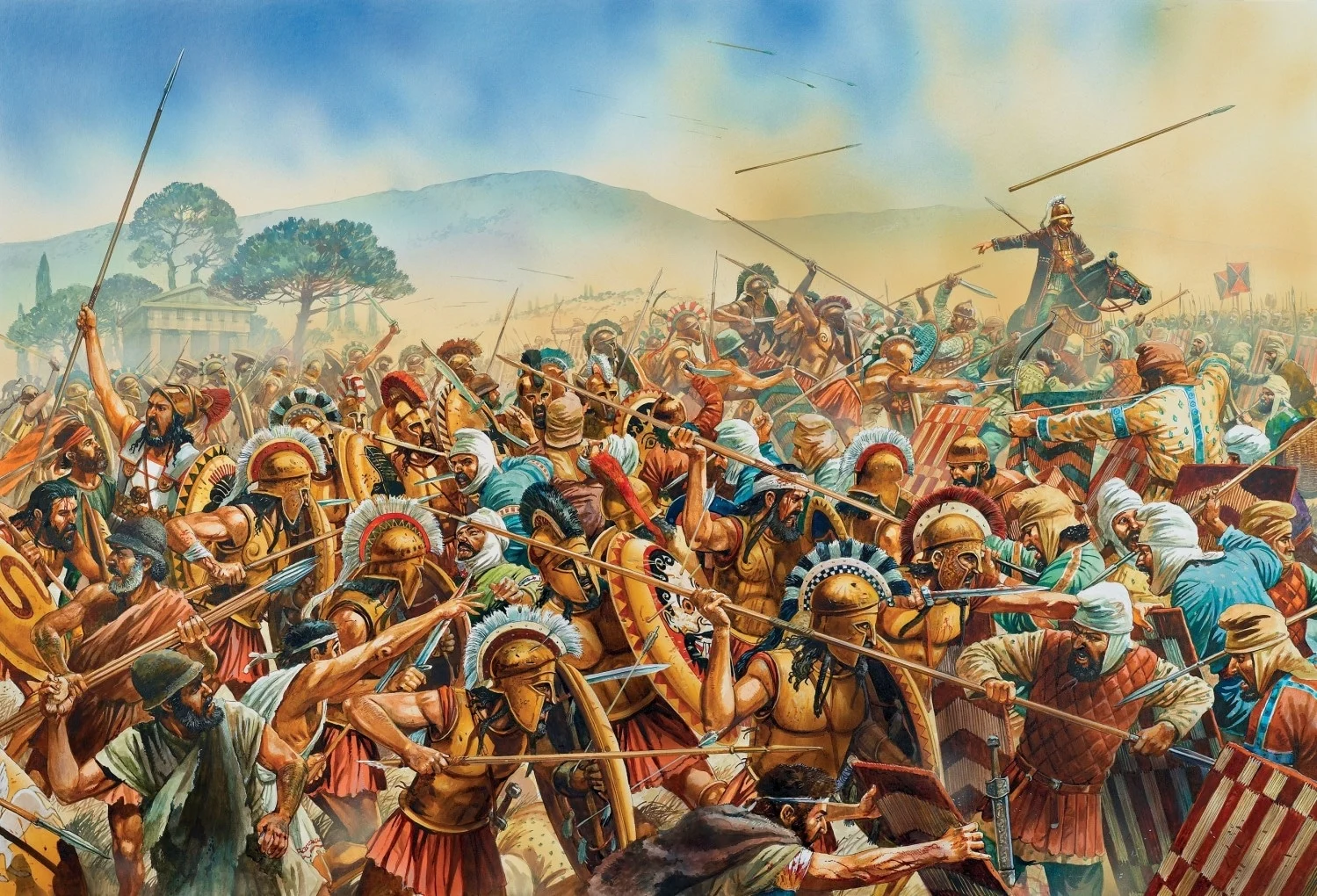
The definitive arena where Greek warfare impacted Rome was on the tactical battlefield, culminating in a series of terminal engagements like Cynoscephalae (197 BC) and Pydna (168 BC). These battles forced Roman commanders to deeply study the structural mechanics of the Macedonian phalanx to exploit its fatal vulnerabilities.
The Frontal Impenetrability: Roman generals quickly learned that a frontal assault against a locked Greek phalanx was suicidal. The 18-foot sarissa pikes created a literal wall of iron points that easily kept the shorter Roman swords (gladius) at bay.
The Vulnerability of Rough Terrain: However, Roman strategists observed that the phalanx required perfectly flat, unobstructed terrain to maintain its cohesion. If the phalanx marched over a ditch, a hill, or a stream, the line would naturally fracture, creating small gaps.
The Manipular Penetration: The Roman response was to weaponize flexibility. Unlike the monolithic Greek block, the Roman legion was divided into small, independent tactical units called maniples.
When the Greek phalanx fractured over uneven ground, Roman centurions did not wait for centralized orders; they autonomously directed their maniples to pivot and charge directly into the open seams. Once inside the pike line, the long Greek spears became useless encumbrances. The Romans, wielding heavy shields and lethal short swords, transformed the melee into a localized slaughter, teaching Rome the supreme value of decentralized tactical initiative over rigid geometric mass.
2. The Absorption of Hellenistic Siege Craft (Poliorketika)
Before their exposure to the Hellenistic world, Roman siege warfare was rudimentary, relying primarily on simple starvation blockades or basic battering rams. The Greeks, conversely, had turned siege craft into a highly advanced branch of mathematical engineering, pioneered by figures like Demetrius Poliorcetes ("The Besieger") and Archimedes.
The Torsion Catapult Revolution: Rome adopted the Greek invention of the torsion catapult, which utilized twisted skeins of animal sinew or human hair to store massive kinetic energy. Roman engineers copied and standardized the Greek ballista (for launching heavy stones to shatter stone walls) and the scorpio or catapulta (high-velocity bolt-throwers used as sniper weapons to clear enemy ramparts).
The Agger and Moving Towers: The construction of massive earthen assault ramps (agger) and multi-story wooden siege towers packed with artillery platforms was taken directly from Hellenistic engineering manuals.
The Analytical Standardization: Rome did not merely copy these machines; they institutionalized them. Every Roman legion was equipped with a standardized artillery train and an internal corps of architects (architecti), turning what had been a specialized Greek artistic genius into a routine, assembly-line component of Roman imperial expansion.
3. The Re-Engineering of Naval Warfare
The most dramatic example of Greek strategic impact occurred during the First Punic War (264–241 BC), when Rome realized it could not defeat Carthage without becoming a major maritime power overnight. Rome possessed virtually no naval tradition, whereas the western Mediterranean was dominated by Greek-influenced naval architecture.
The Polyreme Templates: Rome built its first major fleet by capturing and systematically dismantling a stranded Carthaginian quinquereme, which itself was an evolution of the heavy capital ships developed during the Hellenistic wars in Greece and Egypt.
The Corvus (The Boarding Bridge): Recognizing that their citizen-soldiers were superior infantrymen but amateur sailors who could not match the complex maneuvering tactics of Hellenistic-trained crews (like the diekplous or periplus), Roman engineers invented the corvus (crow). This was a heavy, spiked boarding bridge mounted on the bow of the Roman ship.
Inverting the Maritime Paradigm: Instead of maneuvering to ram the enemy's side, Roman helmsmen steered directly toward the opponent, dropped the corvus onto their deck—where the heavy iron spike slammed into the wood, locking the two ships together—and marched their heavy legionaries across. This strategic adaptation effectively neutralized Greek-style naval geometry, turning a sea battle into a land combat scenario where Roman muscle could dominate.
4. Combined-Arms and the Integration of Cavalry
Alexander the Great’s victories were the ultimate masterclass in combined-arms doctrine, utilizing the heavy Companion Cavalry as a decisive hammer while the phalanx acted as the steady anvil. Early Roman Republican strategy ignored this balance, relying almost exclusively on the heavy citizen legionary while treating cavalry as a minor, aristocratic auxiliary.
The Bitter Lessons of Hannibal: The Carthaginian general Hannibal Barca was deeply educated in Hellenistic military history, explicitly modeling his tactical maneuvers after Alexander the Great and Pyrrhus of Epirus. At battles like Cannae (216 BC), Hannibal used superior Numidian and Celtic cavalry to encircle and annihilate the Roman infantry core.
The Scipio Reforms: To defeat Hannibal, the Roman general Scipio Africanus systematically adapted Hellenistic combined-arms theory. He recognized that Rome's citizen cavalry was deficient.
The Auxiliary Strategy: Scipio forged a critical alliance with the Numidian prince Masinissa, securing an elite mercenary horse force. At the Battle of Zama (202 BC), Scipio executed a flawless Hellenistic-style hammer-and-anvil maneuver: his legions pinned Hannibal's veterans in place, while his newly integrated Numidian cavalry swept around to smash the Carthaginian rear, proving that Rome had finally mastered the holistic tactical canvas of the Greek East.
5. Intellectualizing War: Strategy, Logistics, and Treatises
Perhaps the most permanent impact of Greek warfare on Rome was not material, but intellectual. The Greeks were the first to treat war as an academic discipline requiring literary documentation, philosophical analysis, and mapped logistics.
The Adoption of Military Theory: Educated Roman commanders from the late Republic onward—such as Julius Caesar, Pompey the Great, and Scipio Aemilianus—were fluent in Greek and deeply read in Hellenistic military literature. They studied the campaigns of Xenophon, the tactical manuals of Aeneas Tacticus, and the historical analyses of Polybius.
The Camp Blueprint: The highly disciplined, geometric layout of the Roman marching camp (castra)—built every single night with uniform trenches, gridded streets, and defensive palisades—was heavily influenced by Hellenistic camp doctrines, particularly the camp layouts utilized by King Pyrrhus during his campaigns in Italy.
The Professionalization of Logistics: Rome absorbed the Greek understanding of long-range logistical planning. Hellenistic kings had pioneered the use of specialized supply networks, granary hubs, and naval transport routes to keep armies fed deep within foreign territory. Rome perfected this, embedding advanced logistics into the legal fabric of the state, ensuring that a Roman army on campaign was continuously sustained by an imperial network of roads and supply depots.