Introduction: The Triumph of Naval Geometry
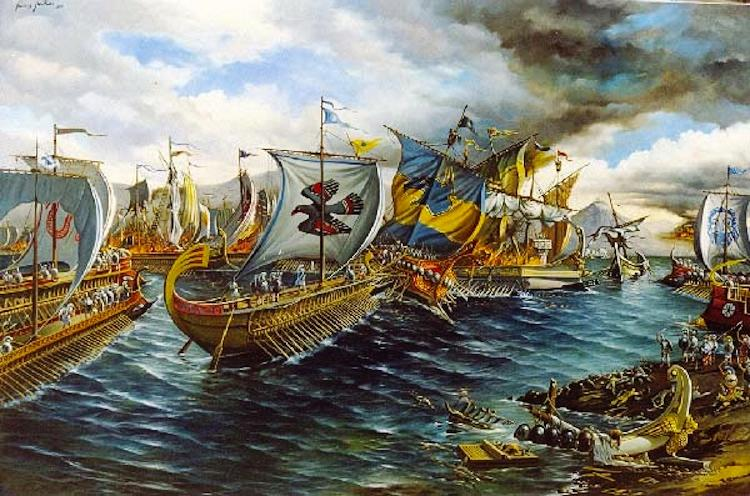
The Battle of Salamis in 480 BC stands as the definitive moment in the history of naval warfare. Facing the massive, multi-national imperial fleet of Xerxes I, the Athenian-led Greek alliance—outnumbered by nearly two-to-one—found themselves trapped in the narrow straits between the island of Salamis and the Attic mainland. Themistocles, the Athenian commander, recognized that he could not win in an open-water slugfest. Instead, he engineered a defensive masterpiece that utilized local geography, hyper-specialized naval maneuvering, and psychological manipulation to turn the Persian Empire's numerical strength into its own fatal terminal liability.
1. The Strategy of the Bottleneck
Themistocles’ fundamental objective was to neutralize the Persian numerical advantage by restricting the battlefield. He correctly identified that the Straits of Salamis were so narrow that the Persian fleet, which relied on its sheer volume of ships to swarm opponents, would be forced into a catastrophic bottleneck.
By tricking Xerxes into believing the Greek fleet was retreating, he lured the Persians into the narrowest part of the channel at dawn. Once the Persian ships entered the straits, they lost the ability to maneuver. Their front-line ships were blocked by the narrow walls of the channel, while their rear-line ships, ignorant of the gridlock ahead, continued to push forward. This effectively compressed the massive Persian fleet, causing them to collide with one another and preventing them from turning their superior numbers into a coordinated offensive.
2. The Tactical Maneuvers: Mastering the Oar
Once the Persian fleet was compressed, the Athenian triremes executed two signature naval maneuvers that defined their tactical doctrine.
The Diekplous (The Shearing Break-Through)
The Athenians used their superior rowing synchronicity to execute the diekplous. They would sprint directly at the Persian line, aiming for the gaps between ships. At the last possible second, the Athenian rowers would pull their oars inside the hull. Their ship would slide past the enemy, shearing off the exposed oars of the Persian vessel. This rendered the enemy ship completely paralyzed in the water, allowing the Athenian ship to wheel around in a tight arc and ram the vulnerable side or stern of the now-helpless ship.
The Periplus (The Outflanking Wheel)
For ships on the wings of the Greek formation, the maneuver of choice was the periplus. Because the Persians were trapped in the center of the straits, the Athenian ships on the flanks were able to utilize the open water to swing wide and circle behind the Persian formation. Once in position, they would wheel inward and strike the Persian ships on their undefended, blind sides.
3. The Hydrodynamic Advantage: Localized Knowledge
The Greeks were not only better at naval geometry; they possessed intimate knowledge of the local maritime environment.
Wind and Currents: Themistocles timed the engagement to coincide with the predictable morning winds that funnelled through the straits. As the wind picked up, the high-decked, top-heavy Persian and Phoenician ships—which were already congested—began to pitch and roll violently. Their crews, unaccustomed to the specific chop of the Salamis straits, struggled to maintain oar rhythm.
Ship Stability: Athenian triremes were intentionally built low to the water with a shallow draft, making them incredibly stable and responsive in the specific wave patterns of the Aegean. While the Persian ships floundered in the choppy water, the Athenians remained steady, allowing their rowers to maintain the precise cadence necessary for ramming.
4. Psychological Warfare: The Illusion of Panic
Themistocles also used deception to break the Persian command structure. Before the battle, he sent a secret message to Xerxes claiming that the Greek fleet was in a state of civil war and attempting to flee. Xerxes, eager to finish the Greeks quickly, ordered his fleet to enter the straits throughout the night, forcing them to remain at their oars for hours in full battle armor.
By the time the battle began at dawn, the Persian crews were physically exhausted, sleep-deprived, and psychologically strained. When the Athenian fleet surged out from behind the headlands in a coordinated, silent, and disciplined line, the exhausted Persian sailors—already anxious from the cramped, chaotic conditions—suffered a collective moral collapse.