Introduction: The Terror of the Scythe
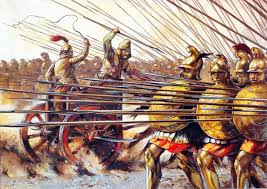
In the panoply of Hellenistic weaponry, few tools were as visually and psychologically terrifying as the scythed chariot. Originating from Achaemenid Persian tactical doctrines and later adopted by Hellenistic monarchs (most notably the Seleucids and the Pontic kings), these vehicles were not designed for transport or scouting. They were industrial-scale weapons of mass trauma, specifically engineered to shatter the tight, rhythmic cohesion of a heavy infantry phalanx. By mounting long, razor-sharp blades to the wheel hubs and axles, commanders transformed a simple transport cart into a high-velocity, ground-level guillotine.
1. The Anatomy of a Mobile Guillotine
A scythed chariot was a marvel of destructive engineering, built for maximum impact speed and lethality in close-quarters infantry engagement.
The Chassis: The frame was kept light and low to the ground to maintain stability at high speeds, usually pulled by a team of two or four horses.
The Scythes: The defining feature was the blades.
Axle Blades: Long, straight, double-edged steel blades were bolted to the wheel hubs, extending outward from the sides of the chariot. These were intended to act as massive horizontal saws, sweeping through the legs and torsos of infantry standing in the ranks.
Down-turned Scythes: Some variants featured blades angled downward or forward from the chassis, intended to slice through the shield wall or decapitate soldiers in the front row.
The Crew: The chariot was typically manned by a driver (auriga) and sometimes a combatant who used a long spear to strike at soldiers who managed to dodge the initial blade pass.
2. Tactical Purpose: Breaking the Phalanx
The central challenge in Hellenistic warfare was how to break the "porcupine" of the Macedonian phalanx—a dense wall of 18-foot pikes (sarissas) that was virtually impenetrable from the front.
The Disruptor Logic: Scythed chariots were never intended to defeat a phalanx through direct combat. Their purpose was disruption. A charge of 50 to 100 chariots hitting a phalanx line at a dead sprint forced the infantrymen to break their rigid formation. If the phalanx soldiers parted ranks to let the chariots pass, they created fatal gaps in their line that could be exploited by following cavalry or heavy infantry.
The Psychological Shock: The mere sight of a hundred chariots charging with gleaming, spinning blades, accompanied by the deafening sound of wheels and horse hooves, was designed to induce panic (phobos). If the infantry turned to flee, the chariots became the ultimate pursuit tool, cutting down the retreating mass with mechanical efficiency.
3. The Structural Failures: Why They Often Failed
Despite their terrifying appearance, scythed chariots were notoriously unreliable and frequently backfired on their own commanders.
The "Panic Reversal": Because the horses pulling the chariots were terrified by the carnage and the sound of their own blades, they were prone to panic. If the drivers lost control, or if a horse was hit by a single well-placed javelin, the horses would bolt backward or turn 180 degrees.
The Friendly Fire Hazard: When a chariot panicked and turned back toward its own lines, the scythes were just as deadly to the commander's own infantry and cavalry as they were to the enemy. At the Battle of Gaugamela, the Macedonians neutralized the scythed chariots by simply opening their lines to let them pass through, rendering them useless; conversely, at other engagements, panicked chariots forced entire wings of the commanders' own army to collapse in a self-inflicted slaughter.
Terrain Sensitivity: Scythed chariots were strictly limited by geography. They required perfectly level, dry, and rock-free ground to maintain speed. Any ditch, mud patch, or steep incline would ground the vehicle or break an axle, turning an expensive weapon into a stationary, vulnerable obstacle.
4. Counter-Measures: How Infanty Neutralized the Blades
As scythed chariots became more common, Hellenistic armies developed sophisticated tactical manuals for dealing with them, effectively turning the weapon’s own momentum against it.
The Lane Maneuver: As seen at Gaugamela, the most effective defense was to drill infantry to open vertical "alleys" in their line. When the chariots charged, the phalanx would simply step aside. Once the chariots passed through, the infantry would close the lanes, trapping the chariots in the middle of the formation where the driver could be pulled off and the horses speared.
Missile Suppression: Because the driver and horses were unarmored, light skirmishers (like the Agrianian javelin-throwers or Cretan archers) were tasked with firing at the chariot before it reached the phalanx line. A single javelin in a horse’s chest or a driver’s shoulder was often enough to crash the entire chariot and flip it.
Caltrops: Some armies began scattering iron triboli (caltrops)—four-pointed metal spikes—in front of their lines. When a horse stepped on a caltrop, it would instantly collapse, causing the chariot to crash, break its axle, and tumble into the dirt.
5. Historical Legacy
The scythed chariot represents a "technological dead end" in Hellenistic military evolution. While they achieved devastating tactical victories in specific, flat-terrain engagements against undisciplined or poorly drilled infantry, they were ultimately too sensitive to terrain and too prone to failure. By the time of the Roman expansion into the East, the Romans—who had studied these failures meticulously—viewed scythed chariots as an antiquated curiosity rather than a genuine threat, easily countered by the disciplined, modular flexibility of the Roman legion.