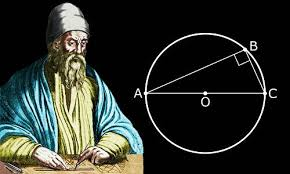
Introduction: The Father of Systematized Thought
Around 300 BCE, in the vibrant intellectual melting pot of Ptolemaic Alexandria, a mathematician named Euclid sat down to compile the existing mathematical knowledge of his era. The resulting work, a 13-volume masterpiece titled the Elements (Stoicheia), became the most influential textbook in human history. For over two millennia, if you studied geometry anywhere in the world, you were studying Euclid.
Euclid’s true genius did not lie in discovering completely new, radical geometric shapes or formulas. Many of the theorems in the Elements had already been worked out by predecessors like Pythagoras, Eudoxus, and Thales. Instead, Euclid’s monumental contribution was methodology. He took a chaotic, scattered collection of isolated mathematical tricks and forged them into a single, breathtakingly logical framework. By starting with just five simple, self-evident truths, Euclid proved that human beings could deduce the entire layout of physical space through raw, unassailable logic.
1. The Axiomatic Method: Building Truth from Scratch
Before Euclid, mathematics was often treated like a collection of practical recipes: if you mix these angles and lines this way, you get a pyramid or a field boundary. Euclid rejected this piecemeal approach and pioneered the axiomatic method.
He argued that to build a system of absolute truth, you must start with a small foundation of undisputed, self-evident assumptions called axioms or postulates. Once these foundations are set, every single subsequent claim must be rigorously proved step-by-step using strict deductive logic. If your foundations are true, and your logic is flawless, your final conclusions are permanently indisputable.
                  [ The Geometric Pyramid of Truth ]

                               /\
                              /  \  <- Advanced Theorems (e.g., Pythagoras)
                             /____\
                            /      \ <- Basic Propositions
                           /________\
                          /          \ <- Common Notions & Definitions
                         /____________\
                        [5 Postulates ]  <- The Absolute Foundation
Euclid began Book I of the Elements with 23 basic definitions (defining points, lines, and surfaces) and 5 core postulates that form the literal bedrock of Euclidean Geometry:
A straight line segment can be drawn joining any two points.
Any straight line segment can be extended indefinitely in a straight line.
Given any straight line segment, a circle can be drawn having the segment as radius and one endpoint as center.
All right angles are equal to one another.
The Parallel Postulate: If a straight line falling on two straight lines makes the interior angles on the same side less than two right angles, the two straight lines, if produced indefinitely, meet on that side on which the angles are less than the two right angles.
2. The Fifth Postulate: The Enigma of Parallel Lines
While the first four postulates are short, punchy, and completely obvious, Euclid’s Fifth Postulate—often simplified as the Parallel Postulate—reads more like a complex theorem than a self-evident truth.
          Line A  ───────────────────────────
                        /
                       / Line C
                      /
          Line B  ───/───────────────────────
                    /
                   /  Angle x + Angle y < 180°
                  /   (Lines A & B will eventually collide!)
Euclid himself was clearly deeply uncomfortable with his own fifth postulate. He recognized it was clunky, so he intentionally avoided using it in the Elements until he reached Proposition 29, attempting to prove as much geometry as he possibly could without relying on this fifth assumption.
For the next 2,000 years, mathematicians across the globe—from medieval Islamic scholars like Al-Haytham to European thinkers like Gauss—spent lifetimes trying to mathematically prove the Fifth Postulate using only the first four. They all failed. Ultimately, this centuries-long failure triggered a massive scientific revolution in the 19th century, when mathematicians realized that if you intentionally alter or throw out Euclid's Fifth Postulate, you discover entirely new, internally consistent realities: Non-Euclidean Geometries (like the curved space-time later used by Albert Einstein to explain gravity).
3. Geometric Proofs: The Architecture of Book I
Once his postulates were established, Euclid began building his logical pyramid. Book I of the Elements contains 48 propositions, leading the reader on an intellectual journey from constructing a simple equilateral triangle up to the ultimate climax of the book: a pristine, geometric proof of the Pythagorean Theorem (Proposition 47).
Euclid did not use algebra or coordinate grids ($x, y$ axes) to prove his claims. He relied strictly on synthetic geometry, using two physical drafting tools: an unmarked straightedge (to draw lines) and a collapsing compass (to draw circles and lift lengths).
4. Beyond Triangles: Euclid's Secret Contributions
While the Elements is universally celebrated for flat plane geometry, Euclid’s 13 volumes delve deeply into several other foundational branches of mathematics that form the backbone of modern data science and computer programming.
Number Theory (Books VII–IX): Euclid formulated the Fundamental Theorem of Arithmetic, proving that every integer greater than 1 is either a prime number itself or can be unique factored into a product of prime numbers.
The Infinity of Primes: In Book IX, Proposition 20, Euclid delivered one of the most beautiful mathematical proofs ever written, demonstrating through a brilliant contradiction that there are infinitely many prime numbers.
The Euclidean Algorithm: Euclid engineered a step-by-step mathematical recipe to quickly calculate the Greatest Common Divisor (GCD) of two numbers without needing to factor them. This simple, elegant algorithm remains a staple of modern computer science, running silently inside billions of software operations every single second.
Ultimately, Euclid’s greatest gift to humanity was not the formulas themselves, but the unyielding standard of evidence he demanded. By showing that complex, real-world physical space could be organized and conquered by a handful of clear, logical concepts, he established the definitive blueprint for rational thought that defined the trajectory of Western science, philosophy, and engineering.