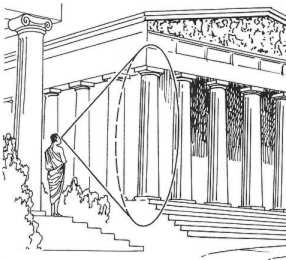
Introduction: The Nature of Visual Rays
How do we perceive the world around us? When we look at a mountain, a sculpture, or a star, how does that physical object enter our consciousness? To the ancient Greeks, this was not a simple passive question—it was a fierce battleground of physics, mathematics, and philosophy.
Long before the modern consensus that light is an electromagnetic wave of photons reflecting off surfaces into our eyes, Greek thinkers engineered highly sophisticated models to explain vision. They split into two main competing scientific camps: those who believed the eye shoots out active, psychic lasers to scan the environment (emission theory), and those who believed objects physically shed microscopic skins that fly into our pupils (intromission theory). By translating these physical concepts into rigorous geometry, Greek scholars laid the structural foundations for the science of optics ($optika$).
1. The Great Philosophical Divide: Emission vs. Intromission
The debate over how light and vision operate was divided by two fundamentally opposed mechanics of perception.
       [ Emission Theory (Euclid/Plato) ]           [ Intromission Theory (Democritus) ]

                 Active visual ray                               Microscopic skin
               ====================►                           ◄───────────────────
              /                                               /
            (O)                                             (O)
            Eye                                             Eye
The Emission (Extramission) Theory
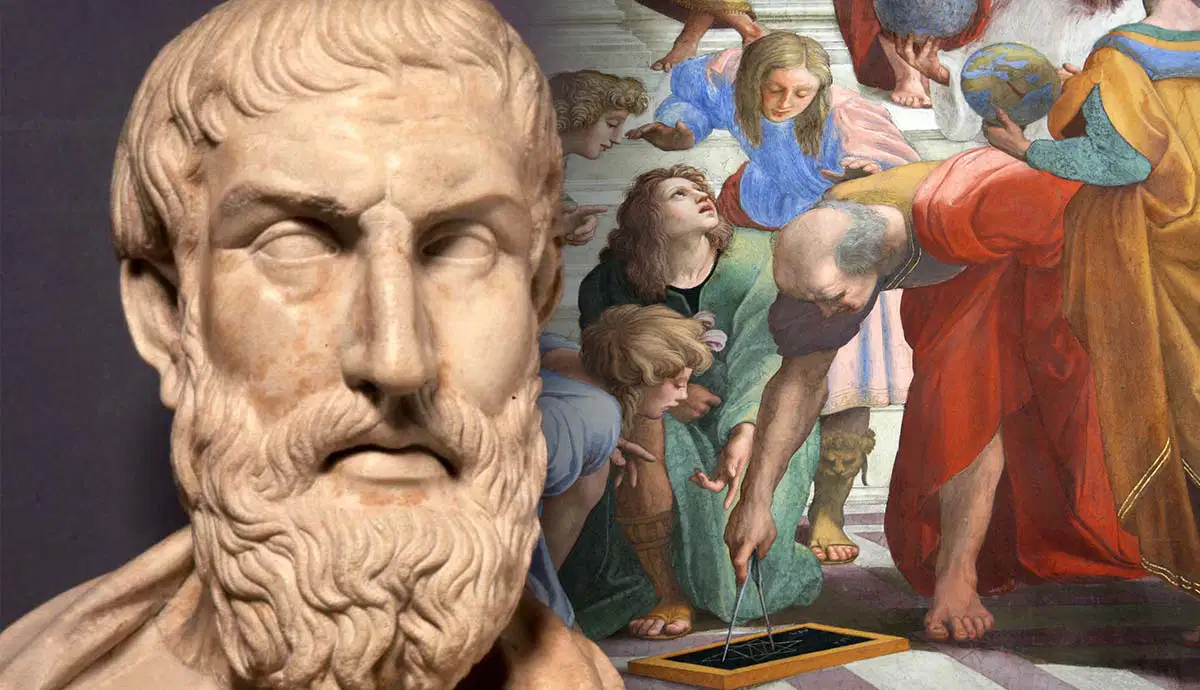
Championed by Plato, Euclid, and later the astronomer Ptolemy, this model argued that the eye is an active, dynamic organ. They posited that the mind generates a gentle, fiery stream of visual light that shoots outward from the eye in straight, conical rays. These visual rays actively strike the objects in front of us, sending tactile sensations back to the brain—functioning much like a blind man's walking stick scanning a room.
While this sounds absurd to us today, the Greeks had compelling common-sense arguments for it. They noted that the eyes of apex predators like cats seem to literally glow in the dark, and they asked: if the eye simply receives light passively, why can't we see perfectly clear pictures in total darkness?
The Intromission Theory
Championed by the Atomists (Democritus and Epicurus) and later refined by Aristotle, this camp argued the exact opposite. Democritus asserted that physical objects are constantly shedding microscopic, ultra-thin atomic layers from their outermost surfaces. These floating atomic films, called eidola or "images," hurtle through the air and physically enter the pupil of the eye, which acts as a passive collector of data.
2. Euclid's Catoptrics: Geometry Conquers the Mirror
Around 300 BCE, Euclid bypassed the messy philosophical debate about what light was made of, and focused entirely on how it behaved spatially. In his treatises Optics and Catoptrics, he applied the strict rules of deductive geometry to light rays, establishing the foundational laws of reflection.
Euclid treated visual rays as perfectly straight geometric lines. By doing this, he unlocked several universal optical truths:
The Cone of Vision: He proved that our sight is a three-dimensional cone, with the apex sitting inside the pupil of the eye and the base wrapping around our field of view. Objects that sit within a larger angle of this cone appear larger; objects at a narrow angle look smaller.
The Law of Reflection: Euclid mathematically demonstrated that when a light or visual ray strikes a flat, polished mirror, it bounces off at an angle perfectly symmetrical to its approach. Today, this is taught in every physics classroom as the law of matching angles:
$$\text{Angle of Incidence } (\theta_i) = \text{Angle of Reflection } (\theta_r)$$
                     Visual Ray       Reflected Ray
                              \       /
                               \     /
                                \   /
                                 \ /
       ═══════════════════════════*═══════════════════════════
                                Mirror
3. Ptolemy's Refraction Experiments: The Physics of Bending Light
In the 2nd century CE, the astronomer Claudius Ptolemy conducted what is widely considered the most sophisticated, quantitative experimental trial of the ancient world. He wanted to understand refraction—why a straight stick appears sharply bent the moment it is submerged in a glass of water.
Instead of writing an abstract theory, Ptolemy built a specialized physical apparatus: a circular bronze disk graduated into 360 degrees, half-submerged vertically in a basin of water.
                         Air (Less Dense)
                             │  /
                             │ /  Angle of Incidence (Air)
                             │/
       ══════════════════════*══════════════════════ [ Water Line ]
                            /│
                           / │    Angle of Refraction (Water is bent
                          /  │    closer to the vertical normal line!)
                        Water (More Dense)
The Protocol
Ptolemy placed a sighting marker at a specific angle in the upper "air" half of the disk. He then looked through the water from below to adjust a second marker until the two points appeared perfectly aligned in a straight line. He meticulously recorded the changing angles across different mediums: from air to water, air to glass, and glass to water.
The Conclusion
Ptolemy compiled his data into precise numerical tables. He discovered that as a ray passes from a less dense medium (air) into a denser medium (water), it consistently bends toward the vertical normal line. While he did not discover the exact trigonometric formula used today (Snell's Law), his empirical tables were so accurate that they were used by astronomers for centuries to correct the distorting atmospheric refraction of starlight near the horizon.
4. The Burning Mirrors of Archimedes: Applied Optics
The ultimate practical manifestation of Greek optics belongs to the legendary engineer Archimedes of Syracuse (c. 287–212 BCE). During the Roman siege of Syracuse, historical accounts claim that Archimedes engineered a terrifying weapon: a "burning mirror" that weaponized sunlight to set invading Roman warships ablaze from a distance.
       Solar Rays
       ─────────────────► \
       ─────────────────►  \   Hexagonal
       ─────────────────►   )  Parabolic ───► [ Focal Point: Target Ship! ]
       ─────────────────►  /   Mirrors
       ─────────────────► /
For centuries, modern historians dismissed this story as complete military folklore. However, modern engineering reconstructions have proven the underlying mathematics are completely sound.
Archimedes understood the geometry of parabolic mirrors. While a flat mirror bounces light off symmetrically, a collection of curved, hexagonal mirrors configured into a parabolic arc will take parallel incoming solar rays and focus them down into a single, intensely concentrated dot: the focal point. By aiming this collective thermal focal point at the dry timber and pitch-soaked hulls of the Roman ships, Archimedes translated abstract geometric optics into devastating military hardware.
The Ultimate Legacy: The Pipeline to Alhazen
The Greek understanding of light was brilliant but fundamentally incomplete due to the stubborn persistence of emission theory, which treated the eye as a projector rather than a camera.
The ultimate resolution of this model did not occur until the 11th century CE, when the Islamic physicist Ibn al-Haytham (Alhazen) synthesized Greek geometry with Aristotelian intromission. By using systematic experimentation, Alhazen proved that light travels from external sources, reflects off objects, and enters our eyes passively, finally unifying Euclid’s gorgeous geometric rays with the physical reality of the material world.