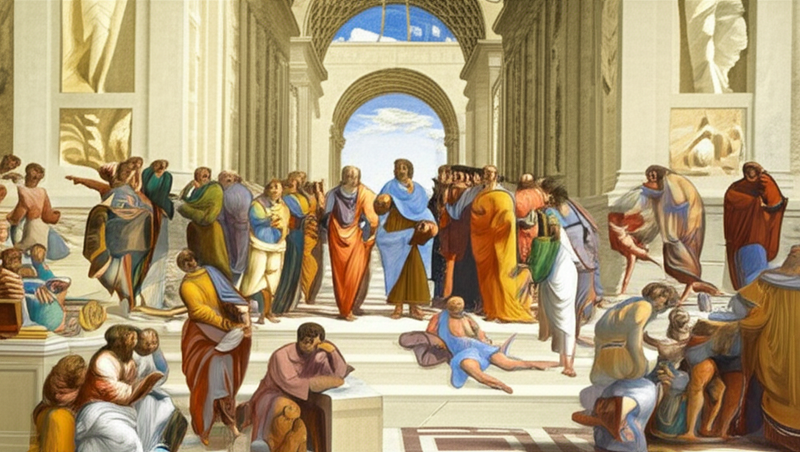
Introduction: The Battlefield of Consciousness
Long before the advent of modern neuroscience, the philosophers of ancient Greece wrestled with a fundamental mystery: What animates us? What is the seat of our thoughts, emotions, and identity? To the early Greeks, this animating force was the psyche ($\psi\upsilon\chi\eta$), originally translated as "breath" or "life-force," which eventually evolved into our modern concept of the soul.
The debate on the nature of the soul was not a uniform, harmonious school of thought. It was a fierce intellectual battleground that pitted radical materialists against spiritual dualists. How a philosopher defined the soul determined how they viewed everything else—from the existence of an afterlife and the structure of a just government to the very definition of what it means to be human.
1. The Pre-Socratic Materialists: The Breath of Matter
Before Socrates turned the philosophical lens inward toward human morality, the early thinkers of Miletus and Ionia—the Pre-Socratics—approached the soul through the lens of natural science. They sought to explain the psyche using the same physical elements that made up the cosmos.
Anaximenes (c. 586–526 BCE): He argued that the soul was composed of infinite air (aer). Just as air encompasses and holds the entire universe together, a specialized, refined breath of air keeps the human body alive and functional.
Heraclitus (c. 535–475 BCE): For Heraclitus, the universe was in a state of constant, dynamic change, governed by cosmic fire. Consequently, he argued the soul was made of cosmic fire. A healthy, wise soul was a "dry" soul, blazing with intellectual clarity, while a "wet" soul (such as that of a drunkard) was sluggish, compromised, and losing its vital spark.
2. The Pythagorean and Platonic Dualism: The Divine Prisoner
The trajectory of Western thought shifted radically when thinkers began separating the soul from the physical body entirely, treating the flesh not as the soul's home, but as its prison.
The Pythagorean Transmigration
Pythagoras (c. 570–495 BCE) introduced the revolutionary concept of metempsychosis—the transmigration of souls. He argued that the soul was an immortal, immaterial entity trapped in a cycle of reincarnation. Upon the death of the physical body, the soul would be reborn into a new vessel, whether human or animal, based on its moral purity and understanding of cosmic harmony.
Plato's Tripartite Soul
Plato (c. 428–348 BCE) took these dualist ideas and built a highly sophisticated psychological framework. In his dialogue, the Republic, Plato argued that the human soul is immortal and divided into three distinct, competing forces.
The Allegory of the Charioteer: In his dialogue Phaedrus, Plato compared the soul to a chariot driven by a single charioteer (Reason), who struggles to command two winged horses. The noble white horse (Spirit) represents our righteous anger, honor, and courage. The volatile black horse (Appetite) represents our base, instinctual desires for food, wealth, and physical pleasures. Virtue is achieved only when Reason masters both steeds.
3. Aristotle's Hylomorphism: The Functional Soul
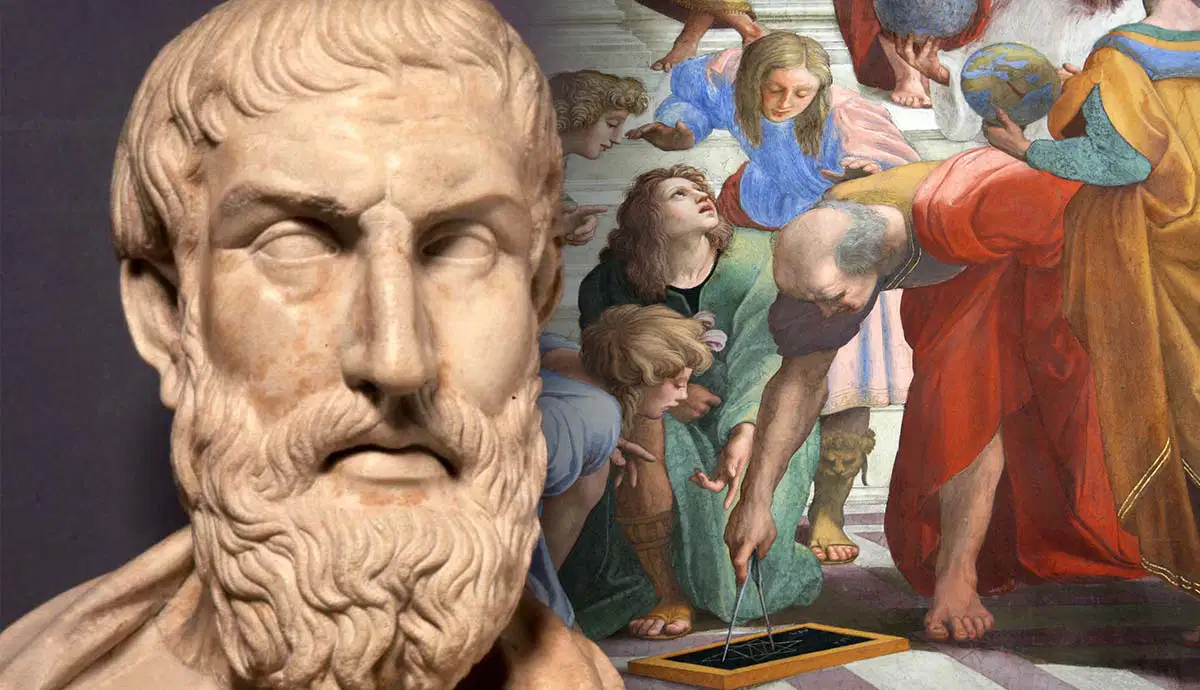
Plato’s most brilliant student, Aristotle (384–322 BCE), completely rejected his master’s dualism. In his groundbreaking treatise De Anima ("On the Soul"), Aristotle argued that searching for a soul separate from the body was a fundamental misunderstanding of nature. He pioneered the concept of hylomorphism—the idea that all things are a inseparable combination of matter (hyle) and form (morphe).
For Aristotle, the body is the physical matter, and the soul is the form or functional essence of that matter.
To ask if the body and soul are one is as meaningless as asking if the wax and the shape stamped into it by a seal are one.
If an eye were an independent living creature, Aristotle argued, its "soul" would simply be the act of seeing. Because the soul is merely the function and organization of the physical body, Aristotle concluded that when the physical body dies, the individual soul ceases to exist.
The Three Tiers of Life
Aristotle categorized souls into a hierarchical biological continuum based on their capabilities:
    [ Rational Soul ]   -> Humans (Logic, thought, deliberation)
           |
   [ Sensitive Soul ]  -> Animals (Movement, perception, desire)
           |
  [ Vegetative Soul ] -> Plants (Growth, nutrition, reproduction)
The Vegetative Soul: Possessed by plants. It is limited entirely to the functions of nutrition, growth, and reproduction.
The Sensitive Soul: Possessed by animals. It includes vegetative functions but adds sensory perception, desire, and the capacity for physical movement.
The Rational Soul: Unique to human beings. It encompasses all lower functions but adds the capacity for abstract thought, intellect (nous), and moral deliberation.
4. The Atomists and Epicureans: The Material Mind
The final major shift in the Greek debate came from the Atomists, led by Democritus (c. 460–370 BCE) and later championed by Epicurus (341–270 BCE). They took Pre-Socratic materialism to its absolute logical conclusion.
They argued that the universe consisted entirely of two things: indivisible physical particles called atoms, and empty space. The soul was not an invisible, magical entity; it was a physical organ inside the body made of exceptionally smooth, round, and highly mobile "soul-atoms" (resembling heat or wind) distributed throughout the nervous system.
       ___________________________________________
      |     o    o    o    o    o    o    o       | <- Spherical, volatile
      |   o    o    o    o    o    o    o    o     |    "Soul Atoms"
      |_____o____o____o____o____o____o____o_______|
Because these soul-atoms were held together entirely by the physical container of the body, the moment a person died, their soul-atoms immediately scattered into the wind like smoke escaping a broken vase.
Epicurus used this atomic reality as the ultimate antidote to existential anxiety. He famously noted that we should not fear death or damnation in an afterlife, because once our body fails, our consciousness is completely dissolved: