How the Greeks Measured the Earth’s Circumference
In the 3rd century BCE, Eratosthenes of Cyrene (c. 276–195 BCE), the chief librarian at the Library of Alexandria, calculated the circumference of the Earth with astonishing accuracy. Utilizing simple geometric principles, solar observations, and known distances, he achieved this without leaving the African continent.
1. The Observation: Syene and Alexandria
Eratosthenes based his calculations on observations made in two Egyptian cities during the summer solstice: Syene (modern-day Aswan) and Alexandria.
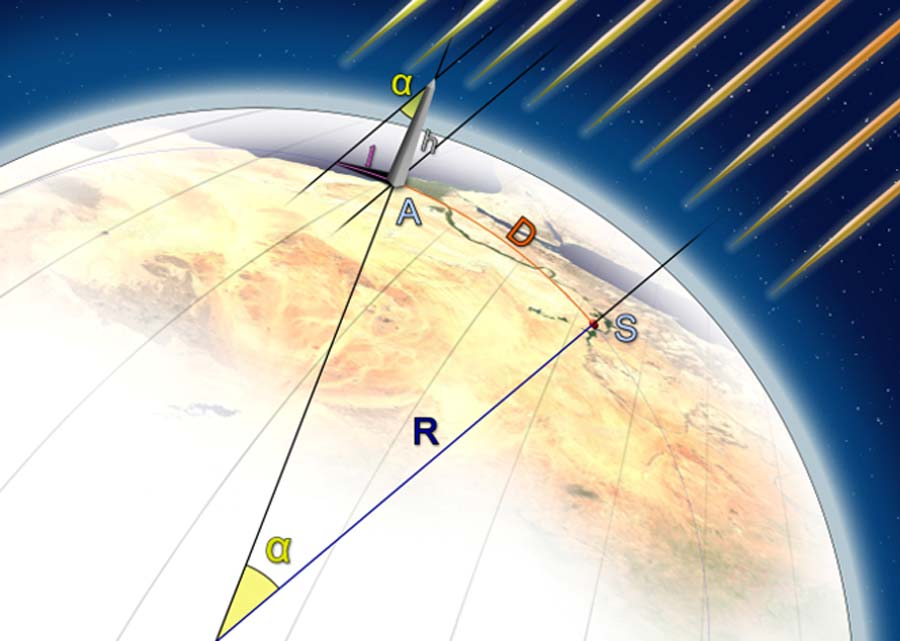
Syene: He learned that at local noon on the summer solstice, the sun was directly overhead. In Syene, the sun's rays shone straight down to the bottom of a deep well, casting no shadow, and an obelisk cast no shadow. This meant the sun was at the zenith ($90^\circ$ relative to the horizon).
Alexandria: On the same day and at the same time, Eratosthenes observed that an obelisk in Alexandria cast a shadow. By measuring the angle of this shadow, he determined that the sun's rays were at an angle of $7.2^\circ$ from the vertical (or $\frac{1}{50}$ of a $360^\circ$ circle).
2. The Mathematical Proportions
Eratosthenes reasoned that the difference in the shadow angles was due to the curvature of the Earth. If the Earth is a sphere, the ratio of the angular difference to a full circle ($360^\circ$) must equal the ratio of the distance between the two cities to the total circumference of the Earth.
$$\frac{\text{Angle}}{360^\circ} = \frac{\text{Distance between cities}}{\text{Earth's Circumference}}$$
The Angle: $7.2^\circ$ is equal to $\frac{1}{50}$ of a full circle.
The Distance: The distance between Alexandria and Syene was estimated to be approximately $5,000 \text{ stadia}$ (a unit of distance used in antiquity).
The Calculation:
$$\text{Earth's Circumference} = 50 \times 5,000 \text{ stadia} = 250,000 \text{ stadia}$$
3. Modern Conversion and Accuracy
While the exact length of the Greek stadion is still debated by historians, using the most common estimates (around 157 to 185 meters per stadion), Eratosthenes' result was incredibly precise:
Lower Estimate (157 meters): $\approx 39,250 \text{ km}$
Upper Estimate (185 meters): $\approx 46,250 \text{ km}$
Actual Polar Circumference: $\approx 40,008 \text{ km}$
This calculation was remarkably close to the true value, especially given the limitations of measurement technology in the 3rd century BCE.