The Ancient Greek Theory of the Four Elements
The ancient Greek theory of the four elements posited that all matter in the universe is composed of four fundamental substances: earth, water, air, and fire. Rather than relying purely on mythology, this framework represented one of the earliest attempts by natural philosophers to explain the diversity, properties, and changes of physical matter through observation and reason.
This idea dominated Western science, philosophy, and medicine for over two thousand years until the rise of modern chemistry in the 17th century.
1. Empedocles and the Four Roots
The theory was first formalized in the 5th century BCE by the Sicilian-born Greek philosopher Empedocles of Acragas (c. 490–430 BCE).
The Four Roots (Rhizomata): Seeking to reconcile earlier philosophical claims that all matter is either constantly changing or completely unchanging, Empedocles proposed that fire, earth, air, and water are eternal and immutable building blocks.
Cosmic Forces: He argued that these elements do not transform into one another. Instead, matter takes shape when they are mixed and separated by two opposing cosmic forces:
Love (Philia): The force of attraction that unites the elements to create complex objects.
Strife (Neikos): The force of repulsion that breaks the elements apart.
2. Plato and the Geometric Elements
In the 4th century BCE, the philosopher Plato (c. 428–348 BCE) integrated the four elements into his grand cosmological vision in the dialogue Timaeus.
The Platonic Solids: Rather than viewing elements purely as physical matter, Plato associated them with three-dimensional geometric shapes:
Fire: Tetrahedron (sharp, easily penetrable)
Air: Octahedron (smooth, light)
Water: Icosahedron (mobile, fluid)
Earth: Cube (stable, rigid)
The Fifth Element: Plato and later thinkers hinted at a fifth element, Aether, which was associated with the heavens and the stars.
3. Aristotle and the Qualities of Matter
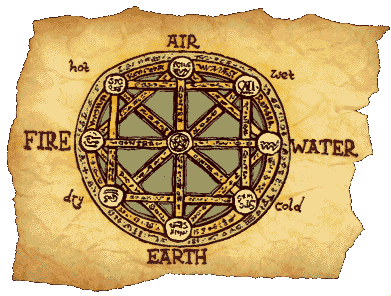
Aristotle (384–322 BCE) expanded on Empedocles's theory, modifying it to explain how substances could transform and change physical states. He asserted that elements could be broken down into an underlying prime matter combined with two of four core sensible qualities: hot, cold, dry, and wet.
Fire = Hot + Dry
Air = Hot + Wet
Water = Cold + Wet
Earth = Cold + Dry
This system allowed for transmutation—the idea that if you alter the underlying qualities of an element (for instance, heating and drying water), it can turn into another element (like fire).
4. Application to Medicine: The Four Humors
The four elements also formed the foundation of ancient Greek medicine, largely through the work of Hippocrates and later Galen.
The Four Humors: The elements were linked to internal fluids within the human body. To maintain health, these humors needed to remain in perfect balance:
Air: Blood (sanguine, optimistic)
Fire: Yellow Bile (choleric, passionate)
Water: Phlegm (phlegmatic, calm)
Earth: Black Bile (melancholic, depressed)
Historical Note: The balance of elements and humors was not just thought to govern health, but also emotional temperaments and behavior.