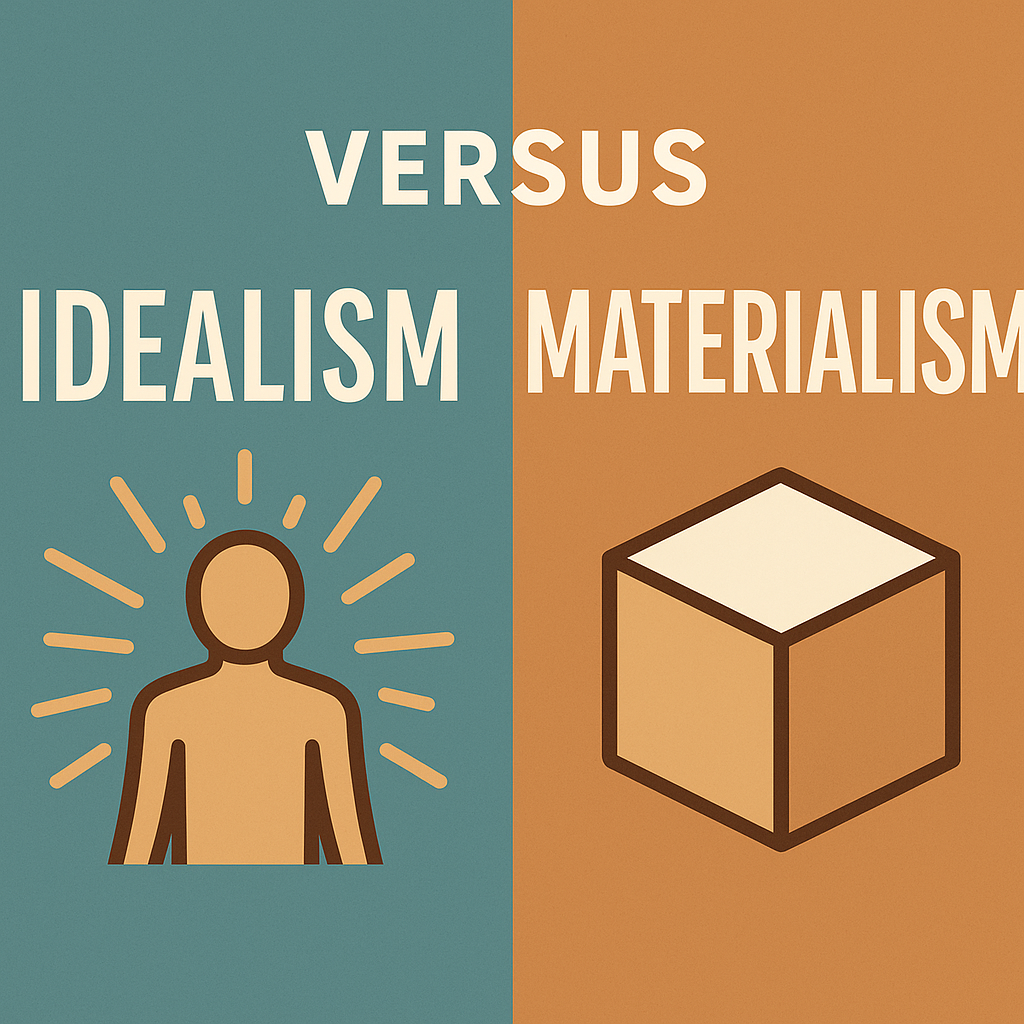
The intellectual battle over the ultimate fabric of reality split ancient Greek philosophy into two fiercely competing camps. On one side stood Materialism, a worldview asserting that everything in the cosmos is physical, mechanical, and bound by the laws of matter. On the opposite side stood Idealism, which argued that the physical world is a mere shadow, and that true reality is composed of eternal, non-physical minds, reasons, and ideas.
This historic clash found its ultimate champions in Democritus, who built a universe out of colliding particles, and Plato, who anchored reality in a transcendent realm of pure concept.
1. Democritus and the Mechanics of Materialism
Building upon the early concepts of his mentor Leucippus, Democritus of Abdera (c. 460–370 BCE) pushed physical philosophy to its absolute limits by introducing Atomism. He sought to explain the entire universe without relying on gods, cosmic purposes, or immaterial forces.
The Code of the Void
Democritus argued that if you were to cut an object—like an apple or a stone—in half infinitely, you would eventually hit a physical limit. You would arrive at a particle so small, solid, and indestructible that it could not be cut any further. He named these particles atoms (meaning "uncuttable").
According to Greek materialism, the architecture of reality requires only two things:
Atoms: Infinite, uncreated, eternal particles of pure matter. They possess no color, temperature, or smell; they only have geometric shapes, sizes, and weights. Some are hooked, some are smooth, and others are jagged.
The Void: Literal empty space or nothingness. The void is not a lack of reality; it is the essential stage that allows atoms the freedom to move, vibrate, and collide.
The Blind Pinball Machine
For Democritus, there is no grand design or afterlife. Everything we experience is the result of mechanical necessity. When atoms drifting through the void collide, their shapes determine how they interact. Hooked atoms latch together to form solid iron; smooth, round atoms slide past one another to form fluid water.
Even human consciousness and the soul are entirely material. Democritus explained the soul as a physical cluster of exceptionally smooth, spherical "fire-atoms" that animate the flesh through the physical act of breathing. When a person dies, this atomic cluster scatters back into the void like smoke, ending personal existence completely.
2. Plato and the Fortress of Idealism
Plato (c. 428–348 BCE) found the materialist worldview deeply dangerous. To him, reducing the universe to blind, colliding particles stripped human life of objective morality, justice, and divine purpose. Plato inverted the materialist model entirely, establishing Objective Idealism: the doctrine that matter is secondary, and ideas are primary.
The Theory of Forms
Plato argued that the physical objects we can touch, see, and hear are not truly real. They are imperfect, decaying copies of higher, eternal truths. He called these perfect, non-physical blueprints the Forms (or Ideas).
To understand this, consider a beautiful marble sculpture, a beautiful sunset, and a beautiful person. All three are physical, temporary, and will eventually decay. Plato argued that these objects are only beautiful because they "participate" in a single, unchanging, immaterial cosmic blueprint: the Form of Beauty. While physical objects are generated and destroyed, the Forms exist eternally in a non-physical realm accessible only to human reason.
The Prison of Shadows
To help humanity grasp this idealism, Plato crafted his famous Allegory of the Cave in the Republic. He envisioned human beings as prisoners chained inside a dark, underground cavern since childhood, forced to face a blank wall. Behind them, a fire burns, and puppeteers carry objects across a walkway. The fire casts the shadows of these puppets onto the wall in front of the prisoners.
Because the prisoners have never seen anything else, they believe these flat, fleeting shadows are absolute reality. Plato argued that the materialist is like a prisoner who studies the shadows, mistaking them for genuine substance. The philosopher is the prisoner who breaks his chains, endures the painful climb out of the cave into the blinding sunlight, and finally beholds the true, solid, illuminated objects that cast those shadows in the first place.
3. Aristotle’s Synthesis: Hylomorphism
The polarization between Democritus's cold, raw matter and Plato's abstract, floating ideas left a massive intellectual rift. Plato’s greatest student, Aristotle (384–322 BCE), sought to heal this divide by forging a brilliant middle path called Hylomorphism (from the Greek words for matter, hyle, and form, morphe).
Aristotle rejected both extremes:
Against Democritus, he argued that raw matter is just an chaotic pile of potential that cannot exist without an organizing principle or purpose.
Against Plato, he argued that Forms cannot exist floating around by themselves in a separate, magical sky-realm. A blueprint is useless unless it is actively shaping something physical.
Aristotle asserted that every single object in our universe is an indivisible, functional unity of both Matter and Form:
The Matter: The raw physical material of an object (its raw potential).
The Form: The structural design, essence, and functional purpose that makes that specific matter what it is (its actualization).
For example, a bronze statue of a horse is not just a lump of copper, nor is it a ghostly, floating idea of a horse. It is a single substance where the raw matter (the bronze) has been completely unified with a specific form (the shape of the horse given by the artist). If you melt the statue down, you destroy the form, leaving only raw matter. Through this framework, Aristotle grounded Plato's lofty ideas directly inside Democritus's physical universe.
4. The Ontological Legacy
The clash between these schools established the structural tracks for all future Western thought.
Democritus’s mechanical materialism bypassed mysticism and superstition, directly anticipating modern physics, chemistry, and secular empiricism. Every time a modern scientist breaks down the universe into subatomic particles and mechanical forces, they are speaking the language of the Atomists.
Conversely, Plato’s idealism provided the core vocabulary for Western theology, metaphysics, and early cognitive science. By arguing that the mind can access absolute, non-physical mathematical and moral truths, Plato framed the universe as an inherently meaningful, rational structure.
By forcing humanity to choose between the tangible certainty of the atom and the transcendent power of the concept, these ancient thinkers framed the essential boundaries of how we explore existence to this day.