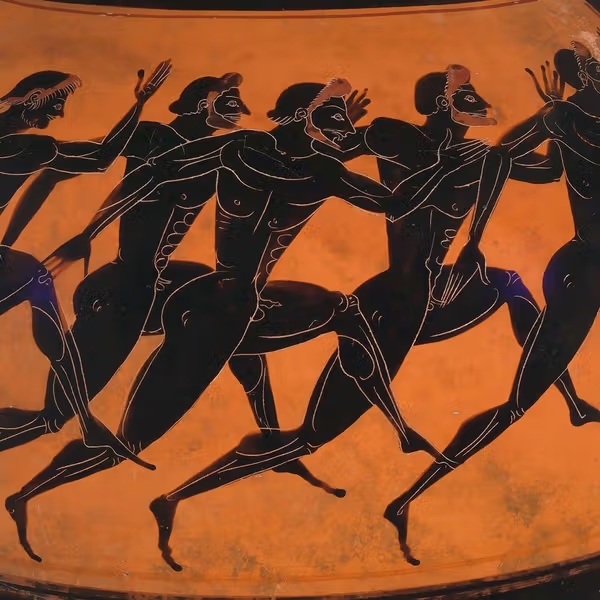
The ancient Olympic Games were not an amateur athletic showcase; they were a highly competitive testing ground for elite warriors. To compete at Olympia, an athlete had to be a free male Greek citizen and commit to a mandatory, continuous ten-month training regimen backed by the legal authority of the state. The training routines of these ancient athletes were incredibly rigorous, blending high-intensity interval training, calisthenics, strict dietary regimens, and psychological conditioning.
                  [ THE OLYMPIC PREPARATION SEQUENCE ]
                                   │
        ┌──────────────────────────┴──────────────────────────┐
        ▼                                                     ▼
[ THE TETRAS CYCLE ]                                [ THE ELIS TRIAL PERIOD ]
* Day 1: Preparation & Stretching                   * Mandatory 30-day elite lockdown
* Day 2: High-Intensity Assault                     * Supervised by the Hellanodikai
* Day 3: Recovery & Light Cardio                    * Disobedient athletes publicly whipped
* Day 4: Moderate Skill Training                     * Elimination of the physically/morally unfit
The Tetras: The World's First Periodization Training
Greek trainers, known as gymnastai, developed a revolutionary four-day training cycle known as the Tetras ($\tau \epsilon \tau \rho \dot{\alpha} \varsigma$). This system is the direct ancestor of modern athletic periodization, ensuring that muscles were systematically stressed, overloaded, and recovered:
Day 1: The Preparation: Dedicated to preparing the athlete’s body. It consisted of light, rhythmic movements, flexibility work, deep tissue preparation, and basic mobility training.
Day 2: The Intensity: A high-intensity, exhausting assault on the body. An ancient sprinter or wrestler would be pushed to their absolute physical limits, executing rapid, explosive multi-joint movements, heavy sprints through deep sand pits, and carrying heavy stone weights (halteres).
Day 3: The Recovery: Focused entirely on down-regulation and rest. Athletes engaged in light cardio, gentle swimming, and stretching.
Day 4: The Skill: A moderate-intensity day dedicated exclusively to technical skill mastery—refining the specific angles of a javelin throw, practicing the footwork of a wrestling takedown, or perfecting the lunging rhythm of a long jump.
The Mechanics of Resistance Training
Because the Greeks lacked modern steel weights, they turned their natural environment into a gym. Athletes lifted massive, irregular boulders, carried heavy calves on their shoulders until they grew into full-sized bulls (a feat popularized by the legendary wrestler Milo of Croton), and dug up the hard-packed clay of the wrestling pits using heavy iron pickaxes to build immense upper-body strength.
Furthermore, the long jump was executed using halteres—crescent-shaped stone or bronze weights weighing between 2 to 10 pounds held in each hand. As the jumper launched off the wooden platform, they violently swung the weights forward to alter their center of mass, and then hurled them backward mid-air just before landing, utilizing the laws of conservation of momentum to pull their bodies further into the pit.
The Elis Lock-Up and Judicial Discipline
The final phase of Olympic training was an intense psychological and physical test. One month before the games commenced, all competitors were legally required to gather at the city of Elis, just a few miles from Olympia. For thirty days, the athletes were subjected to an elite training lockdown under the direct, tyrannical supervision of the Hellanodikai (the Olympic judges).
The Hellanodikai forced the athletes to train under the scorching midday sun on a sparse, minimalist diet of fresh cheese, dried figs, and barley bread (meat was only introduced in later periods by elite trainers).
If an athlete arrived late, showed a lack of focus, or complained about the intensity of the drills, the Hellanodikai did not issue fines; they deployed officials known as alytai to publicly whip the athlete with birch rods directly in front of their peers. This brutal environmental and physical filter eliminated the weak, ensuring that only the most resilient, disciplined, and elite warriors stepped onto the sacred sands of Olympia.