Introduction
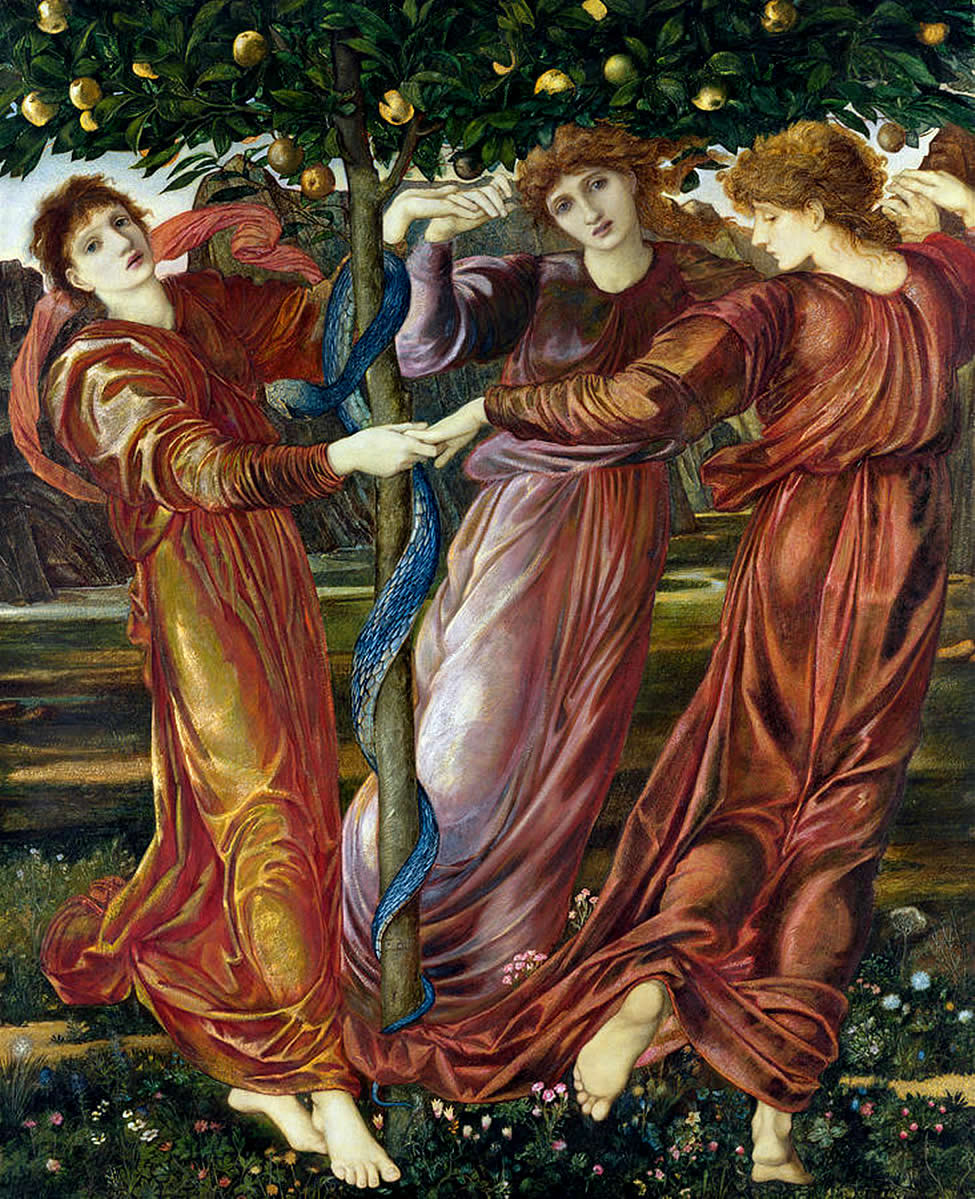
The Hesperides were the mythical nymphs who guarded the legendary Golden Apples, one of the most treasured objects in Greek mythology. Their enchanted garden was believed to lie at the western edge of the world, beyond the setting sun, where divine orchards flourished under the protection of the gods. The apples were a sacred wedding gift from Gaia (Earth) to Hera upon her marriage to Zeus, symbolizing immortality, divine authority, and everlasting youth. Because of their immense value, Hera entrusted the Hesperides with protecting the orchard alongside the fearsome hundred-headed dragon Ladon.
The Garden of the Hesperides
Ancient Greek writers placed the Garden of the Hesperides in a mysterious western paradise, sometimes associated with North Africa or islands beyond the Mediterranean Sea. The garden contained lush forests, crystal-clear springs, fragrant flowers, and the miraculous apple tree whose golden fruit granted immortality or eternal vitality.
The Hesperides themselves were often described as beautiful daughters of Atlas or Nyx, depending on the version of the myth. Their names commonly included Aegle, Erytheia, Hesperia, and Arethusa, although ancient sources vary considerably.
Protecting the garden alongside the nymphs was Ladon, an enormous serpent or dragon whose many heads remained constantly alert, ensuring that no mortal could steal the sacred fruit.
Heracles' Eleventh Labor
The Garden of the Hesperides became famous through the Eleventh Labor of Heracles. King Eurystheus ordered Heracles to retrieve several Golden Apples, believing the task to be impossible because no mortal knew the garden's location.
During his search, Heracles encountered numerous challenges before finally reaching the Titan Atlas, whose shoulders supported the heavens. Since Atlas was the father of the Hesperides in many traditions, Heracles persuaded him to collect the apples while he temporarily carried the sky in Atlas's place.
Atlas successfully returned with the Golden Apples but attempted to leave Heracles permanently burdened with holding the heavens. Heracles cleverly pretended to accept the arrangement but asked Atlas to briefly resume carrying the sky while he adjusted his cloak. Once Atlas took back the celestial burden, Heracles picked up the apples and departed, successfully completing his labor through intelligence rather than strength alone.
Symbolism of the Golden Apples
The Golden Apples symbolized immortality, divine privilege, abundance, and unattainable perfection. Their location at the edge of the known world represented humanity's endless search for wisdom, eternal life, and sacred knowledge.
The myth also emphasizes themes of perseverance, cleverness, and cooperation, illustrating that even the strongest hero occasionally relied on strategy and negotiation rather than physical force.
Legacy
The Garden of the Hesperides influenced countless later legends concerning magical gardens, sacred trees, and quests for immortality. Its imagery appears frequently in Greek and Roman art, Renaissance paintings, and modern literature, where the Golden Apples continue to represent rare and priceless rewards.
Conclusion
The myth of the Hesperides and their Golden Apples remains one of the most enchanting stories in Greek mythology. Through its magical garden, vigilant guardians, and Heracles' heroic quest, the legend celebrates courage, wisdom, and humanity's enduring desire to attain the seemingly impossible.