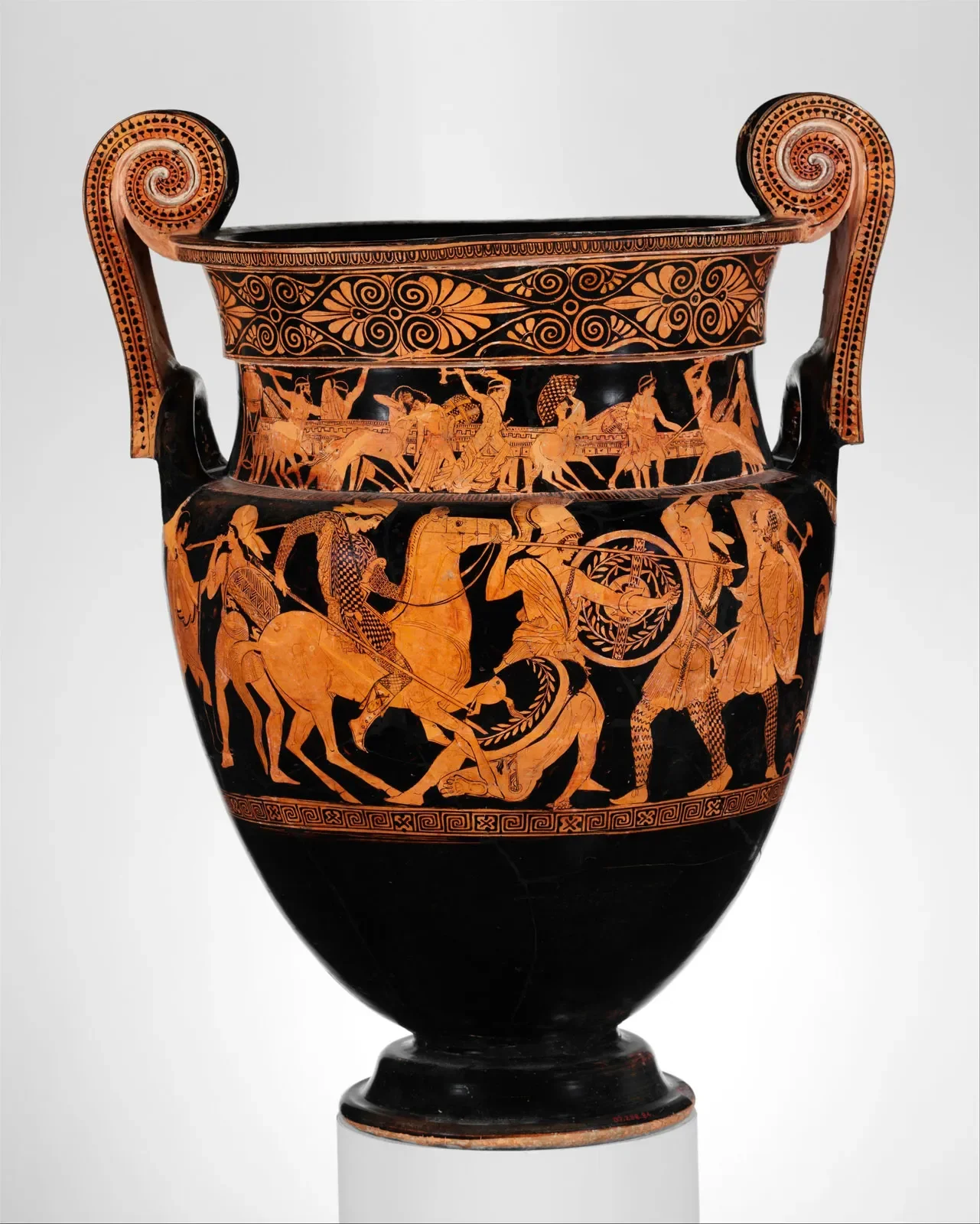
At first glance, ancient Greek red-figure pottery looks almost impossible.
The background is a deep, glossy black. Against it appear detailed human figures with muscles, clothing, faces, weapons, musical instruments, and scenes from mythology.
But the famous red figures were not painted with ordinary red paint.
The remarkable effect was created through a sophisticated combination of clay preparation, mineral-rich slip, controlled firing, and carefully managed oxygen levels inside the kiln.
The result became one of the most recognizable artistic styles of the ancient world.
What Is Red-Figure Pottery?
Red-figure pottery emerged in Athens around the late sixth century BCE, traditionally dated to approximately 530 BCE.
It developed after the earlier black-figure technique, which created dark figures against the natural reddish color of the clay.
Red-figure pottery reversed the visual relationship.
The background became black, while the figures retained the natural reddish-orange color of the fired clay.
This change gave painters enormous artistic advantages.
Why Red-Figure Was a Major Innovation
In black-figure pottery, artists created dark silhouettes and then scratched details into the surface.
This technique could produce beautiful images, but it had limitations.
Red-figure painters instead used a brush to paint details directly onto the lighter clay figures.
This allowed greater flexibility.
Artists could create:
More natural body proportions
Detailed facial features
Complex folds in clothing
Anatomically convincing muscles
Overlapping figures
More complicated poses
Greater emotional expression
The human body became increasingly dynamic.
Figures could twist, bend, sit, run, fight, and interact in ways that were more difficult to achieve using the older black-figure technique.
The First Step: Preparing the Clay
The entire process began with clay.
Athenian potters had access to iron-rich clay that fired into the characteristic reddish-orange color seen in Attic pottery.
The clay had to be prepared carefully.
Impurities and unwanted particles could interfere with the quality of the vessel. Potters processed and refined the material to create clay suitable for shaping.
The prepared clay was then formed into vessels.
Depending on the type of object, the potter might create an amphora, krater, kylix, hydria, lekythos, or another specialized form.
These were not merely decorative objects.
Greek pottery served practical purposes involving:
Storage
Transportation
Drinking
Mixing wine
Carrying water
Perfume and oil containers
Funerary practices
Religious ceremonies
Throwing the Vessel
The potter shaped many vessels using a rotating wheel.
Large or complicated vessels could be made from separate components.
A body might be formed first, followed by the foot, handles, neck, or other sections.
These parts were then carefully joined.
The process required technical skill because the object had to remain balanced and structurally stable.
A vessel that collapsed, cracked, or warped during drying or firing represented a major loss of labor.
Drawing the Scene
Once the clay vessel had reached the appropriate stage of drying, artists could begin decorating it.
The painter applied a refined clay mixture, commonly called slip, to the areas intended to become black.
The figures themselves were largely left unpainted so that the natural color of the clay would remain visible after firing.
Artists then used fine brushes to create interior details.
This is where red-figure pottery became especially impressive.
Lines could describe:
Muscles
Hair
Fingers
Drapery
Weapons
Facial features
Architectural elements
Decorative patterns
The painter was essentially creating a detailed visual narrative on a curved surface.
The Three-Stage Firing Process
The most extraordinary part of Greek pottery production occurred inside the kiln.
The famous black-and-red appearance was created not by simply applying different colors but by controlling the chemical behavior of iron compounds in the clay and slip.
The firing process generally involved three stages.
Stage One: Oxidation
The kiln was heated while oxygen was available.
Under oxidizing conditions, the iron-containing materials in the clay developed a reddish color.
At this stage, much of the pottery became red or orange.
Stage Two: Reduction
The environment inside the kiln was then changed to reduce the amount of oxygen.
Organic material could be introduced to create a smoky, oxygen-poor atmosphere.
Under these conditions, the refined slip covering the painted background turned dark and black.
The entire vessel could darken during this stage.
Stage Three: Reoxidation
Oxygen was reintroduced.
The uncoated areas of the vessel returned to their reddish-orange appearance.
However, the fine particles within the specially prepared slip had undergone a process that caused the black surface to remain dark.
The final result was the famous contrast:
Red clay figures against a glossy black background.
Why the Technique Was So Difficult
The entire process required extraordinary control.
The artist had to create the vessel correctly.
The clay had to dry without cracking.
The decorative slip had to be applied precisely.
The kiln temperature and atmosphere had to be controlled.
A mistake at any stage could ruin the final product.
This makes surviving Greek pottery particularly valuable evidence of ancient technological skill.
Famous Red-Figure Artists
Unlike many ancient artists, some Greek vase painters are known today by names or conventional labels.
Artists such as Euphronios, Euthymides, and the Berlin Painter became associated with important developments in red-figure pottery.
Their works demonstrate increasing experimentation with movement and perspective.
Artists attempted to show bodies from different angles, creating more complex visual relationships.
Although Greek vase painting did not use modern mathematical perspective, it displayed an extraordinary interest in representing the human body in space.
Pottery as Ancient Storytelling
Greek pottery was more than decoration.
The scenes painted on vases preserve stories about mythology, religion, athletics, warfare, music, drinking culture, and daily life.
A single vessel might depict:
Achilles and other heroes
Heracles performing his labors
Dionysus and his followers
Athletes preparing for competition
Warriors leaving for battle
Musicians and dancers
Domestic activities
Funerary scenes
For historians, these images provide valuable evidence.
However, they must be interpreted carefully. A painted scene was not necessarily a photograph of everyday life. Artists could combine reality, mythology, symbolism, and artistic convention.
The Legacy of Red-Figure Pottery
Red-figure pottery eventually became one of the most influential artistic products of the Greek world.
Athenian workshops exported vessels across the Mediterranean.
Today, these objects are found in archaeological sites far from Athens, demonstrating the scale of ancient trade and the prestige associated with Greek craftsmanship.
The secret behind their beauty was a remarkable fusion of art, chemistry, engineering, and storytelling.
Ancient Greek potters may not have used modern scientific terminology, but they mastered physical processes that required precise control over materials and fire.
Every surviving red-figure vase is evidence that ancient art was also ancient technology.