Long before smartphones, wristwatches, or mechanical clocks, ancient Greeks could estimate the time of day by watching a shadow move across a surface.
This sounds simple, but Greek sundials were connected to sophisticated ideas involving geometry, astronomy, latitude, and the changing position of the Sun.
The development of sundials demonstrates how ancient science transformed an everyday observation—the movement of a shadow—into a tool for measuring time.
The Basic Principle of a Sundial
A sundial works because the Earth rotates.
As the Earth turns, the apparent position of the Sun changes across the sky.
A fixed object exposed to sunlight produces a shadow.
As the Sun's apparent position changes, the direction and length of the shadow also change.
By marking predictable positions, a person can use the shadow to estimate the time.
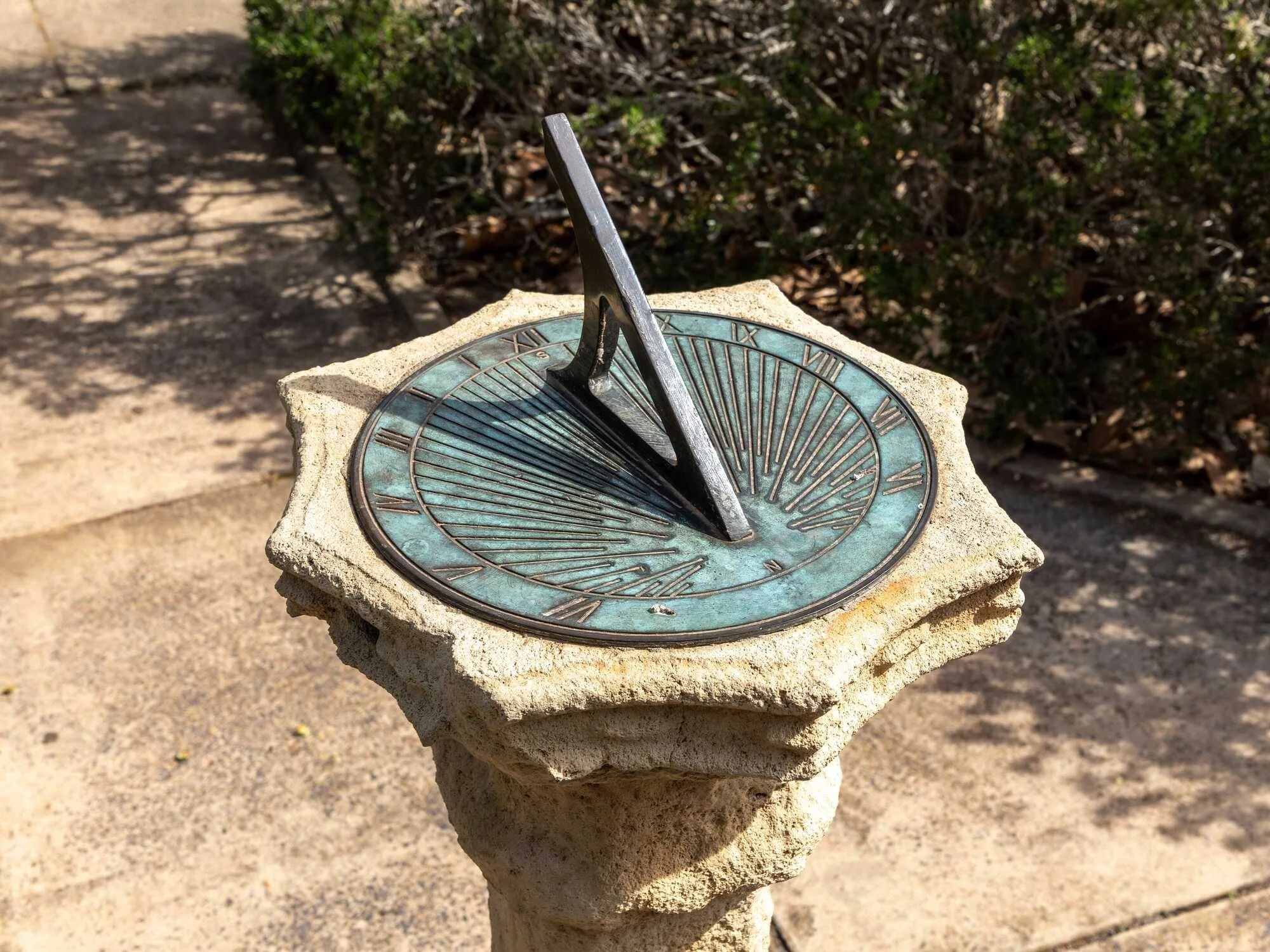
The projecting component of a sundial is often called a gnomon.
The gnomon casts the shadow.
The surface receiving the shadow contains markings representing divisions of the day.
Greeks and the Development of the Gnomon
The use of shadow-based timekeeping existed in several ancient civilizations. Greek knowledge developed within a wider Mediterranean and Near Eastern scientific world.
Greek thinkers studied the behavior of shadows and connected them to geometry and astronomy.
A vertical object produces different shadow lengths depending on the height of the Sun.
At noon, when the Sun reaches its highest daily position, the shadow is often shortest.
However, the exact pattern changes according to:
Geographic latitude
Season
Time of day
Orientation of the instrument
This meant that an accurately designed sundial was not simply a flat board with random lines.
Why Latitude Matters
One of the most important scientific challenges was that the Sun does not move through the sky in exactly the same way at every location.
A sundial designed for one latitude may not work accurately somewhere else.
This is because the angle between the Sun and the horizon changes depending on where a person is located on Earth.
Ancient Greek astronomers and mathematicians increasingly recognized the importance of geographical position.
This connection between place, celestial motion, and geometry helped transform sundials into scientific instruments.
The Changing Length of the Day
Ancient Greeks also faced another challenge.
Daylight is not always divided naturally into equal modern hours.
In many ancient systems, daylight could be divided into twelve seasonal or temporary hours.
This meant that the length of an "hour" could change depending on the season.
During summer, daylight hours were longer.
During winter, daylight hours were shorter.
A summer hour and a winter hour were therefore not necessarily equal in duration.
Sundial markings had to account for this relationship between the seasons and the changing path of the Sun.
Different Types of Greek Sundials
Ancient sundials came in several forms.
Some were relatively simple.
Others involved curved surfaces and complex mathematical calculations.
A particularly interesting design involved concave surfaces, sometimes shaped like a section of a bowl.
The shadow of the gnomon moved across the interior surface.
The curved geometry allowed designers to represent the changing solar path in more sophisticated ways.
These instruments demonstrate that ancient timekeeping was closely connected to theoretical geometry.
Greek Mathematics Made Better Sundials Possible
Greek mathematicians developed powerful traditions of geometry.
Thinkers such as Euclid, Archimedes, and later astronomers contributed to intellectual traditions that investigated space, angles, measurement, and celestial phenomena.
Although not every development can be attributed to one individual or one invention, Greek science increasingly attempted to describe natural phenomena mathematically.
A sundial became a practical demonstration of geometry.
The changing shadow translated the apparent movement of the Sun into a measurable pattern.
Sundials Were Not Perfect Clocks
Despite their sophistication, sundials had obvious limitations.
They did not work:
At night
During heavy cloud cover
Inside buildings
When visibility of the Sun was blocked
They also measured apparent solar time, which does not perfectly match the standardized clock time used today.
Modern time zones and standardized hours are relatively recent developments in human history.
Ancient Greeks did not need a device synchronized with a global network.
Their concept of time was more closely connected to the natural movement of the Sun and the daily rhythm of human activity.
Sundials and Water Clocks
Because sundials could not operate under all conditions, ancient societies also used water clocks, or clepsydrae.
These devices measured time through the controlled movement of water.
Water clocks could operate at night and indoors, although they presented their own technical problems.
Together, sundials and water clocks demonstrate that ancient Greeks possessed multiple approaches to measuring time.
Sundials and Greek Astronomy
The study of sundials was closely connected to astronomy.
To understand a shadow, one had to understand the apparent motion of the Sun.
To design an accurate instrument, one needed to consider angles and geographical position.
This encouraged the development of what would later become more formal mathematical astronomy.
Greek astronomers attempted to model the movements of celestial bodies.
They calculated celestial cycles, investigated the shape and size of the Earth, and developed increasingly complex explanations of the cosmos.
The humble sundial existed within this larger intellectual environment.
More Than a Clock
A Greek sundial was not simply a device for answering the question, "What time is it?"
It represented an attempt to connect human life with the mathematical order of the universe.
The Sun moved.
The Earth existed within a measurable world.
Shadows followed predictable patterns.
By transforming those patterns into lines and numbers, ancient Greeks demonstrated one of the central ambitions of science:
To find order in nature and make that order useful.