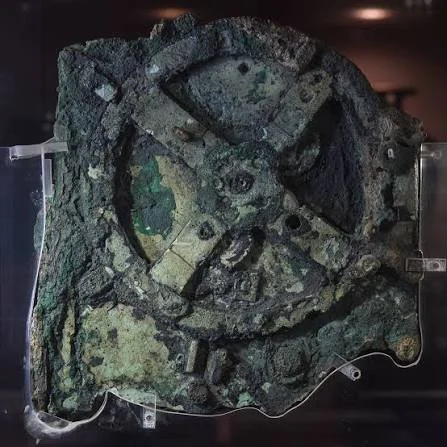
The Antikythera Mechanism is one of the most extraordinary technological discoveries from the ancient world. Recovered from a shipwreck near the Greek island of Antikythera, the device consists of a complex arrangement of bronze gears, inscriptions, scales, and mechanical components designed to model astronomical cycles.
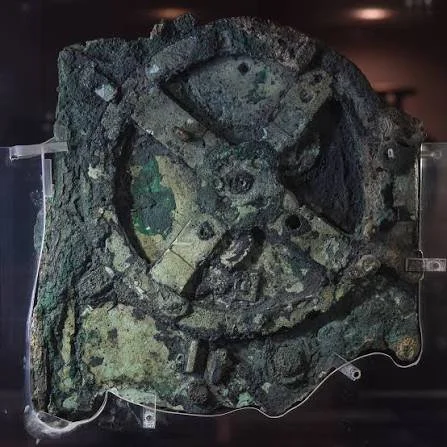
At first glance, the surviving fragments appear to be corroded pieces of metal. Yet detailed scientific investigation has revealed that they once formed an intricate mechanical system capable of tracking the movements of celestial bodies and predicting astronomical events such as eclipses.
The Antikythera Mechanism challenges modern assumptions about ancient technology. It demonstrates that Greek engineers were capable of creating sophisticated gear-driven devices more than two thousand years ago.
For this reason, the mechanism is often described as the world's earliest known surviving example of an analog astronomical computing device.
The Discovery of the Antikythera Shipwreck
The mechanism was discovered among the remains of an ancient shipwreck near Antikythera, a small island located between Crete and the Peloponnese.
In 1900, sponge divers encountered the wreck.
The site contained numerous artifacts, including:
bronze statues,
marble sculptures,
ceramics,
coins,
glassware,
and other valuable objects.
Among the recovered materials were heavily corroded bronze fragments that initially appeared difficult to interpret.
These fragments would later become known as the Antikythera Mechanism.
A Ship Carrying Luxury Goods
The shipwreck appears to have been transporting valuable objects through the Mediterranean.
Its cargo included works of art and luxury materials.
This suggests that the vessel was part of the extensive trade networks connecting different regions of the ancient world.
The mechanism may have been transported as a valuable scientific or technological object, although its exact owner and purpose cannot be known with certainty.
The First Recognition of Gears
The importance of the fragments became clearer when researchers recognized that some pieces contained gear teeth.
This was a remarkable discovery.
The mechanism was not simply a decorative object.
It contained a complex mechanical system.
The existence of precisely arranged bronze gears suggested a device designed to perform calculations through physical movement.
Why Gears Were Revolutionary
A gear system can transfer motion from one component to another.
By changing the number of teeth on interacting gears, a mechanism can produce different rates of movement.
This makes gears useful for modeling astronomical cycles.
For example, one component can move once every day while another moves according to a longer cycle.
The mechanical relationship represents a mathematical relationship.
An Ancient Analog Computer
The term “analog computer” does not mean that the Antikythera Mechanism was a computer in the modern electronic sense.
It had:
no electricity,
no digital screen,
no electronic processor,
and no programmable software.
Instead, it used physical components to represent mathematical relationships.
Turning a handle could cause interconnected gears to move.
The resulting positions of pointers and indicators represented astronomical information.
The mechanism performed calculations mechanically.
Dating the Mechanism
The shipwreck is generally dated to the late Hellenistic period, and the mechanism itself is commonly placed around the second or first century BCE, although precise dating remains a subject of scholarly investigation.
The complexity of the device suggests that it was not created without technological precedents.
A highly sophisticated mechanism usually reflects earlier experimentation and knowledge.
However, no equally complex surviving device from the same period has been discovered.
This creates one of the great mysteries surrounding the mechanism.
What Did the Front Display Show?
The front of the Antikythera Mechanism appears to have contained astronomical displays.
Researchers have reconstructed evidence for indicators connected with the movements of celestial bodies.
The device was designed to represent the cycles of:
the Sun,
the Moon,
and possibly the known planets of the ancient world.
The front display also included zodiacal and calendrical information.
The Moon's Irregular Motion
One of the most remarkable features of the mechanism was its attempt to model the changing motion of the Moon.
The Moon does not appear to move across the sky at a perfectly uniform speed.
Greek astronomers developed mathematical models to explain these variations.
The Antikythera Mechanism appears to have incorporated a mechanical system capable of representing aspects of this irregular lunar motion.
This demonstrates an extraordinary connection between astronomy and engineering.
The Back Dials
The rear of the mechanism contained spiral displays connected with important astronomical cycles.
Among the best understood are the Metonic cycle and the Saros cycle.
These cycles helped ancient astronomers organize relationships between lunar months, solar years, and eclipses.
The Metonic Cycle
The Metonic cycle is based on the approximate relationship:
19 solar years ≈ 235 lunar months.
This relationship allows a lunar calendar to be coordinated more closely with the solar year.
The Antikythera Mechanism included a display connected with this cycle.
The presence of such a system demonstrates the device's relationship with sophisticated Greek astronomical knowledge.
The Saros Cycle
The Saros cycle is associated with the recurrence of eclipses.
After a particular period, the geometric relationship between the Earth, Moon, and Sun repeats closely enough for similar eclipses to occur.
The mechanism included an eclipse prediction system connected with this cycle.
This allowed the user to identify periods in which solar or lunar eclipses were expected.
Predicting Eclipses
The mechanism could not predict eclipses in the same way as a modern computer using contemporary astronomical data.
However, it could represent known cyclical relationships.
By following the mechanical cycle, a user could identify expected eclipse events.
This was an extraordinary achievement for ancient technology.
The Olympiad Dial
Evidence also indicates that the mechanism included a system associated with major Greek athletic games.
One dial recorded a cycle involving events such as the Olympic Games.
This demonstrates that the device was not concerned only with the heavens.
It also connected astronomical and calendrical cycles with important human events.
Inscriptions on the Mechanism
The surviving fragments contain inscriptions.
Modern imaging techniques have made it possible to read portions of these texts.
The inscriptions appear to function partly as labels and explanations.
They provide valuable evidence for understanding the intended operation of the device.
In effect, the mechanism contained elements of its own instruction system.
How Did It Work?
Although the original device is incomplete, researchers have developed increasingly detailed reconstructions.
A user likely operated the mechanism by turning an input.
This movement activated a system of gears.
Different gear ratios caused indicators to move at different speeds.
The positions of the indicators represented:
dates,
lunar phases,
astronomical cycles,
eclipse predictions,
and other information.
The mechanism transformed rotational motion into astronomical calculation.
The Importance of Gear Ratios
A gear ratio is determined by the relationship between interacting gears.
If one gear has a different number of teeth from another, their rotational speeds differ.
Greek engineers could use this principle to represent numerical relationships.
This required extremely precise design.
The placement of a single gear affected the entire mechanical system.
How Was It Made?
The mechanism was constructed primarily from bronze components.
Creating precise gear teeth without modern industrial machinery required exceptional skill.
Craftsmen needed to:
shape bronze plates;
cut gears;
drill holes;
create axles;
assemble components;
and ensure that the system moved correctly.
The device likely required specialized tools and careful measurement.
Was It Made by Archimedes?
The Antikythera Mechanism is sometimes associated in popular discussions with Archimedes because ancient sources describe sophisticated mechanical devices associated with his broader scientific tradition.
However, there is no evidence proving that Archimedes personally designed or built the Antikythera Mechanism.
The association is therefore speculative.
The mechanism should be understood as evidence of a wider tradition of Hellenistic mathematics, astronomy, and mechanical engineering.
Why Is There Only One?
One of the greatest mysteries is why no other equally sophisticated device has survived.
Several explanations are possible.
First, bronze was valuable and frequently recycled.
A broken device could be melted down.
Second, complex mechanical instruments may have been rare and expensive.
Third, organic components may have decayed.
Finally, archaeological discovery is incomplete.
The absence of surviving examples does not necessarily mean that the Antikythera Mechanism was completely unique.
Modern Scientific Investigation
The mechanism has been studied using advanced technologies.
Researchers have employed methods such as:
X-ray imaging,
computed tomography,
surface imaging,
digital reconstruction,
and three-dimensional modeling.
These techniques allow scientists to examine internal structures that cannot be seen directly because of corrosion.
Modern technology has therefore made it possible to understand ancient technology.
Reconstructing Missing Parts
Many parts of the original mechanism are missing.
Researchers must therefore combine surviving evidence with mathematical reasoning.
A reconstruction is based on:
visible gears,
inscriptions,
known astronomical cycles,
physical dimensions,
and mechanical logic.
Different reconstructions may disagree about uncertain features.
This is an important part of the continuing mystery.
The Planetary Display Debate
Researchers have proposed that the Antikythera Mechanism may have included a sophisticated display representing the movements of the five planets known to ancient Greek astronomers:
Mercury,
Venus,
Mars,
Jupiter,
and Saturn.
Some modern reconstructions attempt to explain how this could have been achieved.
However, because important parts are missing, the exact design remains uncertain.
The evidence supports remarkable sophistication, but researchers must distinguish between confirmed components and plausible reconstructions.
What the Mechanism Reveals About Greek Science
The Antikythera Mechanism demonstrates that ancient Greek science involved more than abstract philosophy.
Greek scholars developed mathematical models of the universe.
Engineers could translate some of those models into physical mechanisms.
The device therefore represents the intersection of:
astronomy,
mathematics,
metallurgy,
engineering,
and craftsmanship.
Ancient Knowledge Was Not Linear
The Antikythera Mechanism also reminds historians that technological development is not always a simple upward progression.
A society can develop a sophisticated technology that later becomes rare or disappears.
Knowledge can be:
lost,
forgotten,
restricted to specialists,
or destroyed through economic and political change.
The mechanism demonstrates that technological history includes both innovation and loss.
The Mystery of the Lost Tradition
The sophistication of the Antikythera Mechanism suggests a broader tradition of mechanical astronomy.
Ancient writers describe devices and machines associated with astronomical study.
However, the physical evidence is limited.
The mechanism may represent the surviving fragment of a technological tradition that has largely disappeared.
This possibility makes it historically significant.
Why the Antikythera Mechanism Still Fascinates Us
The mechanism fascinates modern audiences because it challenges expectations.
People often imagine ancient technology as simple.
A corroded collection of bronze fragments containing dozens of interconnected gears forces us to reconsider that assumption.
The device shows that ancient engineers could build machines capable of representing complex mathematical relationships.
Conclusion
The Antikythera Mechanism remains one of the greatest mysteries of ancient technology.
Recovered from a shipwreck after lying beneath the sea for centuries, its corroded fragments revealed an astonishing system of gears designed to model astronomical and calendrical cycles.
The mechanism could track relationships involving the Sun and Moon, represent important cycles such as the Metonic and Saros periods, and identify expected eclipse events. Evidence also points toward additional functions involving calendars, athletic cycles, and possibly planetary motion.
Its exact original appearance remains uncertain because important parts are missing.
That uncertainty is part of its fascination.
The Antikythera Mechanism stands at the meeting point of science and craftsmanship. It demonstrates that ancient Greek thinkers did not merely observe the universe.
They attempted to calculate it, model it, and build a machine capable of representing its rhythms.
More than two thousand years later, the mechanism continues to remind us that much of ancient knowledge remains hidden not necessarily because it never existed, but because only fragments have survived.