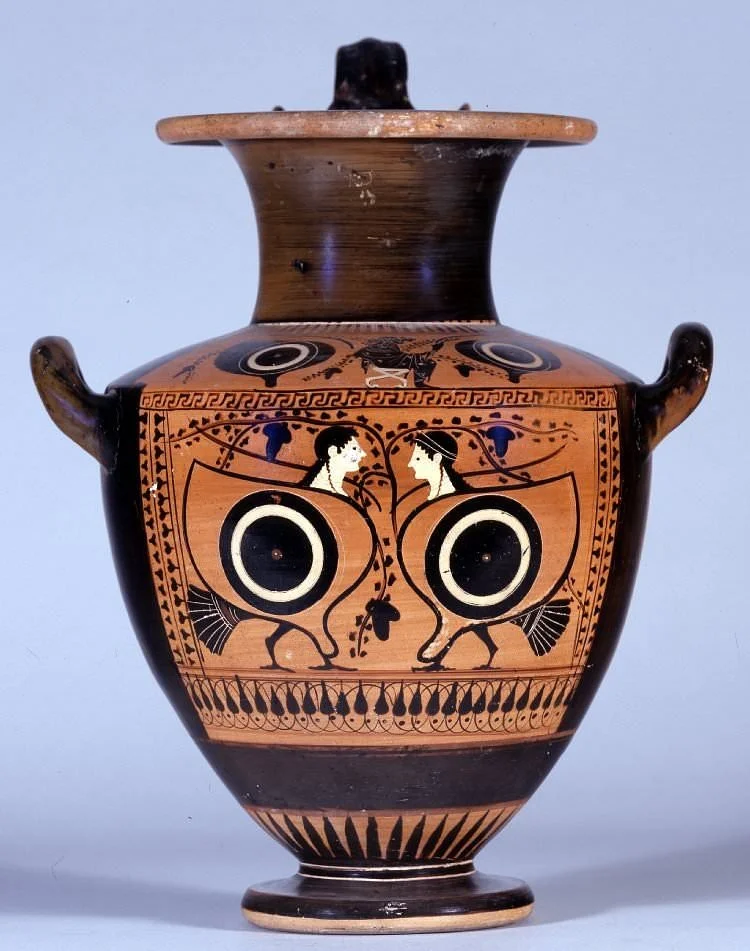
Ancient Greek pottery is famous for its striking red-and-black appearance. Modern viewers often assume that Greek potters painted their vessels using black and red pigments in the same way a modern artist applies paint to a canvas. In reality, the famous colors of Greek pottery were produced through a remarkably sophisticated combination of clay chemistry, mineral composition, surface preparation, kiln control, and firing technique.
The story behind the colors of Greek pottery is therefore a story of ancient technology.
Greek potters learned how to manipulate the physical and chemical properties of iron-rich clay to create dramatic contrasts between red and black surfaces. The most famous techniques—the black-figure and red-figure styles—did not depend primarily on two different colors of paint. Instead, they depended on controlling the atmosphere inside the kiln.
This achievement required generations of experimentation and specialized knowledge.
Why Greek Pottery Was Important
Pottery was essential to ancient Greek life.
Ceramic vessels were used for:
storing grain,
transporting liquids,
serving food,
mixing wine,
preparing cosmetics,
carrying perfume,
and participating in religious or funerary rituals.
Pottery was practical, but it also became an artistic medium.
A vase could contain detailed scenes involving:
mythology,
warfare,
athletics,
daily life,
religious rituals,
and social gatherings.
The colors made these scenes visually powerful.
The Natural Color of Greek Clay
Many Greek clays contained significant amounts of iron.
When fired under oxygen-rich conditions, iron compounds could produce reddish or orange colors.
This natural property created the warm red background associated with much Greek pottery.
The exact color depended upon:
the chemical composition of the clay,
firing temperature,
oxygen availability,
and the characteristics of the kiln.
Greek potters therefore worked with the natural properties of local materials.
Attic Clay
The pottery of Athens became especially famous.
Attic clay was valued for its ability to produce a distinctive orange-red color after firing.
This made it particularly suitable for decorative techniques.
The visual contrast between the red body of the vessel and the dark figures became a defining feature of Athenian pottery.
The Black “Paint” Was Not Ordinary Paint
The dark decoration applied to Greek pottery is often described as black paint.
However, it was not simply a modern-style pigment painted onto an already finished ceramic surface.
Potters used a fine clay mixture or slip that behaved differently from the body of the vessel during firing.
The transformation depended on carefully controlled kiln conditions.
This made Greek pottery production both artistic and scientific.
Preparing the Clay
Before a vessel could be shaped, the raw clay needed preparation.
This could involve:
collecting clay;
removing unwanted materials;
mixing and refining the clay;
adding water to create workable consistency;
allowing the material to settle or age.
The quality of the clay influenced the final vessel.
A poorly prepared mixture could crack or contain impurities.
Shaping the Vessel
Greek potters commonly used the potter's wheel.
The wheel allowed symmetrical forms to be created efficiently.
A vessel might be made from several separately shaped components.
These could include:
the body,
the neck,
the foot,
and the handles.
The components were then carefully joined.
Drying Before Decoration
The vessel could not be fired immediately.
It first needed to dry to an appropriate condition.
If a vessel containing too much moisture entered a hot kiln, trapped water could create pressure and cause cracking or even breakage.
The timing of decoration was also important.
The surface needed to be firm enough for detailed work but still capable of interacting properly with the applied slip.
The Black-Figure Technique
The black-figure technique became especially important during the Archaic period.
In this style, artists painted the main figures using the fine clay slip.
Details could then be created through incision.
A sharp tool removed portions of the dark surface, revealing the lighter clay beneath.
This allowed artists to create:
muscles,
clothing,
hair,
weapons,
and facial details.
Additional colors could also be applied in some cases.
The Art of Incision
Incision was one of the defining features of black-figure pottery.
The artist had to work with precision.
A line cut too deeply could damage the surface.
A poorly placed line could not easily be erased.
The technique therefore demanded control and planning.
The Red-Figure Technique
The red-figure technique reversed the visual relationship.
Instead of painting the figures black and leaving the background red, the artist left the figures in the natural red color of the clay.
The surrounding background was filled with the dark slip.
This allowed details to be painted directly onto the red figure using brushes rather than created primarily through incision.
Why Red-Figure Pottery Allowed More Detail
Painting with a brush allowed greater flexibility.
Artists could create:
curved lines,
detailed anatomy,
folds of clothing,
facial features,
and complex overlapping forms.
This contributed to increasingly naturalistic representations of the human body.
The development of red-figure pottery therefore represented both a technical and artistic innovation.
The Three-Stage Firing Process
The most important secret behind the famous colors was the firing process.
Greek potters used a carefully controlled sequence of changes in temperature and oxygen.
Although the exact procedures could vary, the basic process involved three major stages.
Stage One: Oxidation
The kiln received sufficient oxygen.
The iron in the clay reacted with oxygen.
The vessel and its surface developed a reddish color.
At this stage, the entire object could appear relatively similar in color.
Stage Two: Reduction
The oxygen supply was reduced.
The kiln atmosphere became smoky and chemically different.
Under these conditions, iron compounds changed, and the vessel became much darker.
The surfaces could appear black or dark gray.
Stage Three: Reoxidation
Oxygen was reintroduced.
The porous clay body returned toward its reddish color.
However, the fine slip used for the painted areas had become more tightly vitrified and did not respond in exactly the same way.
As a result, the vessel developed the characteristic contrast between red clay and black decoration.
Why the Painted Areas Stayed Black
The fine slip used by Greek painters contained very small clay particles.
During firing, these surfaces could become denser and more vitrified than the larger clay body.
When oxygen returned during the final stage, the porous body of the vessel could return to a red color.
The vitrified slip remained dark.
The result was the distinctive black-and-red appearance.
This process required careful control.
The Potter's Kiln
The kiln was one of the most important pieces of technology.
A pottery kiln needed to achieve high temperatures while allowing the craftsperson to control airflow.
The potter needed to manage:
fuel,
heat,
oxygen,
smoke,
and timing.
A mistake could ruin an entire batch of vessels.
Fuel and Temperature
Wood was a common source of fuel.
The burning fuel created heat, but the amount of oxygen entering the kiln influenced the chemical environment.
A potter could not simply light a fire and wait.
Successful firing required active management.
The craftsperson needed to understand the behavior of the kiln.
Why Kiln Failure Was Expensive
A failed firing could cause:
cracking,
warping,
unwanted colors,
or complete destruction of the vessel.
Because pottery required time and labor before firing, the kiln represented a critical point in production.
The potter could spend hours or days preparing objects that might be ruined by a single mistake.
This encouraged the development of specialized knowledge.
Additional Colors
Although black and red are the most famous colors, Greek pottery could include additional shades.
Artists sometimes applied white or red-purple details.
These could be used for:
clothing,
skin,
decorative patterns,
and special objects.
However, some added colors were less durable than the main black-and-red effects.
This is why many surviving vessels appear simpler today than they originally did.
The White-Ground Technique
Another important Greek pottery style is known as white-ground pottery.
In this technique, a light-colored surface was created and then painted with additional colors.
White-ground vessels could produce delicate and detailed images.
However, the surface was often less durable than the fully fired black-and-red decoration.
Many colors have therefore deteriorated over time.
Pottery and Storytelling
Greek pottery was not simply decorative.
It preserved visual stories.
Artists represented scenes involving:
Heracles,
Athena,
Achilles,
Odysseus,
Dionysus,
athletes,
musicians,
weddings,
funerals,
and ordinary work.
These images provide historians with important evidence about Greek culture.
Mythology on Pottery
Mythological scenes allowed artists to transform familiar stories into visual narratives.
A single vessel could capture a dramatic moment.
The artist needed to decide:
which characters to include;
how to identify them;
how to organize the composition;
and which moment of the story to represent.
Pottery therefore became a form of visual storytelling.
Everyday Life on Pottery
Not all pottery depicted gods and heroes.
Some scenes show:
athletic training,
music,
domestic activity,
warfare,
drinking,
and religious ceremonies.
These images help historians reconstruct aspects of ancient life.
However, pottery images should not automatically be treated as photographs.
Artists could idealize, exaggerate, or follow artistic conventions.
Famous Vessel Shapes
Greek potters created specialized forms for different uses.
These included:
Amphora
Used primarily for storage and transport.
Krater
Used for mixing wine and water.
Kylix
A wide drinking cup.
Lekythos
Often associated with oil and, in some contexts, funerary use.
Aryballos
A small vessel commonly associated with scented oil, especially in athletic contexts.
The shape of a vessel often reflected its intended function.
The Pottery Workshop
A Greek pottery workshop could include multiple specialists.
One person might shape the vessel.
Another could decorate it.
Others might prepare clay, manage the kiln, or transport finished products.
Some individuals were both potters and painters.
In other cases, labor was divided.
Potters and Painters
Ancient Greek vessels sometimes contain signatures.
A craftsperson might identify themselves as the maker or painter.
These signatures provide rare evidence for individual artists.
However, many surviving works remain anonymous.
Modern scholars often assign names based on distinctive styles when the original artist's identity is unknown.
Trade and Greek Pottery
Greek pottery was widely traded.
Athenian vessels have been discovered far beyond Athens.
Their distribution demonstrates the importance of maritime commerce.
A decorated vase could travel across the Mediterranean as:
a household object,
a trade item,
a luxury product,
or a cultural artifact.
Greek pottery therefore spread artistic styles between communities.
Pottery as Evidence for Archaeologists
Ceramics survive exceptionally well.
Unlike wood or textiles, fired clay can remain in the ground for thousands of years.
Even when a vessel breaks, fragments known as sherds can survive.
Archaeologists use pottery to study:
trade,
chronology,
artistic development,
household activity,
and cultural exchange.
How Modern Science Studies Greek Pottery
Researchers can examine ancient pottery using scientific methods.
These may include:
microscopic analysis,
chemical testing,
mineral analysis,
and examination of firing conditions.
Such techniques help identify:
clay sources,
manufacturing methods,
and trade patterns.
Modern science has therefore revealed much about the technological sophistication behind ancient pottery.
The Meaning of the Colors
The famous colors of Greek pottery were not selected randomly.
They resulted from the interaction between:
local clay,
iron chemistry,
fine slip,
artistic design,
and controlled firing.
The red and black appearance became visually distinctive because Greek craftsmen learned how to control these processes with remarkable consistency.
Conclusion
The story behind the colors of Greek pottery is a story of art meeting chemistry.
Greek potters did not simply paint black figures onto red clay. They manipulated the chemical behavior of iron-rich clay through carefully controlled stages of oxidation, reduction, and reoxidation.
The black-figure technique used dark slip and incision to create detailed images, while the later red-figure technique reversed the relationship between figure and background and allowed artists to paint more complex interior details.
Behind every surviving Greek vase was a long process involving:
clay collection,
purification,
shaping,
drying,
decoration,
and high-temperature firing.
A single mistake in the kiln could ruin the entire object.
The famous red-and-black vessels of ancient Greece therefore represent far more than beautiful artwork.
They are evidence of an advanced technological tradition in which potters understood through observation, experience, and experimentation how to transform ordinary earth into objects of extraordinary color, durability, and artistic power.