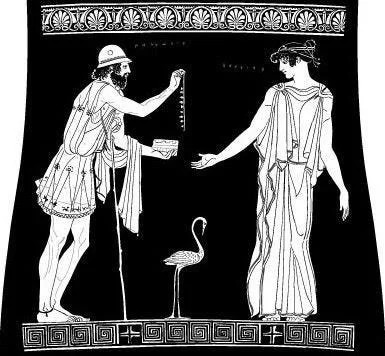
Among the most enduring objects of destruction in Greek mythology is the necklace of Harmonia, a magnificent wedding gift whose beauty concealed a devastating curse. Often associated with the fall of Thebes and the repeated destruction of its royal family, the necklace became a symbol of how violence, betrayal, and divine punishment could continue across generations. Unlike a weapon that kills only through direct use, Harmonia’s necklace represented a more disturbing idea: that an object could carry the consequences of an original crime long after the people responsible for that crime were gone.
The story of the necklace is inseparable from the myth of Cadmus and Harmonia, the founding generation of Thebes. Cadmus, a Phoenician prince and the legendary founder of the city, married Harmonia, a divine woman commonly identified as the daughter of Ares, the god of war, and Aphrodite, the goddess of love. Their marriage united two opposing forces—war and love—and was celebrated on Mount Olympus by the gods themselves. Yet the marriage also contained the seed of future disaster.
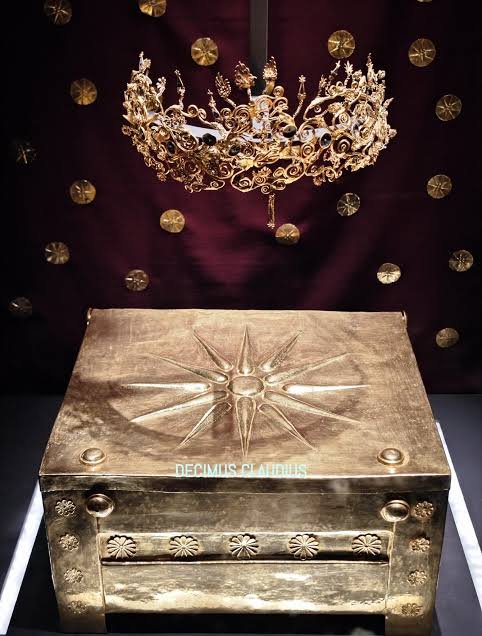
According to the most familiar version of the myth, Harmonia received a magnificent necklace from Cadmus. Ancient traditions differ concerning its maker and precise origin. In some accounts, the divine craftsman Hephaestus created it; in others, its association with Cadmus and the gods remained central while the details of its manufacture varied. What remained consistent was its extraordinary beauty and its destructive reputation. The necklace was often paired with another famous object, a robe or peplos, and together these treasures later passed through generations of Theban rulers.
Cadmus, Harmonia, and the Founding of Thebes
Before the curse of the necklace affected later generations, the story began with Cadmus himself. Cadmus arrived in Greece while searching for his sister Europa, who had been carried away by Zeus. After receiving guidance from an oracle, he followed a cow and founded a settlement where the animal eventually stopped. This settlement became associated with Thebes.
Cadmus's arrival was followed by another violent event. He encountered a sacred dragon or serpent associated with Ares and killed it. The creature guarded a spring, and Cadmus's killing of it brought him into conflict with the god of war. On the advice of Athena, Cadmus sowed the dragon's teeth into the earth. Armed warriors known as the Spartoi, or “Sown Men,” emerged from the ground.
These warriors fought one another until only a small number survived. The survivors became ancestors of important Theban families. Thus, violence was embedded in the mythological foundation of Thebes from the beginning. Cadmus established the city, but its origin involved bloodshed, conflict, and divine consequences.
Cadmus eventually married Harmonia in one of Greek mythology's most celebrated weddings. The gods themselves attended the event, making the union extraordinary even by mythological standards. However, ancient Greek mythology frequently warns that closeness to the gods does not guarantee happiness. A divine celebration could still produce a tragic future.
The Origin of the Necklace
The precise origin of Harmonia's necklace differs among ancient sources. One major tradition connects the necklace to Hephaestus, the god of fire and craftsmanship. In this version, the object was associated with the complicated relationship between Hephaestus and Aphrodite.
Aphrodite, according to Greek mythology, was unfaithful to Hephaestus with Ares. Harmonia was traditionally considered the daughter of Aphrodite and Ares. Because of this connection, some later accounts interpreted the necklace as carrying the anger or revenge associated with the betrayal of Hephaestus.
The idea is symbolically powerful. A marriage gift intended to celebrate Harmonia's union may have originated in a story of marital betrayal. The necklace therefore connected love, marriage, beauty, jealousy, and revenge within a single object.
However, ancient myths do not always provide one fixed version. Greek mythology developed through poetry, oral tradition, local religious practices, drama, and later literary retellings. The exact nature of the curse and the role of Hephaestus vary depending on the source.
What remains central is the later history of the necklace.
Beauty and Destruction
The necklace possessed extraordinary value. It was a royal treasure and an object of exceptional beauty. Yet its beauty was inseparable from its danger.
This combination reflects an important pattern in Greek mythology. Objects that appear desirable can also become instruments of destruction. Wealth, power, beauty, and status are rarely presented as purely beneficial. Instead, they can create envy, ambition, rivalry, and violence.
The necklace became a physical representation of this principle.
Whoever possessed it gained a magnificent object of prestige. Yet possession often became associated with catastrophe.
The curse therefore worked through human desire.
People wanted the necklace because it was beautiful and valuable.
Their desire for it contributed to decisions that produced tragedy.
The Necklace Passes to the Next Generation
Cadmus and Harmonia had several children, and their descendants became central figures in Theban mythology. Their family included Semele, the mother of Dionysus; Ino; Autonoe; Agave; and Polydorus.
The royal house of Thebes repeatedly suffered from violence and divine punishment.
Thebes became the setting for some of Greek mythology's most famous tragedies, including the stories of Oedipus, Antigone, Eteocles, and Polynices.
The cursed necklace entered this larger network of Theban disasters.
Its history became particularly important during the conflict involving Polynices, one of the sons of Oedipus.
Polynices and the Conflict for Thebes
After Oedipus's downfall, his sons Eteocles and Polynices were expected, in some versions of the story, to share or alternate control over Thebes. Instead, their relationship deteriorated.
Eteocles refused to surrender power.
Polynices was driven into exile.
The brothers eventually became enemies.
Polynices traveled to Argos, where he married Argeia, the daughter of King Adrastus. He then sought military support to reclaim Thebes.
This conflict produced the famous expedition known as the Seven Against Thebes.
Seven leaders marched against the city's seven gates.
The campaign ended in disaster.
Most importantly, Eteocles and Polynices killed one another in a fratricidal battle.
The struggle for political power had destroyed both brothers.
Eriphyle and the Necklace
The cursed necklace played a crucial role in convincing Eriphyle, the wife of the Argive hero Amphiaraus, to support Polynices's campaign.
Amphiaraus was a prophet and knew that the expedition against Thebes would end disastrously. He therefore refused to join it.
However, a previous agreement had established that disputes between Amphiaraus and Adrastus would be resolved through Eriphyle.
Polynices needed Amphiaraus to participate in the war.
To influence Eriphyle, Polynices offered her Harmonia's necklace.
Eriphyle accepted the gift.
She then ordered or compelled Amphiaraus to join the expedition despite his knowledge that he would die.
This episode transformed the necklace from a symbolic curse into a direct instrument of political and military tragedy.
A piece of jewelry became more powerful than prophecy.
Amphiaraus knew the future.
He knew the campaign would kill him.
Yet the necklace helped create circumstances in which he could not avoid participation.
The Death of Amphiaraus
Amphiaraus fought in the war against Thebes, and the prophecy proved correct.
He faced death during the conflict.
According to the myth, Zeus intervened to prevent Amphiaraus from being killed or captured by his enemies. The earth opened, and Amphiaraus, along with his chariot, disappeared into the ground.
He later became associated with a hero cult and an oracle.
His death—or transformation—was therefore unusual.
But for his family, the consequences continued.
Before leaving for the expedition, Amphiaraus instructed his son Alcmaeon to avenge him.
The necklace had helped cause Amphiaraus's death.
Eriphyle's acceptance of the gift became the foundation of another family tragedy.
Alcmaeon and the Murder of Eriphyle
After Amphiaraus's death, his son Alcmaeon faced a terrible conflict.
He was expected to obey his father's command and avenge him.
But the person responsible for sending Amphiaraus to war was Alcmaeon's own mother.
Alcmaeon eventually killed Eriphyle.
This act created another crisis.
In Greek religious thought, the killing of a close family member could produce ritual pollution and attract divine punishment. Alcmaeon therefore became a figure pursued by the consequences of his own act.
The Erinyes, divine powers associated with vengeance and the punishment of certain crimes, were connected with his suffering in later traditions.
Thus, the necklace contributed indirectly to a chain of events:
Polynices desired military support.
He offered the necklace to Eriphyle.
Eriphyle accepted it.
Amphiaraus was forced into a war he knew he would not survive.
Alcmaeon killed Eriphyle to avenge his father.
Alcmaeon himself became pursued by the consequences of kin-killing.
The curse therefore did not operate as a simple magical spell.
It operated through choices, relationships, ambition, and obligation.
The Second Expedition Against Thebes
The story continued with the Epigoni, the sons of the heroes who had participated in the original expedition.
They launched another campaign against Thebes.
Alcmaeon was among the important leaders.
Once again, the necklace became associated with political ambition and family conflict.
In some traditions, Alcmaeon gave the necklace to his wife or another woman connected with his later life. This transfer continued the object's destructive pattern.
The exact sequence varies among ancient accounts, but the central theme remains consistent: possession of the necklace repeatedly became connected with violence and misfortune.
Alcmaeon and the Curse of the Land
After killing his mother, Alcmaeon was driven from place to place.
The pollution associated with the murder affected not only him but, according to some traditions, the lands in which he sought refuge.
Eventually, he arrived in a place associated with newly formed land at the mouth of the river Achelous.
This land had not existed when Alcmaeon committed the murder.
Because of this unusual circumstance, it could provide him with a place of purification.
The story demonstrates another important feature of Greek myth: guilt and pollution could be understood geographically as well as personally.
A person carrying a curse could bring misfortune to an entire community.
The Necklace as an Object of Desire
Why did the necklace continue to cause destruction?
One explanation lies in the role of desire.
The necklace was valuable enough to influence decisions that should have been governed by loyalty, morality, or family responsibility.
Eriphyle accepted it even though doing so meant sending her husband toward death.
The object therefore exposed a conflict between material desire and ethical obligation.
Greek mythology repeatedly examines this problem.
People may know what they should do.
Yet desire can lead them in another direction.
The necklace became a physical symbol of temptation.
The Relationship Between the Necklace and Thebes
The curse is also deeply connected with the broader mythology of Thebes.
The royal family repeatedly experienced:
betrayal,
murder,
incest,
civil war,
exile,
divine punishment,
and conflict between family duty and political authority.
The necklace did not cause every disaster in Theban mythology.
However, it became one of the objects through which the destructive history of the royal house could be represented.
The curse appeared to move from generation to generation just as violence itself moved through the family.
A Comparison with Other Cursed Objects
Greek mythology contains several dangerous objects whose possession brings disaster.
The necklace of Harmonia belongs to this wider tradition.
Such objects are rarely dangerous simply because they possess magical power. Their destructive influence often depends upon human behavior.
A treasure creates greed.
A weapon creates a desire for revenge.
A crown creates ambition.
The necklace of Harmonia combines all of these ideas through beauty.
It is dangerous because people want it.
Fate and Human Choice
The myth also raises an important question:
Were the victims of the necklace controlled by fate, or were they responsible for their own decisions?
Greek mythology frequently presents fate and personal choice as interconnected.
Eriphyle chose to accept the necklace.
Polynices chose to use it as a bribe.
Alcmaeon chose to obey his father's command.
Yet each individual also acted within a network of family obligations, prophecies, curses, and inherited conflicts.
The tragedy comes from the fact that no decision appears entirely free from consequences.
The Necklace in Later Greek Memory
The necklace remained famous long after the earliest myths were established.
Later Greek and Roman writers continued to refer to it as an object associated with Theban tragedy.
Its fame eventually became part of a broader literary tradition in which cursed objects carried the history of the crimes connected with them.
The object could therefore function almost like a historical record.
Each new owner inherited not only the necklace itself but also its terrible past.
What the Necklace Symbolizes
The necklace of Harmonia can be interpreted in several ways.
The inheritance of violence
The object passes from one generation to another, just as unresolved conflicts can affect descendants.
The danger of material desire
Its beauty creates temptation.
The corruption of relationships
The necklace repeatedly appears within conflicts involving husbands, wives, parents, and children.
The connection between wealth and power
It functions as a political instrument because it can be used to influence important decisions.
The impossibility of escaping the past
The crimes associated with the object continue to affect people who did not commit the original wrongdoing.
Harmonia's Name and the Irony of the Curse
Perhaps the most striking element of the myth is the name Harmonia itself.
Her name is associated with harmony, agreement, and balance.
Yet the necklace connected with her becomes one of the most destructive objects in Greek mythology.
This contrast may be intentional.
Greek myths often emphasize the fragility of order.
Harmony can exist beside conflict.
A wedding can contain the beginning of tragedy.
A beautiful object can carry destruction.
A family can contain both love and violence.
Conclusion
The story of Harmonia's cursed necklace is ultimately more than the tale of a magical object.
It is a story about how violence can survive across generations.
From Cadmus's violent encounter with the dragon, through the political conflict between Polynices and Eteocles, to Eriphyle's betrayal of Amphiaraus and Alcmaeon's revenge against his mother, the necklace repeatedly appears at moments when desire and obligation collide.
Its curse is therefore not simply supernatural.
The necklace becomes dangerous because human beings allow beauty, ambition, greed, and revenge to influence their decisions.
Each owner inherits an object.
But they also inherit a history.
That is why Harmonia's necklace remains one of the most powerful symbols of tragedy in Greek mythology. It demonstrates a central idea found throughout Greek myth: the consequences of violence are rarely confined to the generation that first commits it.