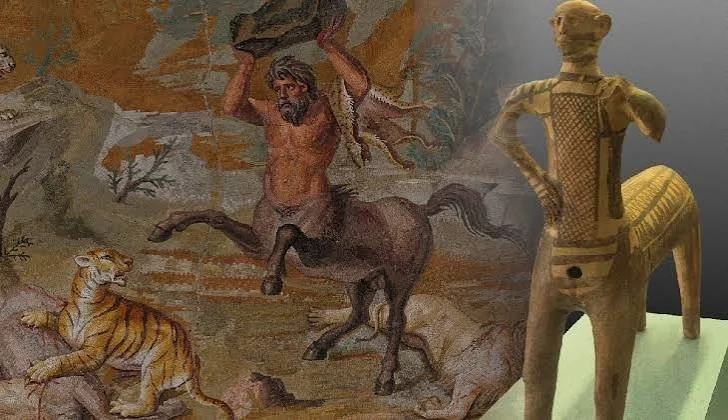
Half Human, Half Horse: How Greek Mythology Created One of Its Most Fascinating Hybrid Creatures
Few creatures are as immediately recognizable as the centaur.
Human torso.
Horse body.
Wild strength.
The centaur became one of the most enduring figures of Greek mythology.
But there was never just one kind of centaur.
Greek traditions portrayed them in different ways.
Some were violent and uncontrolled.
Others were wise teachers.
The contrast reveals an important Greek idea:
civilization and instinct can exist within the same creature.
What Is a Centaur?
A centaur is traditionally a hybrid creature combining:
Human upper body.
Horse lower body.
The image is so distinctive that it has become one of the world's most recognizable mythological forms.
The Mythological Origin
Greek genealogical traditions often connect the centaurs with Ixion and Nephele, a cloud figure created by Zeus.
According to one version, Ixion attempted to violate Hera.
Zeus created a cloud resembling her.
Ixion mated with the cloud.
The resulting offspring became associated with the centaurs.
The genealogy varies across sources.
The Centaurs of Thessaly
Centaurs were particularly associated with Thessaly.
This region had strong connections with horses.
Horse culture may have contributed to the development of the hybrid image.
A people associated with horsemanship could be imagined mythologically as beings who were literally one with their horses.
Wildness and Civilization
Many centaurs were portrayed as:
Drunken.
Violent.
Lustful.
Uncontrolled.
They represented the forces of instinct.
This contrasted with Greek ideals of:
Self-control.
Rationality.
Moderation.
Civilization.
The centaur therefore became a visual metaphor.
Human intelligence was combined with animal instinct.
Which side would win?
The Battle With the Lapiths
The most famous conflict involving centaurs was the Centauromachy, the battle between the Centaurs and the Lapiths.
The conflict began at a wedding.
The centaurs became intoxicated.
One attempted to abduct the bride.
Violence erupted.
The Lapiths fought back.
Why the Story Was Important
The battle represented a conflict between:
civilization and barbarism.
The Lapiths represented social order.
The centaurs represented uncontrolled appetite.
The myth was therefore more than a monster story.
It expressed Greek ideas about civilized behavior.
Centaurs in Greek Art
Centaurs appeared frequently in Greek art.
They decorated:
Pottery.
Temple sculpture.
Architectural reliefs.
Shields.
Decorative objects.
Their hybrid bodies provided artists with fascinating compositional possibilities.
The human torso could express emotion.
The horse body could express motion.
Chiron: The Exception
Not all centaurs were violent.
The most famous exception was Chiron.
Chiron was wise, educated, and civilized.
He was associated with:
Medicine.
Hunting.
Education.
Music.
Heroic training.
He taught famous figures including:
Achilles.
Asclepius.
Jason.
Why Chiron Was Different
Chiron's character demonstrates that the centaur did not automatically represent evil.
The hybrid could symbolize both sides of human existence.
Animal nature was not necessarily destructive.
It could be disciplined and transformed into knowledge.
Chiron and Medicine
Chiron's connection with medicine is especially important.
The Greek god of medicine, Asclepius, was traditionally trained by Chiron.
This creates an interesting mythological lineage:
the half-animal teacher becomes the source of knowledge that saves human lives.
The Centaur as a Symbol
The centaur can represent:
Instinct.
Violence.
Sexuality.
Wilderness.
Strength.
Knowledge.
Education.
Its meaning depends on the individual story.
Why Centaurs Survived
The centaur is powerful because it combines two worlds.
The human body represents intelligence and culture.
The horse body represents movement and instinct.
The creature therefore embodies an ancient question:
What happens when civilization and nature exist inside the same being?
The violent centaurs answer:
Instinct can destroy civilization.
Chiron gives a different answer:
Instinct can be disciplined and transformed into wisdom.
That contrast is why the centaur became much more than a monster.
It became one of Greek mythology's most enduring symbols of the struggle between human reason and animal nature.