The Princess Who Was Carried Across the Sea by Zeus—and Gave Her Name to Europe
The story of Europa is one of the most famous myths connecting Greek mythology with geography.
Europa was a Phoenician princess.
Zeus became fascinated with her and transformed himself into a magnificent white bull.
Europa approached the animal.
She eventually climbed onto its back.
Then the bull suddenly entered the sea and carried her away.
The destination was Crete.
The Disguised Zeus
Zeus frequently appears in Greek mythology as a god capable of changing his form.
His transformation into a bull allowed him to approach Europa without immediately revealing his identity.
The animal was described as exceptionally beautiful and gentle.
The Abduction
Europa initially trusted the bull.
She touched it.
Admired it.
Eventually she climbed onto its back.
Once she was seated, Zeus carried her into the sea.
The myth describes a sudden transition from safety to danger.
Arrival in Crete
Europa eventually reached Crete.
There, Zeus revealed his identity.
The story varies in details depending on ancient sources and later traditions.
Europa became associated with the island and with Zeus.
The Children of Europa
Europa became the mother of several important mythological figures, including:
Minos.
Rhadamanthus.
Sarpedon.
Minos became particularly important in Cretan mythology.
He was associated with the palace at Knossos and the legend of the Minotaur.
The Origin of a Name
The name Europe became associated with the continent.
However, the exact historical development of the geographical name “Europe” is much more complicated than simply saying that the continent was named after the mythological Europa.
The myth nevertheless became a powerful later explanation for the name.
Europa in Ancient Art
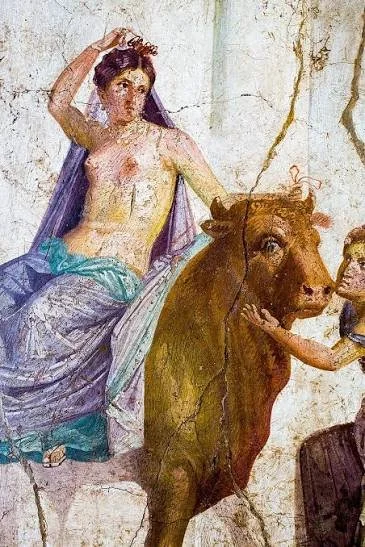
The scene of Europa riding the bull became popular in ancient art.
It appeared on:
Pottery.
Mosaics.
Coins.
Sculptural works.
The image was visually dramatic.
A woman riding a bull across the sea created an immediately recognizable mythological composition.
What Does the Bull Represent?
The bull could symbolize:
Strength.
Fertility.
Royal power.
Sexual power.
Divine transformation.
The myth combines all of these themes.
The Darker Side of the Story
Modern readers often encounter the myth as a romantic image.
But the ancient story involves divine deception and abduction.
The power imbalance is enormous.
Europa is a mortal.
Zeus is the supreme god.
This is consistent with a recurring pattern in Greek mythology in which gods exercise overwhelming power over mortals.
Why Europa Became So Important
Europa's story connects mythology, geography, and political identity.
She begins as a princess.
She becomes connected with Crete.
Her children become kings and heroes.
And her name eventually becomes associated with an entire continent.
Few mythological characters have had such a long geographical afterlife.