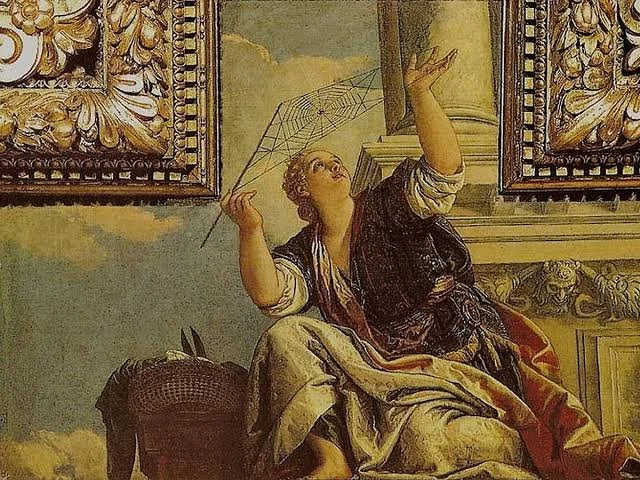
The Mortal Weaver Who Challenged Athena—and Was Transformed Into a Spider
The myth of Arachne is one of Greek mythology's most memorable stories about artistic pride.
Arachne was a mortal woman famous for her weaving.
Her talent became so extraordinary that she began to claim she was better than Athena, goddess of wisdom and crafts.
The challenge ended in disaster.
Arachne's Extraordinary Skill
Arachne was described as an exceptionally talented weaver.
Her work was so beautiful that people came to admire it.
But admiration gradually became pride.
She began to claim that her skill surpassed Athena's.
Athena Appears
Athena was the goddess associated with crafts, wisdom, and strategic intelligence.
She was therefore an especially dangerous deity to challenge in weaving.
According to the myth, Athena first appeared disguised as an old woman.
She advised Arachne to show humility.
Arachne refused.
The Contest
Athena revealed herself.
The two began weaving.
Athena created a magnificent tapestry representing the power of the gods.
Arachne produced an equally extraordinary work.
But Arachne's subject was dangerous.
She depicted the gods behaving badly.
Her tapestry showed divine deception, seduction, and abuse of power.
Why Was Athena Angry?
The myth can be interpreted in multiple ways.
Arachne's technical skill may have been genuinely equal to Athena's.
Her offense was not necessarily poor workmanship.
It was the challenge to divine authority.
She had entered a contest with a goddess and refused to acknowledge the boundary between mortal and divine.
The Punishment
Athena destroyed or damaged Arachne's work.
Arachne became devastated.
In some versions, she hanged herself.
Athena then transformed her into a spider.
She would spend eternity weaving webs.
The Meaning of the Spider
The transformation is almost perfectly symbolic.
Arachne's punishment does not remove her talent.
It transforms it.
She continues weaving forever.
Her artistic ability becomes inseparable from her punishment.
Hubris
The myth reflects the Greek concern with hubris.
Hubris involves excessive pride, arrogance, or behavior that violates proper boundaries.
The Greeks frequently warned that human beings should recognize their limitations.
Arachne's mistake was not simply being talented.
It was believing that talent placed her beyond the limits imposed on mortals.
But There Is Another Interpretation
Modern readers sometimes interpret Arachne differently.
Her tapestry criticized the gods.
This means the myth can also be read as a story about:
Artistic freedom.
Power.
Authority.
Censorship.
The danger of criticizing those with greater power.
This interpretation is particularly compelling because Arachne's artistic skill is not denied.
She loses because of the consequences of challenging divine authority.
Ovid's Version
The most famous surviving literary version comes from the Roman poet Ovid, whose Metamorphoses was written centuries after the Classical Greek period.
This is important.
The version most familiar today is shaped heavily by Roman literary interpretation.
Greek traditions existed before Ovid.
Why Arachne Still Matters
The story has survived because artists continue to understand its central conflict.
What happens when talent becomes pride?
What happens when an artist challenges authority?
Can art criticize power?
Can beauty become dangerous?
Arachne's answer is tragic.
She wins the artistic contest—or at least produces work worthy of comparison—but loses everything because she challenges a goddess.
And yet, ironically, Athena's punishment guarantees that Arachne will never stop weaving.