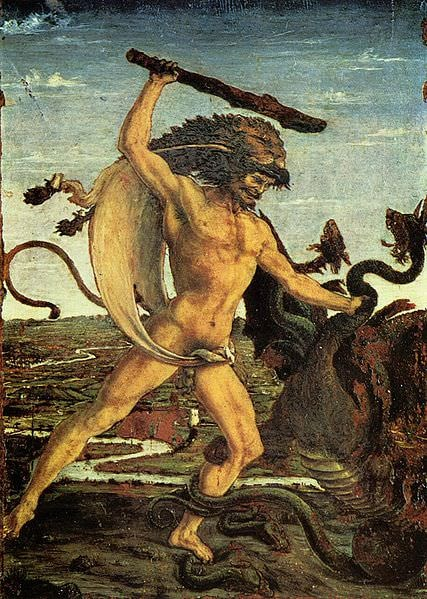
Heracles, known to the Romans as Hercules, became one of the most famous heroes of Greek mythology. His stories are filled with impossible monsters, dangerous journeys, divine conflict, tragic mistakes, and extraordinary feats of strength.
Yet Heracles was more than simply a strong warrior. His mythology explores suffering, guilt, redemption, endurance, and the difficult relationship between mortals and the gods.
The Birth of Heracles
Heracles was traditionally the son of Zeus and the mortal woman Alcmene.
Zeus desired Alcmene and disguised himself as her husband, Amphitryon. From their union, Heracles was born.
Hera, Zeus's wife, hated Heracles because he was living proof of Zeus's infidelity.
Her hostility would follow Heracles throughout his life.
According to mythology, Hera sent madness upon Heracles. During this episode, he killed his wife Megara and their children.
When the madness passed, Heracles realized what he had done and was overcome with grief.
Seeking Redemption
Heracles traveled to Delphi to ask the oracle how he could atone for his terrible actions.
He was instructed to serve King Eurystheus.
This service eventually became the foundation of the famous Twelve Labors.
The tasks were designed to be extraordinarily difficult, forcing Heracles to confront monsters, dangerous environments, and supernatural challenges.
A Hero of Extraordinary Strength
Heracles defeated the Nemean Lion, whose hide was famously resistant to ordinary weapons.
He fought the Lernaean Hydra, a many-headed serpent whose heads could regenerate.
He captured the Ceryneian Hind, a sacred animal associated with Artemis.
He captured the Erymanthian Boar and completed the seemingly impossible task of cleaning the Augean Stables.
Other labors took him across the Mediterranean world and eventually into the realm of the gods and the dead.
Heracles Was More Than Strong
Although strength is his defining characteristic, many stories show that Heracles needed intelligence and assistance.
When fighting the Hydra, for example, his nephew Iolaus helped him prevent the creature's heads from regenerating.
Other adventures required Heracles to negotiate, travel great distances, or obtain supernatural objects.
His mythology therefore demonstrates that heroic achievement could require more than physical power.
The Death of Heracles
Heracles eventually died after being poisoned through a tragic misunderstanding involving his wife Deianira.
She had received the blood of the centaur Nessus, believing it could preserve Heracles' love.
Instead, it contained a deadly poison.
When Heracles wore clothing treated with the substance, he suffered terribly.
He eventually ordered a funeral pyre to be constructed.
Becoming a God
Heracles' story did not end with death.
Greek mythology says that his mortal body was consumed by the flames while his divine nature survived.
He was taken to Olympus and granted immortality.
This process is known as apotheosis, the transformation of a mortal into a divine being.
Heracles was therefore unusual among Greek heroes.
He began life as a mortal, endured extraordinary suffering, and ultimately became immortal.
Conclusion
Heracles became one of Greek mythology's greatest symbols of heroic endurance.
His story contains violence and tragedy, but it also emphasizes perseverance and redemption.
His twelve labors became some of the most recognizable stories in classical mythology, ensuring that Heracles remained one of antiquity's most enduring heroes.