The story of Orpheus and Eurydice is one of Greek mythology's most famous tales of love and loss.
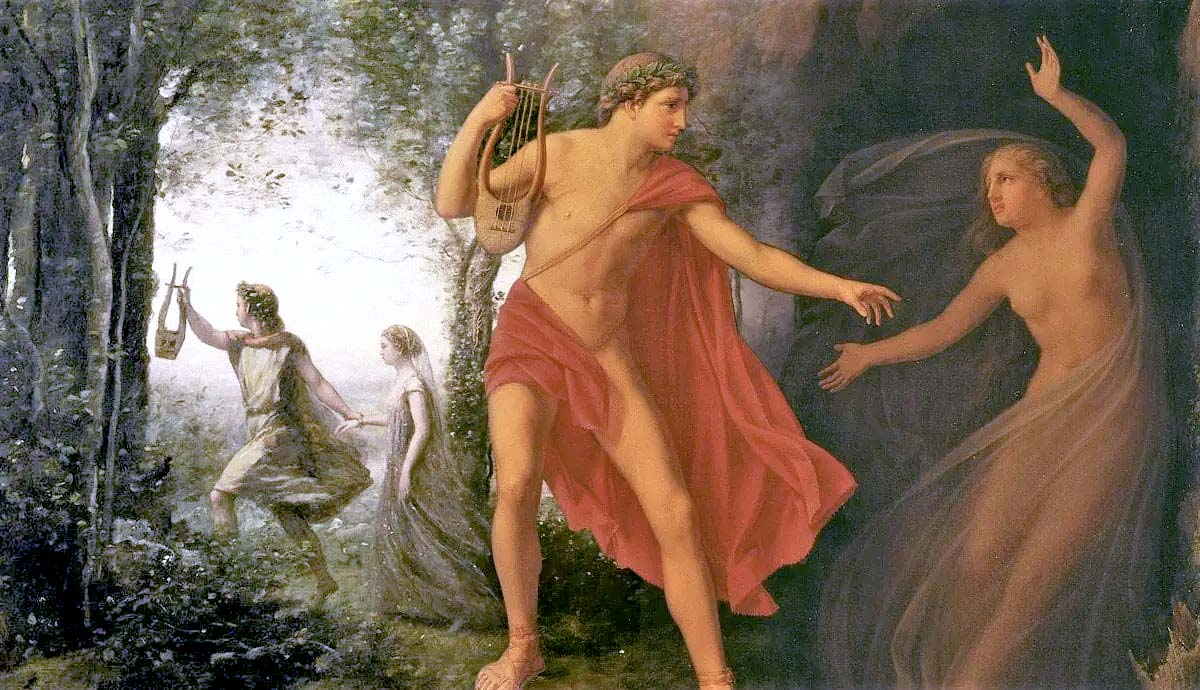
Orpheus was a legendary musician whose music could move humans, animals, trees, and even the gods.
Eurydice was his beloved wife.
Their story became a tragedy about grief, trust, and the inability of humans to escape death.
Orpheus the Musician
Orpheus was said to possess extraordinary musical abilities.
When he played his lyre, nature itself seemed to respond.
Animals gathered around him.
The power of his music became central to his greatest adventure.
Eurydice Dies
Shortly after their marriage, Eurydice died.
The circumstances vary between versions.
One famous tradition says she was bitten by a snake while fleeing from the unwanted advances of Aristaeus.
Orpheus was devastated.
He could not accept her death.
Journey to the Underworld
Orpheus decided to travel into the Underworld.
This was an almost impossible undertaking.
Ordinary living humans could not simply enter the realm of the dead and return.
But Orpheus used music to overcome the barriers.
His songs moved the inhabitants of the Underworld.
Even Hades and Persephone were touched by his grief.
The Condition
The gods agreed to return Eurydice.
But there was one condition.
Orpheus had to walk ahead of Eurydice and not look back at her until they had reached the world of the living.
The condition seemed simple.
Yet as they approached the exit, doubt entered Orpheus' mind.
Was Eurydice really following him?
The Fatal Look
Just before reaching safety, Orpheus turned around.
He saw Eurydice.
But she was immediately pulled back into the Underworld.
This time, Orpheus could not retrieve her.
The Meaning of the Story
The myth has inspired countless interpretations.
Some view it as a story about the destructive power of doubt.
Others interpret it as an expression of the psychological difficulty of accepting death.
The story may also reflect an ancient recognition that love cannot completely overcome mortality.
Orpheus After Eurydice
Orpheus continued to live after losing Eurydice again.
Eventually, he was killed in a violent episode involving the Maenads in one important tradition.
His head and lyre were said to have continued producing music even after his death.
Conclusion
The tragedy of Orpheus and Eurydice has endured because its central emotion remains understandable.
Orpheus had almost everything he wanted.
He had entered the realm of death and persuaded its rulers to give Eurydice back.
Yet at the final moment, his uncertainty destroyed the possibility of reunion.
The myth became one of antiquity's most powerful stories about love, grief, and mortality.