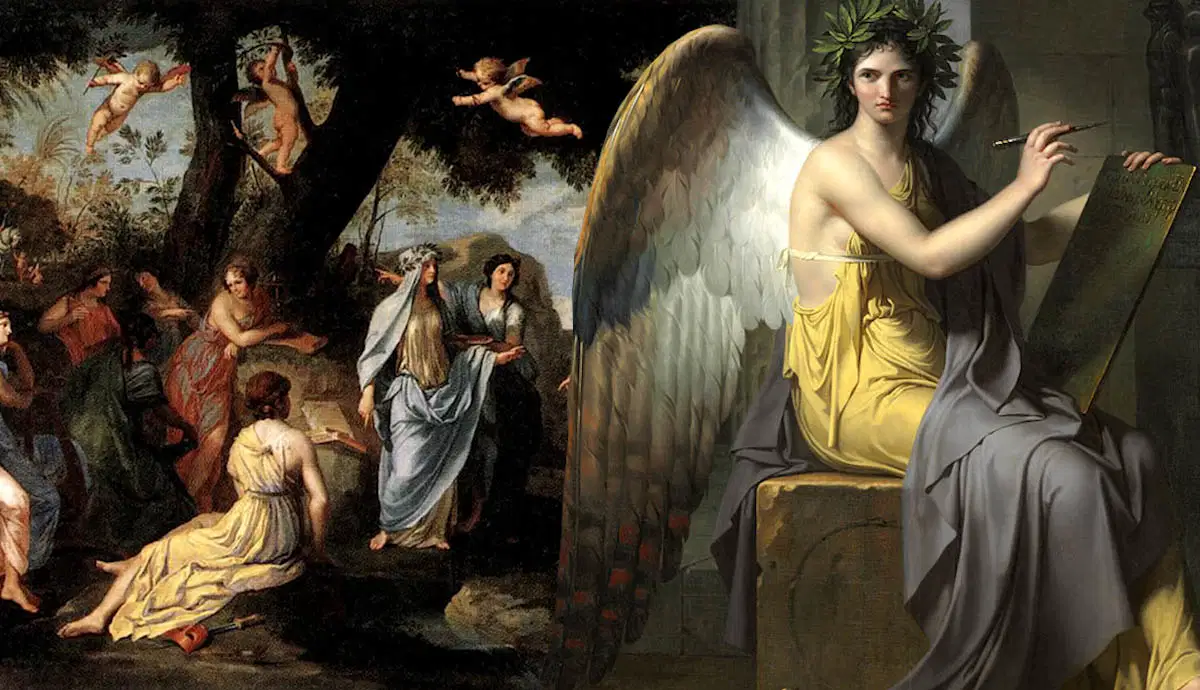
The Muses were nine divine sisters associated with artistic and intellectual inspiration.
They were connected with poetry, music, history, astronomy, tragedy, comedy, dance, and sacred song.
Their importance demonstrates that the ancient Greeks did not always separate art, literature, history, and intellectual knowledge as sharply as modern society often does.
The Nine Muses
The traditional nine Muses were:
Calliope — epic poetry;
Clio — history;
Erato — lyric and love poetry;
Euterpe — music;
Melpomene — tragedy;
Polyhymnia — sacred poetry;
Terpsichore — dance;
Thalia — comedy;
Urania — astronomy.
Their individual roles became more clearly established over time.
Daughters of Zeus
The Muses were traditionally daughters of Zeus and Mnemosyne.
Mnemosyne represented memory.
This parentage is deeply symbolic.
Poetry and history depended upon remembering and transmitting knowledge.
The Importance of Memory
Before widespread literacy, oral tradition was essential.
Poets memorized enormous quantities of material.
Stories, genealogies, laws, religious traditions, and heroic legends could be transmitted orally from generation to generation.
The Muses represented the divine inspiration behind this process.
Homer and the Muses
Epic poets traditionally invoked the Muses.
The opening of the Iliad, for example, calls upon the goddess of inspiration.
This was not simply decorative language.
The poet was presenting the story as knowledge granted or guided by a divine source.
History
Clio became associated with history.
Her role is particularly interesting because ancient Greek historical writing emerged from a culture deeply connected to myth, memory, and oral tradition.
The Greeks increasingly developed methods for investigating the past, but memory remained culturally important.
Urania and Astronomy
Urania was associated with astronomy.
Her inclusion among the Muses shows that ancient Greek culture did not necessarily treat scientific observation and artistic inspiration as completely separate categories.
Studying the heavens could itself be a form of intellectual and cultural achievement.
The Muses and Education
The Muses were connected with education and cultivated learning.
Greek education for elite boys often included music, poetry, physical training, and literary study.
Knowledge of poetry was a marker of cultural sophistication.
Apollo and the Muses
Apollo was closely associated with the Muses.
He could be portrayed as their leader.
This relationship connected music, prophecy, poetry, and divine inspiration.
Conclusion
The Muses represented humanity's desire to create, remember, understand, and communicate.
They were not simply nine goddesses of poetry.
Their domains covered literature, music, history, performance, sacred expression, and astronomy.
Their presence in Greek culture reminds us that knowledge was understood not only as information but also as something requiring memory, creativity, discipline, and inspiration.